
Lost circulation is the most expensive routine problem in drilling, and the cheapest material that fixes it is ground walnut shell. The industry calls it nut plug. It is hard, springy, insoluble in water and oil, chemically inert, and it bridges a fracture instead of dissolving into it. RAHA Gilsonite Co. supplies and exports walnut shell nut plug in fine, medium and coarse grades, in bags and bulk bags, by the container. This page sets out how to match the grade to the loss, the one situation where walnut shell is the wrong answer and calcium carbonate is the right one, why it works better blended than alone, and what to send with an enquiry so a firm quotation comes back on the first reply.
Why buy walnut shell from RAHA Gilsonite Co.
Nut plug is sold almost everywhere as a photograph and three lines of text. The grading is given as fine, medium and coarse with no sieve cuts behind the words, which is a problem, because the grade is the entire product. A fine grade pumped at a fracture that needed coarse does nothing at all except cost a day of rig time. What you want from a walnut shell supplier is the sieve cut and a straight answer about which one your problem needs.
We quote the sieve cut, not an adjective
Every offer states the mesh range behind the grade name, so you can match what arrives to what your mud programme specified. Blends across two or three cuts are made to order when a single grade will not bridge the opening.
We tell you when not to use it
Walnut shell is not acid-soluble. Across a producing interval you intend to acidise, calcium carbonate is the correct material and we will say so. A supplier who sells you nut plug for a reservoir section is not doing you a favour.
The whole LCM blend from one desk
Gilsonite, amorphous graphite, bentonite, barite and the cellulose polymers ship alongside nut plug — one consignment, one set of documents, one person to call.
Technical answers, not brochures
Ask which grade bridges a given fracture width, or how much to carry on location for a 12 and a quarter inch hole, and you get a worked answer rather than a price list.
Two routings, not one
We load from Jebel Ali and from Mersin. Nut plug is a light, bulky cargo where freight decides the delivered cost, so working both ports means we can tell you which one wins on your route.
Inspection welcomed
We arrange independent inspection and sampling at loading by SGS, Bureau Veritas, Intertek or your own surveyor whenever you ask for it.
Grades and sieve cuts
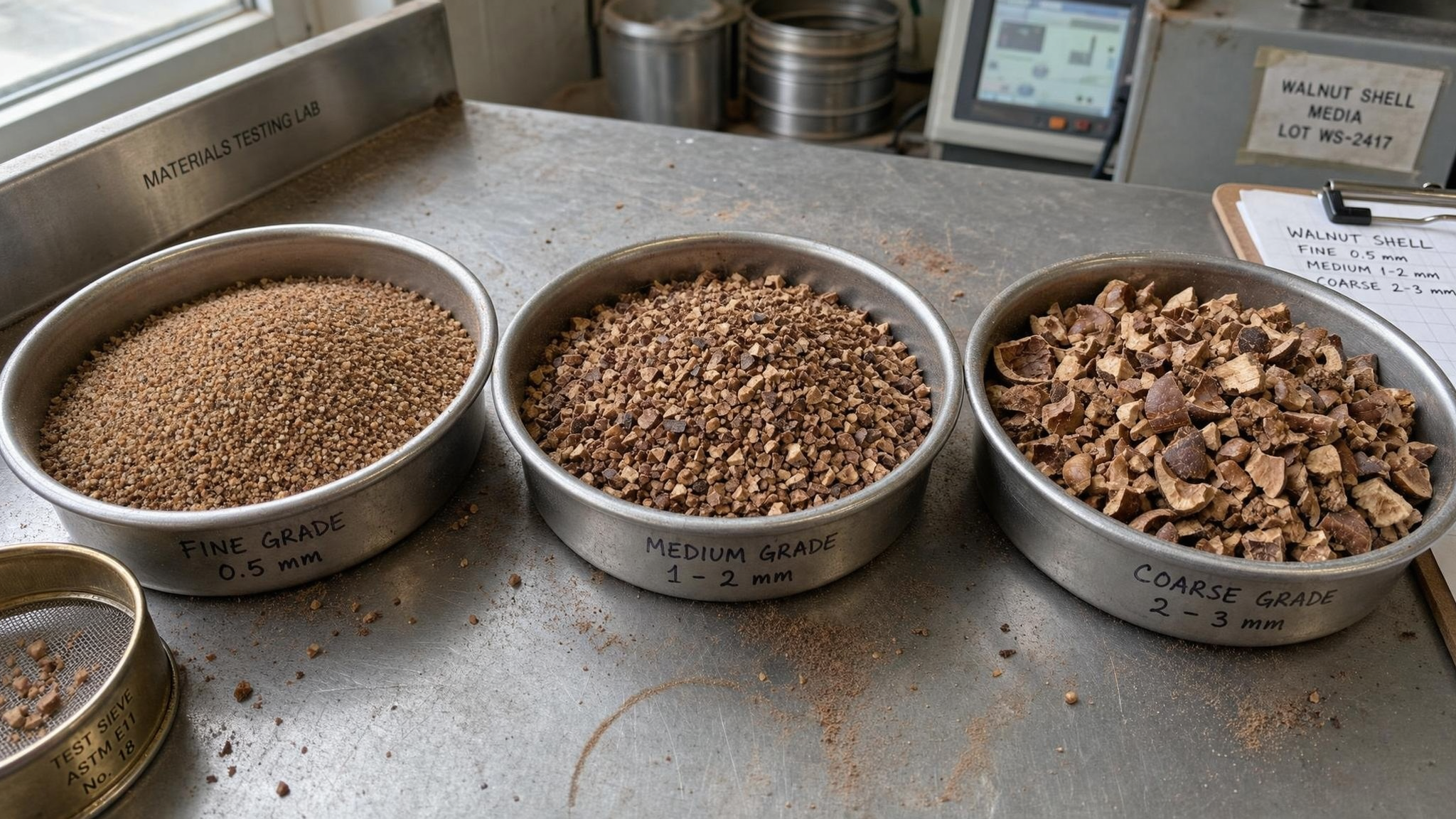
Walnut shell nut plug is supplied in three standard grades. The names are conventional across the industry; the sieve cuts behind them are what actually matter, and they are what a walnut shell supplier should be quoting.
| Grade | Typical sieve cut | Particle size | Bridges |
|---|---|---|---|
| Fine | 20/40 mesh | About 0.4 to 0.85 mm | Seepage losses, porous and permeable sands, pre-treatment of the whole system |
| Medium | 10/20 mesh | About 0.85 to 2.0 mm | Partial losses, natural fractures, the general-purpose grade |
| Coarse | 6/10 mesh | About 2.0 to 3.35 mm | Severe losses, open fractures, vugular and cavernous formations |
Blends are normal rather than exceptional. A pill built from all three grades bridges a wider range of openings than any single cut, because the coarse fraction spans the gap and the finer fractions pack the spaces between. Tell us the blend ratio you work to and we will supply it pre-blended, or supply the cuts separately for mixing on location.
Why walnut shell rather than something else
Several properties have to coincide for a material to work as a bridging agent, and walnut shell is unusual in having all of them at once at a commodity price.
| Property | What it does downhole |
|---|---|
| Hard but resilient | It deforms under pressure and springs back rather than crushing to powder. A bridge made of walnut shell holds when the pressure cycles, which is where brittle materials fail. |
| Insoluble in water and oil | The same product works in water-based and oil-based systems, and the bridge does not dissolve away once it is set. |
| Chemically inert | It does not react with mud chemicals, does not affect pH, and does not interfere with polymer or clay chemistry, so rheology is unchanged apart from the solids it adds. |
| Specific gravity 1.2 to 1.4 | Close enough to the mud that it neither floats to the top of the pit nor settles out of suspension while it is being circulated to the loss zone. |
| Irregular and angular | Angular particles interlock and jam in an opening. Rounded particles roll through it. |
| Thermally stable through normal circulating temperatures | It survives the temperatures of ordinary drilling. It is an organic material, so on a genuinely high temperature well the limit should be checked rather than assumed. |
| Non-toxic and biodegradable | A natural agricultural by-product, which matters increasingly where cuttings discharge and waste disposal are regulated. |
What lost circulation actually costs
Lost circulation is mud leaving the well into the formation instead of returning to surface. The cost is not only the mud, although on an expensive oil-based system that alone is substantial. The real exposure is what the losses lead to.
When the annulus is not full, the hydrostatic column falls. A falling column is how a loss becomes a kick, and how a kick becomes a well control incident. Before that point there is stuck pipe, failed cement jobs across the loss zone, formation damage in the pay, and rig time spent circulating rather than drilling. Industry-wide it is among the largest single contributors to non-productive time, and almost all of the remedies are more expensive than carrying the right grade of nut plug on location in the first place.
The four severities
| Severity | Rate | Usual cause | Grade to reach for |
|---|---|---|---|
| Seepage | Under about 10 bbl/hr | Permeable sand, high overbalance, thin filter cake | Fine, often as a background treatment |
| Partial | About 10 to 100 bbl/hr | Natural fractures, gravel, coarse sand | Medium, or medium and fine blended |
| Severe | Over about 100 bbl/hr | Wide natural or induced fractures | Coarse with medium and fine, as a pill |
| Total | No returns at all | Vugs, caverns, unconsolidated gravel | Coarse blends, and often cement or a settable plug instead |
Total losses into a cavern are the case where no amount of granular LCM will work, and recognising that early saves days. If the opening is larger than the largest particle you can pump, the material goes straight through it. That is a cement or settable-plug problem, not a nut plug problem, and we would rather tell you so than sell you four containers of coarse grade.
How a bridge actually forms
Nut plug does not seal a fracture by filling it. It seals it by jamming at the entrance and then being sealed behind by finer material. Getting that right is a question of particle size against opening width, and there is a usable rule.
The one-third rule
The established guideline, usually credited to Abrams, is that the median particle size of the bridging material should be at least one third of the opening it has to bridge. Below that the particles pass through. Much above it they stack at the face and build a filter cake rather than entering and locking.
Run that backwards and it gives a working answer. A medium grade topping out around 2 mm will bridge openings up to roughly 6 mm. A coarse grade at 3.35 mm reaches to around 10 mm. Beyond that you are into coarse blends, fibre, and eventually cement. This is also why a pill made of one grade underperforms: a single cut bridges a single band of opening widths, and a real loss zone is never one width.
Granular, flaky, fibrous
Lost circulation materials fall into three shape families, and they do different jobs:
Granular
Walnut shell, calcium carbonate, gilsonite, nutshell blends. These carry the load. A granular particle jams in the opening and takes the differential pressure across the bridge.
Flaky
Mica, cellophane, amorphous graphite. Flakes lay over the face of the opening and across the granular bridge, covering the gaps that granules alone leave open.
Fibrous
Cellulose fibre, mineral fibre. Fibres mat together and across the granular framework, and they are what stops the finer material simply washing through the bridge once flow resumes.
Field experience and laboratory work both point the same way: a blend of all three outperforms any one of them at the same total concentration. Walnut shell is the granular backbone of that blend rather than a complete answer on its own, and a mud programme that carries only nut plug is carrying a third of what it needs.
How much to use
Treatment levels run roughly from 5 to 50 kg per cubic metre of drilling fluid, which is about 1.75 to 17.5 pounds per barrel. The low end is a background treatment carried continuously to prevent seepage; the high end is a remedial pill spotted across a known loss zone.
| Use | Typical concentration | Notes |
|---|---|---|
| Preventive, whole system | About 5 to 15 kg/m³ (2 to 5 lb/bbl) | Fine grade, carried continuously through a known seepage interval. Shaker screens will remove part of it, so it has to be replenished. |
| Remedial pill, partial losses | About 30 to 50 kg/m³ (10 to 17 lb/bbl) | Medium and fine blended, mixed as a pill and spotted at the loss zone rather than circulated through the whole system. |
| Remedial pill, severe losses | Higher, with coarse in the blend | Coarse, medium and fine together, commonly with fibre and flake. Pump rate and squeeze pressure matter as much as the concentration. |
These are planning figures, not a recipe. The right concentration depends on the loss rate, the opening width, the mud system and whether the pill is being circulated or squeezed. What they are useful for is estimating how much material to have on location, which is the question that decides the order quantity.
Walnut shell against the other lost circulation materials
Nut plug is one option among several, and the honest comparison is more useful than a sales argument. The column that decides most arguments is the last one.
| Material | Type | Strength | Limitation | Acid-soluble |
|---|---|---|---|---|
| Walnut shell | Granular | Resilient, insoluble, inert, cheap, survives pressure cycling | Cannot be removed chemically | No |
| Calcium carbonate | Granular | Dissolves in acid, so the bridge can be removed afterwards | Softer, crushes under pressure cycling | Yes |
| Gilsonite | Granular, softening | Softens at downhole temperature and seals microfractures; also stabilises shale | Seals rather than spans; will not bridge a wide opening alone | No |
| Amorphous graphite | Granular to flaky | Deformable, seals and lubricates, works at high temperature | Cost, and it is darker on the shakers | No |
| Mica | Flaky | Covers the face of an opening and the gaps in a granular bridge | No load-bearing strength by itself | No |
| Cellulose fibre | Fibrous | Mats across the bridge and holds the fines in place | Degrades over time and at temperature | Partly |
The one case where walnut shell is the wrong answer
If the loss zone is in the producing interval and the plan is to restore permeability afterwards with an acid wash, calcium carbonate is the correct material and nut plug is not. Carbonate dissolves in hydrochloric acid and the bridge comes out; walnut shell does not dissolve in anything you will pump, and whatever you bridged with it stays bridged.
That is the single most important thing to settle before ordering, and it is the question most sellers avoid because the honest answer sometimes loses the sale. Across a non-productive interval — which is most of the hole — walnut shell is the better material precisely because it is permanent and resilient. Across the pay, it is not.
Walnut shell and gilsonite together
These two are routinely treated as competing products and they are not. They work by different mechanisms and on different scales, which is why they appear together in serious loss control programmes.
Walnut shell is rigid. It spans an opening and takes the load across it, and the useful range is openings you could see with the naked eye. Gilsonite softens at downhole temperature and deforms into microfractures and pore throats, sealing what is too small for any granule to bridge. Gilsonite also does something walnut shell cannot: it plates onto the wellbore wall and contributes to shale stabilisation, reducing the chance of inducing a fracture in the first place.
The practical combination is nut plug as the structural element and gilsonite as the sealing element, with flake and fibre completing the blend. A programme carrying both has an answer for a wider range of loss mechanisms than one carrying either, and both ship from this desk in the same consignment.
What to watch for on the rig
Nut plug is straightforward material, but there are four ways it causes problems on location, and all four are avoidable.
Measurement tools and motors
Coarse grades can plug the flow paths through MWD and LWD tools and through a mud motor. Where a pill has to be pumped through the string with those tools in the hole, the grade has to be checked against the tool’s maximum particle size before it goes in the pit, not after.
Bit nozzles
Small nozzles and coarse LCM do not mix. This is why remedial pills are often pumped through an open-ended string rather than through the bit, and why the decision belongs in the plan rather than in the moment.
The shakers take it out
Nut plug is a solid in the size range the shaker screens are there to remove. Material carried as a background treatment is screened out on every circulation and has to be replenished, which is a real and often underestimated consumption rate. Screens are sometimes bypassed while a pill circulates; that is an operational decision with its own consequences for the rest of the solids control.
Dust and storage
Ground shell produces fine dust when handled, so mixing hoppers want ventilation and operators want eye protection. The material also absorbs moisture if bags are left open, which makes it clump and mix poorly rather than spoiling it.
Walnut shell as produced water filter media
The second large market for graded walnut shell has nothing to do with lost circulation. Nutshell filters are the standard way to take oil out of produced water before it is reinjected or discharged, and the media in them is walnut shell.
The reason is a property no mineral media has. Walnut shell has a comparable affinity for oil and for water, so oil adsorbs onto the media during the filtration run but releases again when the bed is agitated during backwash. Sand becomes permanently oil-wetted and has to be replaced; walnut shell is scrubbed, backwashed and put straight back into service.
| Parameter | Typical |
|---|---|
| Media size | 12/20 mesh (0.8 to 1.7 mm) or 12/16 mesh (1.2 to 1.7 mm) |
| Design inlet loading | Under about 100 mg/L oil and under about 100 mg/L suspended solids |
| Removal efficiency | About 90 to 95 per cent |
| Filtration rate | About 7 to 27 gpm/ft² |
| Backwash trigger | Differential pressure, a timer (often 24 hours), or effluent quality |
| Media attrition | Usually under 5 per cent per year |
The failure mode worth knowing is mudballing. If the backwash scrub is too gentle or too short, oil is not fully released and the media agglomerates into balls that channel the flow and ruin the effluent quality. That is a scrubbing problem rather than a media problem, but it is usually first blamed on the media. Media for filter service is a tighter, cleaner cut than drilling grade; tell us which service it is for and we quote the right one.
Other industries we supply
Abrasive blasting
A soft abrasive at around 3 to 4 on the Mohs scale. It strips coatings, carbon and corrosion without cutting into the substrate underneath, which is why it is used on aircraft skins, turbine components, automotive panels, soft stone and timber where sand or grit would do damage.
Vibratory finishing
Used as a carrier and polishing medium in tumbling and vibratory bowls, often charged with a polishing compound, for deburring and finishing metal parts.
Cleaning and deflashing
Removing flash from moulded plastic and die-cast parts, and cleaning electronics and small assemblies where a harder abrasive would be destructive.
Fillers and extenders
Ground shell flour is used as a filler in plastics, adhesives, resins and some paints, where it adds body without the abrasiveness of a mineral filler.
Oil and spill absorbents
The same affinity that makes it work as filter media makes it useful in absorbent formulations for hydrocarbon spills on land.
Agricultural and other uses
Used as a carrier for seed coatings and agricultural actives, and in a range of industrial formulations that need an inert, biodegradable granular solid.
Packing and container loading
| Packing | Description | Suits |
|---|---|---|
| 25 kg bags | Woven polypropylene with inner liner, palletised and wrapped | Rig location, mixing hopper work, sites without lifting equipment |
| Bulk bags | Woven polypropylene FIBC with liner and lifting loops | Bulk storage, filter media charging, base stock for repeat campaigns |
One point about containers is worth making because it runs opposite to the rest of the drilling range. Walnut shell is a light, bulky cargo. Where barite reaches the container’s weight limit long before the space is used, nut plug does the reverse: it fills the space well before the payload is reached. A 20 foot container cubes out considerably below its weight limit, which means a 40 foot container is frequently the better economic unit for this product even though it is never used for barite.
That has a direct effect on freight per tonne, and it is the first thing we look at when quoting. The exact tonnage depends on the grade, the packing and the carrier’s limits for the route, and is confirmed on the proforma invoice rather than estimated here.
Shipping and commercial terms
| Term | Basis |
|---|---|
| Minimum order | One full container |
| Incoterms | FOB, CFR or CIF |
| Loading ports | Jebel Ali or Mersin |
| Payment | 50 per cent by telegraphic transfer in advance, balance agreed with the order |
| Lead time | Confirmed per destination at the time of quotation |
| Documents | Commercial invoice, packing list, bill of lading, certificate of analysis, certificate of origin, insurance certificate on CIF |
Because this is a volume-limited cargo, the container size and the packing choice move the delivered price more than they do on a dense product. We quote both 20 and 40 foot where both are workable and say which one we would use for your destination.
Quality, documents and inspection
Sieve analysis per batch
Every consignment ships with a sieve analysis for the grade supplied, so the cut that arrives can be checked against the cut that was ordered. This is the one document a walnut shell supplier should never ask you to do without.
Independent inspection at loading
We arrange inspection and sampling at loading by SGS, Bureau Veritas, Intertek or the surveyor named in your contract, whenever you ask for it.
Retained samples
Samples are retained against each shipment, so a question raised after arrival is settled against the material that actually loaded.
Pre-shipment samples
A sample can be sent for approval before the order is confirmed, which is worth doing for filter media service where the cut is tighter than drilling grade.
How to get a firm quotation
| Tell us | Why it changes the offer |
|---|---|
| Drilling or filtration | Filter media is a tighter, cleaner cut than drilling grade. They are different products at different prices and the word walnut shell covers both. |
| Grade, or the problem | Tell us fine, medium or coarse if you know. If you do not, tell us the loss rate and the formation and we will recommend the grade and the blend. |
| Whether the interval will be acidised | If it is in the pay zone and acid will follow, we will point you at an acid-soluble material such as calcium carbonate instead of selling you nut plug that cannot be removed. |
| Quantity and packing | 25 kg bags or bulk bags, and how much. On a light cargo the packing choice changes the container economics materially. |
| Destination port and Incoterm | It decides which of our two loading ports we quote from and whether a 20 or 40 foot container is the better unit. |
What to check when the material arrives
| Check | What you are looking for |
|---|---|
| Sieve the sample | The single most useful check, and the only one that verifies you got the grade you paid for. Compare against the sieve analysis that shipped with the consignment. |
| Fines content | Excessive dust and undersize means the material was over-ground or has broken down in transit. Fines do not bridge and they consume the pill. |
| Moisture and clumping | Material should be dry and free-flowing. Clumped material has taken up moisture through damaged packing and will mix badly. |
| Foreign matter | Shell only. Kernel fragments, husk and other organic matter are a processing failure and behave differently in the mud. |
Photograph anything that looks wrong at discharge and send it the same day. A retained sample exists for every shipment, so a question raised with photographs at discharge is straightforward to settle.
Frequently asked questions
Grades and selection
What is nut plug and is it the same as walnut shell?
Nut plug is the oilfield name for ground walnut shell used as a lost circulation material. They are the same material. The name nut plug normally implies that it has been processed and graded to defined sieve cuts rather than simply crushed, which is what makes it usable in a mud programme.
Which grade do I need?
Match it to the loss. Fine for seepage and permeable sands, medium for partial losses and natural fractures, coarse for severe losses and open fractures. If you know the opening width, the median particle size should be at least a third of it. If you do not, send us the loss rate and the formation and we will recommend the grade.
Should I use one grade or a blend?
A blend, almost always. A single cut bridges a single band of opening widths and a real loss zone is never one width. The coarse fraction spans the opening, the medium locks into it and the fine packs the spaces. We supply blended to your ratio or as separate cuts for mixing on location.
What sieve cuts do the grade names refer to?
Conventionally fine is 20/40 mesh, medium is 10/20 mesh and coarse is 6/10 mesh, which correspond to roughly 0.4 to 0.85 mm, 0.85 to 2.0 mm and 2.0 to 3.35 mm. Every offer we make states the cut rather than only the grade name, and a sieve analysis ships with the consignment.
How it performs downhole
Does walnut shell work in oil-based mud?
Yes. It is insoluble in both water and oil and chemically inert, so the same product works in water-based and oil-based systems without affecting the rheology beyond the solids it adds.
What temperature can it take?
It is stable through normal circulating temperatures and is used routinely without a temperature concern. It is an organic material, so on a genuinely high temperature well the limit should be verified against the expected bottom hole temperature rather than assumed. Tell us the well conditions and we will confirm before you order.
How much do I need?
Roughly 5 to 50 kg per cubic metre of fluid, which is about 1.75 to 17.5 lb/bbl. The low end is preventive treatment carried through a known seepage interval, the high end is a remedial pill. Give us the hole size, the interval and the expected losses and we will estimate what to have on location.
Formation damage and removal
Will it damage the formation?
Across a non-productive interval it does not matter, which is most of the hole. Across the pay it is a genuine consideration, because the bridge is permanent and cannot be dissolved out. For a producing interval that will be acidised, calcium carbonate is the right material instead.
Can walnut shell be removed after it has bridged?
Not chemically. It is not soluble in acid or in anything else you would pump, which is exactly why it is durable and why it is the wrong choice in a zone you intend to clean up afterwards. Mechanical removal and underreaming are the only routes, and both are expensive.
How does it compare with calcium carbonate?
Walnut shell is harder and far more resilient, so it survives pressure cycling that crushes carbonate to powder. Carbonate dissolves in acid and walnut shell does not. That one difference decides most selections: use carbonate where the bridge must come out later, walnut shell everywhere else.
On the rig
Can I pump it through MWD tools or a mud motor?
Not without checking first. Coarse grades can plug the flow paths through measurement tools and motors. The tool’s maximum particle size has to be checked against the grade before the material goes into the pit. This is a common and entirely avoidable cause of trouble.
Will the shale shakers remove it?
Yes, which matters for planning. Nut plug is a solid in exactly the size range the screens exist to remove, so material carried as a background treatment is screened out on every circulation and must be replenished. Budget for that consumption rather than ordering as though it stays in the system.
Does it affect mud properties?
Not chemically. It is inert, does not react with mud additives and does not change pH. It does add solids, so it contributes to the solids content and to plastic viscosity like any other inert solid at the same concentration.
Other uses
Is drilling grade the same as filter media grade?
No. Filter media is a tighter, cleaner cut, typically 12/20 or 12/16 mesh, with controlled fines because dust carries through into the effluent. They are different products at different prices. Say which service you need when you enquire.
Why walnut shell rather than sand in a produced water filter?
Because it lets the oil go again. Walnut shell adsorbs oil during the run and releases it when the bed is scrubbed and backwashed, so the media returns to service. Sand becomes permanently oil-wetted and has to be replaced. Attrition on walnut shell media is usually under 5 per cent a year.
Can it be used for abrasive blasting?
Yes, and it is one of the main markets for graded shell. At around 3 to 4 on the Mohs scale it strips coatings and corrosion without cutting the substrate, which is why it is used on aircraft, turbine parts, soft stone and timber. The grading for blasting differs from drilling grade, so specify the application.
Supply, packing and terms
What packing is available and what is the minimum order?
25 kg bags for rig and hopper work, and bulk bags for bulk storage and filter media charging, both woven polypropylene with an inner liner. The minimum is one full container, which is the normal unit for any walnut shell supplier shipping internationally.
Should I ship in a 20 or a 40 foot container?
Often a 40 foot, which is the opposite of the advice for barite. Walnut shell is light and bulky, so a 20 foot container fills up well before it reaches its weight limit. That makes the 40 foot the better unit on freight per tonne for many routes, and we will tell you which applies to yours.
Is walnut shell classified as dangerous goods?
No. It carries no UN number and no transport hazard class and ships as ordinary cargo. It is a natural agricultural by-product, non-toxic and biodegradable, though some destinations apply phytosanitary or plant-product import requirements, which we confirm for your country before shipment.
Can it ship with the rest of the mud programme?
Yes, and on a light cargo it often improves the container economics to consolidate. Nut plug ships alongside gilsonite, graphite, barite, bentonite, sodium chloride and the cellulose polymers as one consignment with one set of documents.
Request a quotation for walnut shell nut plug
RAHA Gilsonite Co. is a walnut shell supplier to drilling contractors, mud companies, produced water operators and industrial buyers worldwide, supplying and exporting graded nut plug by the container with the sieve cut stated on the offer and a sieve analysis on every shipment. Send the application, the grade or the loss problem, the quantity and the destination, and a firm offer comes back on the first reply.
Related products: Gilsonite fluid loss control · Natural amorphous graphite · Barite supplier · Bentonite for drilling mud · Sodium chloride · Calcium chloride · Magnesium chloride · KCl in drilling · PAC LV · CMC
