Shale stabilization in water based mud has a measurement problem before it has a performance problem. Gilsonite and asphaltic additives protect the formation by physically coating the wellbore and sealing micro-fractures — a mechanism that standard bench tests cannot detect. Hot rolling, linear swelling and capillary suction tests all measure chemical inhibition, so they systematically undervalue materials that work mechanically. Triaxial testing under simulated downhole stress changed that, and this page sets out what it found.
Why shale stabilization is hard to measure in the laboratory
Gilsonite and asphaltic additives do not inhibit clay swelling chemically. They shield water-sensitive formations physically, coating the wellbore surface and sealing micro-fractures to prevent — or at minimum slow considerably — the rate at which drilling fluid interacts with the formation.
That distinction matters because it determines which test can see the effect.
| Test method | What it measures | Detects mechanical sealing? |
|---|---|---|
| Shale disintegration / hot rolling | Whether cuttings break down in the fluid | No — no wellbore surface to coat |
| Linear swelling | Dimensional change of a compacted pellet | No — measures clay hydration only |
| Capillary suction time | Rate of fluid uptake by dispersed clay | No — chemical interaction only |
| Triaxial under simulated downhole stress | Time to wellbore failure in a stressed core with fluid circulating | Yes — there is a borehole wall to protect |
The consequence for procurement. If your additive evaluation runs hot rolling and linear swelling, a mechanically acting additive will score poorly against a chemical inhibitor — and the ranking will invert downhole. This is not a marginal effect. It is the reason gilsonite was undervalued in aqueous systems for years while performing well in the field.
How the triaxial shale stabilization test works
The unit is loaded with a shale specimen stressed both axially and radially to simulate borehole stress conditions, while the test fluid is pumped under pressure through a central borehole. A non-stabilising fluid softens the specimen, erodes it, and eventually collapses the simulated wellbore. Stabilising ability is expressed as run time before the specimen begins to fail.
Test conditions
| Parameter | Value |
|---|---|
| Radial pressure | 2,500 psi |
| Axial pressure | 1,200 psi |
| Pump pressure | 150 psi |
| Circulating temperature | 125 °F (52 °C) |
| Annular velocity | 150 ft/min (46 m/min) |
| Run time | To failure, or maximum 18 hours |
Core preparation
Reconstructed Pierre II shale was used rather than specimens cut from cores or outcrops. Samples reconstructed from drill cuttings or ground shale are more representative of the downhole environment; cut cores often contain small fractures and variations in dip angle and composition, which gives poor reproducibility.
| Step | Detail |
|---|---|
| Compaction | 10,000 psi for 24 hours |
| Grinding | Dried, ground to pass a 10-mesh sieve, then screened through 30-mesh |
| Fraction used | Material retained on the 30-mesh sieve |
| Water content | Seawater added to give ±8.5% by weight in the final core |
| Core dimensions | 2 × 1 in. with a ¼-in. borehole at the centre |
Fluid preparation
Four water based systems were formulated — lignite/lignosulfonate, KCl, PHPA and lime-based. Two gilsonite grades were compared against sulfonated asphalt: one with a 350 °F (177 °C) softening point and one at 380 °F (193 °C).
Test material was added at 6 lb/bbl. Rheology, API fluid loss and lubricity coefficient were measured before and after hot rolling. Both gilsonite and sulfonated asphalt samples were hot rolled at 350 °F and 375 °F for comparative representation, and both the triaxial and HP/HT tests were run only on hot-rolled samples.
A Permeability Plugging Apparatus was used for the HP/HT filtration test. This matters for a specific reason: both gilsonite and sulfonated asphalt have low specific gravity and tend to float in the mud. Because a PPA measures fluid loss in the upward position, it captures the behaviour of floating additives that a conventional downward-filtering cell would miss.
What the shale stabilization testing found
Depending on the water based mud analysed, muds treated with naturally occurring gilsonite showed either marked improvement or equal performance against sulfonated asphalt, on both shale stabilization and fluid loss control.
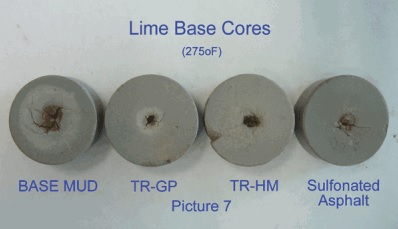
The image compares cores from lime-based mud tested at 275 °F. The centre core was treated with gilsonite; the left is base fluid and the right sulfonated asphalt. The reduction in erosion and swelling is visible without instrumentation.
Further comparisons were run at 375 °F on KCl, lignite and PHPA systems, with a high-temperature gilsonite blend measured against base fluid and sulfonated asphalt cores.
| Property assessed | Gilsonite against sulfonated asphalt |
|---|---|
| Shale stabilization | Marked improvement or parity, depending on the base mud |
| Fluid loss control | Marked improvement or parity, depending on the base mud |
| Core erosion and swelling | Visibly reduced against both base fluid and sulfonated asphalt |
| HSE profile | Non-carcinogenic — an advantage over sulfonated asphalt and some other stabilising blends |
| Cost position | Competitive, with documented savings of up to $1 million per well in some cases |
Findings summarised from an independent evaluation of gilsonite as a shale stabilising and fluid loss control additive for water based fluids, published in the offshore drilling press. We supply comparable grades and will state the measured softening point on the batch certificate of analysis.
Why filtrate invasion destabilises shale
In a water based fluid, filtrate that reaches the formation interacts with the clay. Once that starts, the consequences cascade.
Borehole enlargement
Shale softens at the wall and erodes under circulation, producing an oversize hole that needs more cement and gives a poorer bond.
Stuck pipe
Filtrate invasion into permeable zones raises the pressure differential across the pipe, which is the mechanism behind differential sticking.
Sloughing shale
Hydrated shale disintegrates and falls into the hole, loading the annulus with material the fluid was not designed to carry.
Bridging on trips
Accumulated cavings bridge the annulus, causing packoffs and lost time during tripping.
Bit balling and accretion
Reactive clay adheres to the bit and BHA, cutting rate of penetration and increasing torque.
Low ROP
The combined effect of poor hole cleaning, balling and instability slows drilling and extends time on the well.
Specially treated gilsonite grades have proven effective at eliminating or reducing filtrate invasion in aqueous drilling fluids, in both offshore and onshore applications. The mechanism is covered in more detail on our borehole stabilizer page.
Why water based systems matter more than they used to
Developing a water based mud that approaches the shale inhibition and high-performance characteristics of oil and synthetic systems has been the long-sought objective of the drilling fluid industry.
Invert emulsions remain the systems of choice for technically challenging applications, particularly where the target formations contain highly reactive shales. But their comparatively high unit cost, tightening environmental regulation, logistical burden and disposal constraints have pushed the industry toward aqueous alternatives.
Where it matters most: deepwater and young basins
A high-performance water based fluid capable of inhibiting reactive shales is particularly advantageous in young sedimentary basins and in downhole environments with narrow fracture and pore pressure gradients — conditions frequently found in deepwater.
Those wells have little margin between the pressure needed to hold the hole open and the pressure that fractures the formation. An additive that seals the wall without raising equivalent circulating density is worth more there than anywhere else.
Gilsonite against sulfonated asphalt for shale stabilization
| Gilsonite | Sulfonated asphalt | |
|---|---|---|
| Base material | Naturally occurring mined asphaltite | Refinery bitumen, chemically processed |
| Softening point | 350–380 °F grades available | Depends on the base binder |
| Shale stabilization | Marked improvement or parity in triaxial testing | The established benchmark |
| Fluid loss control | Marked improvement or parity | Effective |
| Carcinogenicity | Non-carcinogenic | HSE profile varies by product |
| Specific gravity | Low — tends to float, so use a PPA for filtration testing | Also low, same testing consideration |
| Water dispersibility | Requires treatment — see water based muds | Sulfonation provides it |
The honest position: sulfonated asphalt is a competent product and the established benchmark. What the triaxial data shows is that gilsonite is a genuine alternative rather than a cheaper substitute — equal or better on the two properties that matter, with a better HSE profile. Our detailed comparison is on the sulfonated asphalt page.
Beyond drilling: what gilsonite is
Gilsonite is a naturally occurring glossy black asphaltic solid hydrocarbon resin with low specific gravity. Industry has used it for decades as an additive in carbon black dispersing agents, hard resin printing inks for newspapers and magazines, asphalt modification for road paving, and in foundry sand moulds.
In exploration and production it has been in use for more than sixty years, as a versatile additive for cementing slurries and drilling fluids, including as a fluid loss additive in oil and synthetic based systems. More on the material itself at what is gilsonite.
Frequently asked questions about shale stabilization
How does gilsonite achieve shale stabilization?
Physically rather than chemically. It coats the surface of the wellbore and seals micro-fractures, preventing or considerably slowing the rate at which drilling fluid interacts with the formation. It does not inhibit clay swelling chemically, which is why it requires a different test method to evaluate properly.
Why do standard laboratory tests undervalue gilsonite for shale stabilization?
Because hot rolling, linear swelling and capillary suction tests all measure chemical interaction with dispersed or compacted clay. None of them presents a wellbore wall for the additive to coat, so a mechanically acting material scores poorly. Triaxial testing under simulated downhole stress is the appropriate method, because it has a borehole to protect.
What does a triaxial shale stability test involve?
A shale specimen is stressed axially and radially to simulate borehole stress while the test fluid is pumped under pressure through a central borehole. A non-stabilising fluid softens, erodes and eventually collapses the simulated wellbore. Stabilising ability is expressed as run time before failure. Typical conditions are 2,500 psi radial, 1,200 psi axial, 150 psi pump pressure, 125 °F circulating, 150 ft/min annular velocity, to failure or 18 hours.
How does gilsonite compare with sulfonated asphalt?
In independent triaxial testing across lignite/lignosulfonate, KCl, PHPA and lime-based water based muds, gilsonite showed either marked improvement or equal performance against sulfonated asphalt on both shale stabilization and fluid loss control, depending on the base mud. Gilsonite is additionally non-carcinogenic, which is an HSE advantage over sulfonated asphalt and some other stabilising blends.
What softening point should be specified?
The testing compared grades at 350 °F (177 °C) and 380 °F (193 °C). Which suits your well depends on circulating temperature: the material has to soften to seal, so a grade matched to the actual circulating temperature outperforms one chosen for the maximum bottomhole figure.
What concentration is used?
The testing used 6 lb/bbl for both gilsonite and the sulfonated asphalt comparison. Field concentrations vary with mud weight, shale reactivity and the fluid loss target, and are normally established by laboratory testing against the specific system.
Why is a Permeability Plugging Apparatus used rather than a standard filter press?
Because both gilsonite and sulfonated asphalt have low specific gravity and tend to float in the drilling fluid. A PPA measures fluid loss in the upward position, so it captures the behaviour of a floating additive. A conventional downward-filtering cell would under-represent it.
Why are reconstructed shale cores used instead of cut cores?
Reproducibility. Samples cut from cores or outcrops often contain small fractures and variations in dip angle and composition, which gives inconsistent results. Cores reconstructed from drill cuttings or ground shale are more representative of the downhole environment and give repeatable data. The Pierre II preparation uses 10,000 psi compaction for 24 hours, grinding through 10-mesh and screening on 30-mesh, with seawater to bring water content to about 8.5% by weight.
What problems does poor shale stabilization cause?
Filtrate invasion destabilises the shale, leading to borehole enlargement, stuck pipe, sloughing shale, bridging on trips, bit balling and accretion, and low rates of penetration. Each of those carries cost, and the effects compound — an enlarged hole cleans poorly, which worsens the cavings problem.
Can gilsonite replace an invert emulsion system?
Not directly, but it narrows the gap. Invert emulsions remain the choice for the most challenging reactive shale applications. Where high unit cost, environmental regulation or logistics push toward an aqueous system, a water based mud treated with gilsonite brings shale inhibition and fluid loss control closer to what an invert delivers, at lower cost and with a better HSE position.
Why does this matter particularly in deepwater?
Because young sedimentary basins and deepwater wells have narrow fracture and pore pressure gradients — little margin between the pressure needed to hold the hole open and the pressure that fractures the formation. An additive that seals the wall without raising equivalent circulating density is worth more in that window than anywhere else.
What forms and particle sizes are supplied?
Granular and micronized powder, with mesh sizes of 30–40, 100, 200, 300 and custom cuts. Softening point, ash content and particle size distribution are adjusted to the well conditions. For water based systems the treated form is required — see water based muds.
Related pages
Drilling applications: gilsonite in drilling fluids, water based muds, oil based muds, borehole stabilizer, deepwater drilling, sulfonated asphalt, cementing and oil and gas overview.
Product information: what is gilsonite, specification, properties, powder and granular, price, MSDS and HS code.
Specify a shale stabilizing grade
Send us the mud system, the circulating temperature, the shale reactivity and the fluid loss target. We will confirm the softening point grade, state the measured value on the batch certificate of analysis, and accept third-party inspection by SGS, Bureau Veritas or the surveyor named in your contract.
Dubai: No. 2305, Burlington Tower, Business Bay — +971 4 566 4998
Ankara: Karşıyaka District, 749 Street No. 30, Gölbaşı 06830 — +90 312 544 5481
