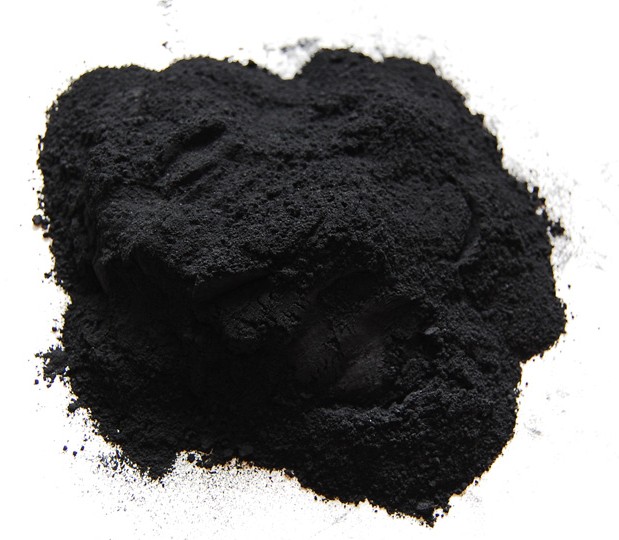
Amorphous graphite is a misnomer, and the misunderstanding costs buyers money. The material is fully crystalline — microcrystalline, to be precise — and what looks like a defect on paper is the working property in several applications. This page explains the naming, sets out the purity grades from 70% to 90%, and is honest about where amorphous graphite is the right choice and where you need flake instead.
Is graphite crystalline or amorphous?
Crystalline. Always. All graphite is crystalline by definition — it is impossible for graphite to be amorphous, because the layered hexagonal carbon structure is what makes it graphite in the first place.
So why the name? Because of how it looks. This form of graphite is anhedral, meaning it shows no visible crystal faces. To the eye, a piece of it simply looks like a lump of anthracite coal.
The accurate terms are microcrystalline graphite or cryptocrystalline graphite. Both are standard geological descriptions for a mineral composed of crystals too small to resolve with the naked eye or standard optical microscopy. The crystals are present; they are simply below the resolution limit.
The analogy that makes it click. Amorphous graphite is to flake graphite what chert is to crystal quartz. Chert looks like a dull uniform rock and quartz like a faceted crystal, but both are silicon dioxide with the same atomic structure. The difference is crystal size, not chemistry. The same holds here: amorphous graphite and flake graphite are the same mineral at different crystal scales.
How the confusion shows up in specifications
X-ray diffraction measures degree of graphitization — how well-ordered the crystal structure is over long range. Amorphous graphite typically shows 20 to 40% by this measure, against 90%+ for flake and vein graphite.
That figure is often misread as purity. It is not. A sample can be 85% carbon by assay and still show 30% graphitization, because the two measure different things: one is how much carbon is present, the other is how ordered it is.
| Measurement | What it tells you | Amorphous graphite |
|---|---|---|
| Carbon content (assay) | How much carbon is in the sample | 70–90%, grade dependent |
| Degree of graphitization (XRD) | How ordered the crystal structure is | 20–40% |
| Ash content | Mineral matter, the balance of the assay | 10–30%, grade dependent |
| Density | Distinguishes it from anthracite | 2.2 g/cc against 1.7 for anthracite |
How amorphous graphite forms
It is a seam mineral, not a vein mineral — a distinction that explains most of its properties.
The sequence runs: organic carbon is deposited, buried and converted into anthracite coal, then subjected to low-grade metamorphism. That metamorphism converts the anthracite into microcrystalline graphite. In many deposits you can find anthracite and graphite adjacent to one another, which shows the process caught different parts of the seam to different degrees.
| Metamorphic agent | Mechanism |
|---|---|
| Contact metamorphism | Localised contact between a magma intrusion and the coal seam. Dike swarms cutting across the country rock are the classic case |
| Regional metamorphism | A large intrusion such as a batholith or stock beneath or adjacent to the carbon-bearing structure |
Why seam origin means higher ash
This is the key consequence and it is not a processing failure.
The proto-carbon was deposited alongside whatever mineral matter washed into the swamp, bog or delta at the time. The system stayed more or less closed to mass exchange with the surrounding rock, so that mineral matter stayed put through metamorphism and remains in the graphite today.
Some of it is free — mechanically attached particles such as quartz. Some is clay-like minerals intimately associated with the carbon at the microscopic level. The second kind is why flotation and other density or chemical separation methods are inefficient here, and why amorphous graphite is not upgraded to flake purities. The graphite and the ash are physically interlocked.
Where the ash is an advantage
Most material pages treat ash as a defect to be minimised. In several real applications it is the reason the product is specified.
-
Mechanical seals
Seal faces need a degree of rubbing abrasion to lap and clean the opposing surface. The ash in amorphous graphite provides exactly that gentle abrasion. Selecting the particle size selects the size of the abrasive.
-
Forging lubricants
The mineral content survives the temperature and contributes to the separating film between die and workpiece.
-
Refractory blends
The alumina and silica already present in the ash are refractory components in their own right, not contaminants.
-
Friction materials
Brake pads need a controlled friction coefficient, not the lowest possible. Ash content contributes to that balance.
-
Coatings
Low reflectance gives a darker near-black colour than the silver-grey of flake, which matters where the coating must not reflect.
-
Cost-sensitive volume use
Where the application tolerates ash, paying for flake purity is paying for a property the process does not use.
The mechanical seal case is the clearest. An engineer specifying high-purity flake for a seal face is removing the abrasive that makes the seal work. That is a real and expensive mistake, and it comes from treating ash as a defect in every context.
Amorphous, flake or vein: which do you need?
Being straightforward about this saves everyone time. Amorphous graphite is not a cheaper substitute for flake in every application — in some it is the correct choice, in others it will not work at all.
| Amorphous | Flake | Vein | |
|---|---|---|---|
| Carbon content | 70–90% | 85–99% | 90–99%+ |
| Graphitization | 20–40% | 90%+ | 90%+ |
| Crystal size | Microcrystalline | Visible flakes | Large, needle or plate |
| Colour | Near-black, low reflectance | Silver-grey | Bright metallic |
| Relative cost | Lowest | Higher | Highest |
| Availability | Most abundant natural form | Widely available | Rare, limited sources |
| Extraction | Conventional coal mining methods | Open pit and underground with beneficiation | Underground |
Where amorphous graphite is the wrong choice
Say so plainly rather than let a buyer find out after delivery.
| Application | Why amorphous will not work | What to use |
|---|---|---|
| Nuclear moderator and reflector components | Requires 99.99%+ purity for low neutron absorption. Ash content is disqualifying | High-purity synthetic electrographite |
| Continuous casting refractories | Stopper rods, nozzles and shrouds are made from flake mixed with alumina and zirconia, isostatically pressed. The flake morphology is structural | Flake graphite |
| Lithium-ion anode material | Requires spheroidised high-purity flake or synthetic with specific surface area control | Spheroidised flake or synthetic |
| Expandable graphite | Expansion depends on intercalating between large crystal layers. Microcrystalline structure cannot expand | Large flake |
| High-conductivity electrical | Conductivity scales with crystal order. 20–40% graphitization limits it | Flake or synthetic |
Applications
Where ash is acceptable or actively useful, amorphous graphite performs well and costs less. It remains lubricious, conductive and chemically stable.
| Industry | Application | Typical grade |
|---|---|---|
| Lubricants | Greases, forging lubricants, dry film lubricants, thread compounds | −200 to −325 mesh, 75–85% |
| Refractories | Refractory bricks, magnesia-carbon brick, blast furnace lining blocks, crucibles, ladles and moulds | Grain or briquette, 80–90% |
| Foundry | Mould coatings, parting compounds, carbon raiser | −100 to −200 mesh |
| Friction materials | Brake pads and linings, clutch facings | −200 mesh, 75–85% |
| Metallurgy | Carbon additive in steelmaking, metal covering compounds | Grain or briquette |
| Rubber and polymers | Conductive and reinforcing filler in composites | −325 mesh |
| Paint and coatings | Anti-reflective and protective coatings where a near-black finish is needed | −325 mesh |
| Drilling fluids | Lubricity additive, alongside gilsonite-based products | −200 mesh |
| Pencils | Core material, where low reflectance and softness suit the product | −325 mesh |
| Mechanical seals | Seal faces where controlled abrasion is required for lapping | Size-selected to control abrasive size |
Grades and sizing
Purity grades
| Carbon content | Typical use |
|---|---|
| 70% | Bulk metallurgical additions, cost-driven applications |
| 75%, 78% | Friction materials, general lubricant fillers |
| 80%, 83% | Refractory blends, foundry coatings, most industrial use |
| 85%, 88% | Lubricants, coatings, applications where ash must be controlled |
| 90% | The upper limit for this material. Above this, flake is the correct product |
Sizes available
| Form | Sizes |
|---|---|
| Powder | −100 mesh, −200 mesh, −325 mesh |
| Grain | 0–3 mm, 0–6 mm, 0–15 mm, 1–5 mm, 2–5 mm, 1–6 mm |
| Briquette | 45×38×25 mm, 45×45×20 mm, 30×25×20 mm, 25×20×16 mm |
| Lump | Run of mine up to 4-inch, sized on request |
Any purity grade can be supplied in any size. Fine powders at higher purity cost more per tonne because both grinding and selection add cost — specifying finer or purer than the process needs adds cost without adding performance.
Packing
| Form | Packing |
|---|---|
| Lump | 500–1,000 kg jumbo bag |
| Grain and coarse mesh | 500–1,000 kg jumbo bag, or PP bag on pallet |
| −200 mesh powder | 25 kg multi-ply paper bag, 50 lb multi-ply paper bag, or jumbo bag |
| −325 mesh powder | 25 kg PP bag or jumbo bag |
| Bulk | Vessel shipment for large volumes |
Specification
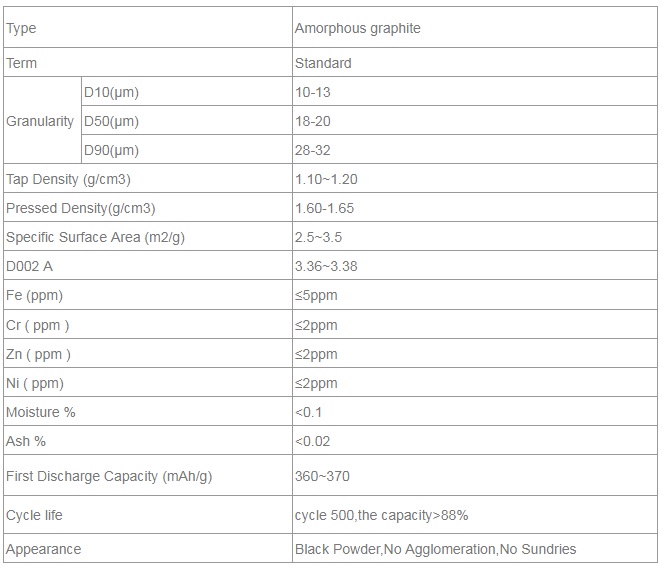
Measured batch values are stated on the certificate of analysis with the lot number and production date, not typical values. Third-party inspection at loading by SGS, Bureau Veritas, Intertek or the surveyor named in your contract is accepted.
Frequently asked questions
Is graphite crystalline or amorphous?
All graphite is crystalline. It is impossible for graphite to be amorphous, because the layered hexagonal carbon structure is what defines it as graphite. The term “amorphous graphite” describes appearance, not structure: the crystals are present but too small to see. The accurate terms are microcrystalline graphite or cryptocrystalline graphite.
Why is it called amorphous if it is crystalline?
Because it is anhedral — it shows no visible crystal faces. To the eye a piece looks like a lump of anthracite coal rather than a crystal. The name stuck despite being technically wrong. A useful analogy: amorphous graphite is to flake graphite what chert is to crystal quartz. Both pairs are the same mineral at different crystal scales.
What is the difference between amorphous and flake graphite?
Crystal size and everything that follows from it. Amorphous is microcrystalline with 70 to 90% carbon and 20 to 40% graphitization; flake has visible crystals with 85 to 99% carbon and over 90% graphitization. Amorphous is near-black with low reflectance, flake is silver-grey. Amorphous is the most abundant natural form and the lowest cost.
How is amorphous graphite formed?
By low-grade metamorphism of existing anthracite coal seams. Organic carbon is deposited, buried and converted to anthracite, then metamorphosed into microcrystalline graphite. The agent is either contact metamorphism from a magma intrusion such as a dike swarm, or regional metamorphism from a large intrusion nearby. It is a seam mineral, not a vein mineral.
Why does amorphous graphite have higher ash content?
Because the proto-carbon was deposited alongside mineral matter washing into the swamp or delta, and the system stayed largely closed through metamorphism, so that mineral matter remained. Some is mechanically attached particles such as quartz; some is clay-like minerals intimately associated with the carbon. The second kind is why flotation and chemical separation are inefficient here.
Is high ash content always a disadvantage?
No, and this is often misunderstood. Mechanical seal faces need a degree of rubbing abrasion to lap and clean the opposing surface, and the ash provides exactly that. Selecting the particle size selects the size of the abrasive. In refractory blends the alumina and silica in the ash are refractory components themselves. Specifying high-purity flake for a seal face removes the abrasive that makes the seal work.
What purity grades are available?
70%, 75%, 78%, 80%, 83%, 85%, 88% and 90% carbon. 80 to 83% covers most industrial use including refractory blends and foundry coatings. 90% is the practical upper limit for this material — above that, flake graphite is the correct product rather than an upgraded amorphous.
What sizes can be supplied?
Powder at −100, −200 and −325 mesh. Grain at 0–3 mm, 0–6 mm, 0–15 mm, 1–5 mm, 2–5 mm and 1–6 mm. Briquettes in four standard sizes. Lump up to 4 inch, sized on request. Any purity grade can be supplied in any size.
When should I use flake graphite instead?
Nuclear components, which need 99.99%+ purity for low neutron absorption. Continuous casting refractories such as stopper rods and nozzles, where the flake morphology is structural. Lithium-ion anode material, which needs spheroidised high-purity flake. Expandable graphite, which depends on intercalating between large crystal layers. And high-conductivity electrical applications, where conductivity scales with crystal order.
How is amorphous graphite extracted?
Using conventional coal-type mining techniques, because it occurs in seams rather than veins. That is the same reason it carries higher ash: the deposit geometry and the mineral matter both come from its origin as a metamorphosed coal seam.
How does it compare with anthracite coal?
It looks similar but is materially different. Density is 2.2 g/cc against 1.7 for anthracite, and amorphous graphite is soft and lubricious while anthracite is not. The graphite formed from anthracite through metamorphism, which is why deposits sometimes contain both adjacent to each other.
What packing is available?
25 kg multi-ply paper or PP bags and 50 lb paper bags for powder, 500 to 1,000 kg jumbo bags for all forms, PP bags on pallet for coarse grades, and bulk vessel shipment for large volumes. Packing is matched to the form and to handling equipment at the receiving end.
Related pages
Other materials we supply: gilsonite, gilsonite powder, natural bitumen, coal tar and bituminous coal.
Industrial applications: foundry, chemical products, paint, drilling fluids and all industrial uses.
Specify amorphous graphite for your process
Send us the application, the carbon content your specification names, the size you need and the volume. If you are not certain whether amorphous or flake is right, tell us the application — we will say plainly if flake is the correct product, because a wrong specification costs more than the price difference.
Dubai: No. 2305, Burlington Tower, Business Bay — +971 4 566 4998
Ankara: Karşıyaka District, 749 Street No. 30, Gölbaşı 06830 — +90 312 544 5481
