
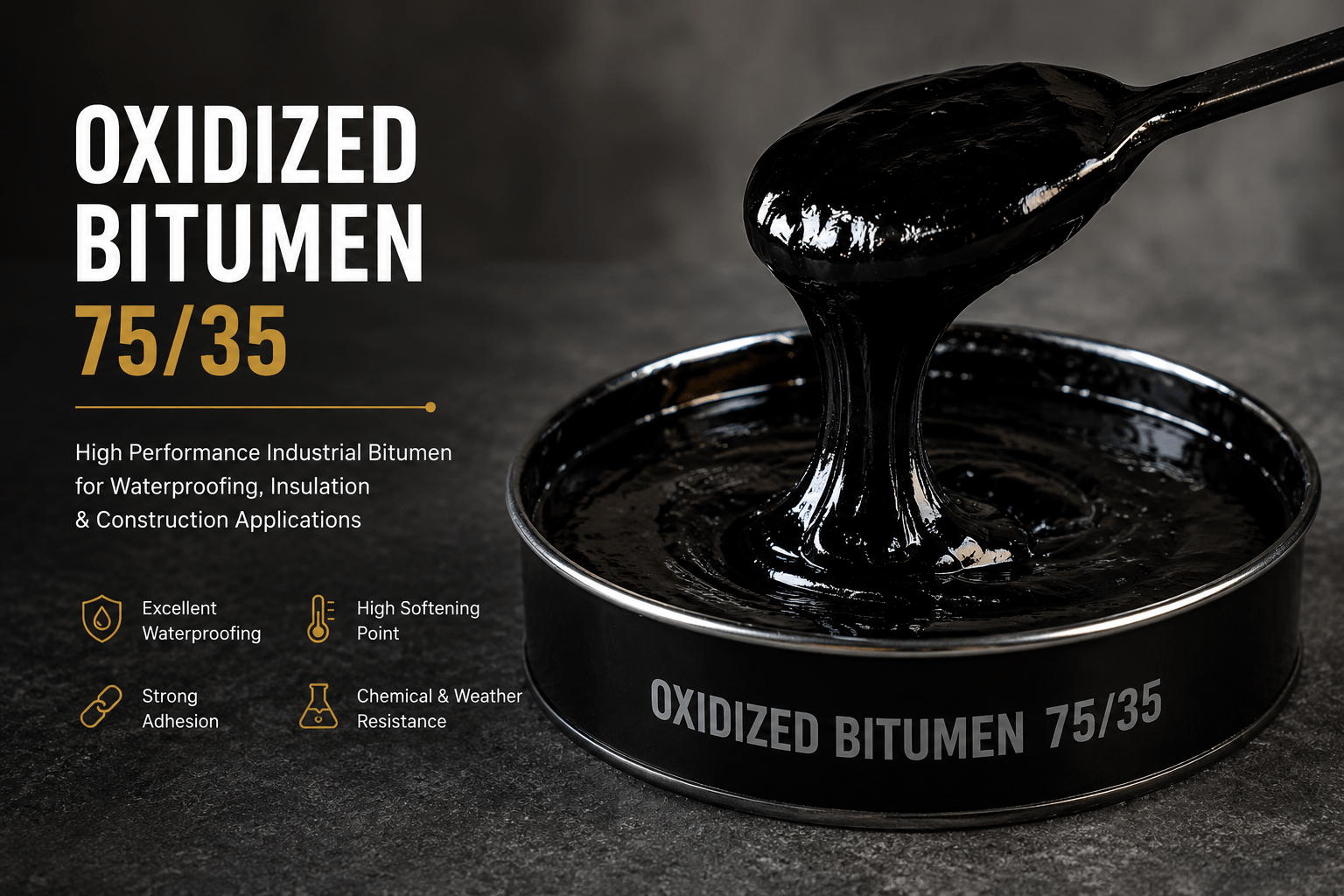
Oxidized bitumen 75/35 sits at the very bottom of the blown range, and that position defines it. With a softening point of 70 to 80 °C and 30 to 40 dmm penetration, it is only modestly harder than the penetration grade it started from. For roofing that makes it a limited product. For cable impregnation, bituminous paint, sound damping and cold-climate damp proofing it makes it the right one — because those applications need flow, wetting and flexibility rather than heat resistance.
RAHA Gilsonite supplies oxidized bitumen 75/35 against ASTM D312, BS EN 13304:2009, BS 3690, DIN 1995 or a buyer’s own specification, with a batch certificate of analysis issued before loading. This page covers the specification, the applications where a lightly blown grade genuinely outperforms a harder one, the low melting temperatures it needs, and the storage precautions its softness demands.
What is oxidized bitumen 75/35?
Oxidized bitumen 75/35, also called blown asphalt 75/35 or blown bitumen 75/35, is produced by passing hot compressed air through penetration grade bitumen at elevated temperature. The air-blowing process alters the chemical and physical structure of the binder, raising the softening point and reducing the penetration.
Reading the designation
| Number | What it measures | Meaning |
|---|---|---|
| 75 | Ring-and-ball softening point, °C | The temperature at which the binder transitions from solid to pliable |
| 35 | Penetration at 25 °C, dmm | A standard needle sinks 3.5 mm under defined test conditions |
Under BS EN 13304:2009, oxidised grades are expressed as multiples of 5, so 75/35 is a standard-defined grade within that European framework.
The lightest blowing in the range
Most descriptions call 75/35 a “hard grade” because all oxidised bitumen is harder than the feedstock it came from. That framing is misleading. Against the rest of the blown family, 75/35 is the softest and least modified product available.
Start with 60/70 penetration bitumen at roughly 49 to 56 °C softening point and 60 to 70 dmm. Blow it lightly and you arrive at 75/35: about 25 °C more softening point, roughly half the penetration. Blow it hard and you reach 150/5, which is effectively a rigid resin.
75/35 keeps most of the character of the parent binder. It still flows, still wets surfaces readily, still tolerates handling in cold weather. Those are the properties the harder grades trade away, and they are exactly what several industrial applications require.
The distinction that matters. Ask what the compound must do rather than how hot it must survive. A cable impregnation compound must penetrate between conductor strands — it needs flow, not rigidity. A bituminous paint must brush out to a thin even film — again flow. A sound damping pad must stay bonded to a vibrating panel — flexibility. In all three, a harder grade performs worse, not better.
Oxidized bitumen 75/35 specification
| Property | Unit | Specification | Typical result | Test method |
|---|---|---|---|---|
| Softening point (ring & ball) | °C | 70–80 | 75 | ASTM D36 / EN 1427 |
| Penetration @25 °C, 100 g, 5 s | dmm | 30–40 | 35 | ASTM D5 / EN 1426 |
| Ductility @25 °C | cm | 2.5 min | 4–8 | ASTM D113 |
| Flash point (Cleveland open cup) | °C | 230 min | 255 | ASTM D92 |
| Solubility in trichloroethylene | wt % | 99 min | 99.5 | ASTM D2042 |
| Loss on heating (163 °C, 5 h) | wt % | 0.2 max | 0.1 | ASTM D6 |
| Density @25 °C | g/cm³ | 1.00–1.05 | 1.02 | ASTM D70 |
| Ash content | wt % | 0.5 max | 0.2 | ASTM D2939 |
| Spot test | — | Negative | Negative | AASHTO T102 |
Ductility runs high for a blown grade, typically 4 to 8 cm, because the material retains much of its parent binder character. For cable, paint and damping applications this is a useful indicator. Solubility is tested in trichloroethylene to ASTM D2042 — older specifications sometimes name carbon disulphide, but that solvent has been withdrawn from routine use on fire-safety grounds. Test methods are maintained by ASTM International.
Production process
| Stage | What happens | Why it matters |
|---|---|---|
| 1. Feedstock selection | Penetration grade 60/70 or 80/100 from vacuum distillation residue | Because blowing is light, the feedstock character carries through strongly into the finished grade |
| 2. Pre-heating | Charge heated to 240–270 °C in the blowing tower | Temperature uniformity prevents localised over-blowing, which matters more on a short cycle |
| 3. Air injection | Compressed air injected for a comparatively short cycle | The shortest blowing time of any grade in the range. Over-running by even an hour overshoots the target |
| 4. QC monitoring | Softening point and penetration tested frequently through the cycle | The window closes quickly. Production stops when both land inside the target simultaneously |
| 5. Packing and inspection | Decanted under temperature control into bags, cartons or drums | Third-party inspection verifies quality and quantity at loading |
The short blowing cycle is worth noting when comparing suppliers. A batch that has been over-blown and then coasted is not the same material as one stopped on target, even if both certificates read 75/35 — the molecular distribution differs and it shows up in flow behaviour.
Applications of oxidized bitumen 75/35
Unusually for a blown grade, the industrial applications outweigh the roofing ones. Each of them uses the flow and flexibility that the harder grades have lost.
-
Electrical cable impregnation
- Underground and armoured power cables
- Telecommunications cable filling
- Joint and termination compounds
Needs to penetrate between conductor strands. Flow matters more than hardness.
-
Bituminous paints and coatings
- Metal surface protection
- Marine and offshore structures
- Industrial tanks and vessels
Must brush or spray out to a thin even film without dragging.
-
Sound deadening pads
- Automotive underbody coatings
- Vibration damping pads
- Appliance and machinery damping
Bonds to a panel that flexes constantly. A brittle compound delaminates.
-
Cold-climate damp proofing
- Damp proof course sheet
- Below-grade barrier layers
- Foundation protection in frost zones
Stays workable at low installation temperature.
-
Pipe wrapping and coating
- Wrapping tape compounds
- Secondary coating layers
- Cold-applied pipe protection
Conforms tightly to the pipe surface without cracking at the weld bead.
-
Roofing felt, cool climates
- Base felt saturation
- Low-cost membrane in cold markets
- Temporary and short-life roofing
Suitable only where summer roof temperature stays well below 70 °C.
-
Bituminous adhesives
- Board and panel bonding
- Membrane laying compounds
- Flexible construction adhesives
Wets the substrate readily and stays flexible after cooling.
-
Chemical and process compounds
- Sealants for moderate service
- Impregnation of fibre and board
- Blending base for modified compounds
A common starting point for polymer-modified formulations.
Where 75/35 is the wrong grade
Any application where the material must resist heat. At a softening point of 70 to 80 °C, this grade softens at temperatures that a dark roof surface reaches in an ordinary temperate summer, let alone a hot one. For roofing membrane sold into anywhere warmer than northern Europe or highland regions, use 85/25 as a minimum and 105/35 for hot climates.
Equally, it has poor creep resistance under sustained load. Pipe coating enamel on buried line, static sealing compounds and industrial mastics carrying weight belong to 90/10 or 105/15.
75/35 against 75/25 and 85/25
| 75/35 | 75/25 | 85/25 | |
|---|---|---|---|
| Softening point | 70–80 °C | 70–80 °C | 80–90 °C |
| Penetration | 30–40 dmm | 20–30 dmm | 20–30 dmm |
| Flow and wetting | Best of the three | Good | Moderate |
| Heat resistance | Lowest | Same as 75/35 | 10 °C better |
| Suits cable impregnation | Yes — the natural choice | Acceptable | Marginal |
| Suits bituminous paint | Yes | Yes | Needs more solvent |
| Suits roofing membrane | Cool climates only | Cool climates only | Yes — the volume grade |
| Melting temperature | 150–175 °C | 155–180 °C | 160–185 °C |
Against 75/25, the choice comes down to whether you need flow or firmness at the same heat resistance. Against 85/25, it is whether the application is industrial or architectural.
How 75/35 compares with the full oxidized range
| Grade | Softening point | Penetration | Class | Principal use |
|---|---|---|---|---|
| 150/5 | 145–155 °C | 0–10 dmm | Hardest | Electrical compounds, battery sealing, pipe enamel, rubber |
| 115/15 | 110–120 °C | 10–20 dmm | Hard | Waterproofing, adhesives, sealing, pipe coating |
| 105/35 | 100–110 °C | 30–40 dmm | Medium | Membrane for hot climates |
| 105/15 | 100–110 °C | 10–20 dmm | Hard | Sealing, jointing, industrial mastics |
| 95/25 | 90–100 °C | 20–30 dmm | Medium | Membrane and damp proofing in warm markets |
| 90/40 | 85–95 °C | 35–45 dmm | Softer | Membrane for temperate and cool climates |
| 90/15 | 85–95 °C | 10–20 dmm | Medium | Adhesives, sealing compounds, mastics |
| 90/10 | 85–95 °C | 5–15 dmm | Hard | Pipe coating, cable filling, tank lining |
| 85/40 | 80–90 °C | 35–45 dmm | Softer | Cold-climate membrane, winter installation |
| 85/25 | 80–90 °C | 20–30 dmm | Medium | The volume roofing grade worldwide |
| 75/35 | 70–80 °C | 30–40 dmm | Softest | Cable impregnation, bituminous paint, damping, cold damp proofing |
| 75/25 | 70–80 °C | 20–30 dmm | Softest | General waterproofing, jointing |
The full range is listed on our oxidized bitumen grades page.
Advantages of oxidized bitumen 75/35
-
Superior flow and wetting
Penetrates cable strands, brushes to a thin film and saturates fibre substrates better than any harder blown grade.
-
Retained flexibility
The highest ductility in the blown range. Bonds stay intact on panels and substrates that move.
-
Lowest working temperature
Melts and applies 20 to 40 °C cooler than the hard grades, cutting fuel use, fume generation and burn risk.
-
Cold-weather workability
Remains handleable at low ambient temperature, suiting winter installation and cold-store construction.
-
Weathering resistance
UV stable and resistant to normal temperature cycling within its service range.
-
Chemical resistance
Resistant to acids, alkalis and salts, suiting below-grade and industrial exposure.
-
Good adhesion
Bonds readily to concrete, metal, wood, fibre and fabric carriers.
-
Cost efficiency
The shortest blowing cycle in the range, which is reflected in the price.
Melting and application temperatures
| Operation | Temperature | Notes |
|---|---|---|
| Melting | 150–175 °C | The lowest in the range. Melts readily — do not overheat out of habit |
| Pumping | 160–180 °C | Heat traced lines. Flows easily once molten |
| Application / blending | 165–190 °C | Cable and paint work runs at the lower end; felt saturation higher |
| Absolute maximum | 205 °C | The lowest ceiling of any oxidised grade. Above this the penetration falls fast |
| Hot holding | Avoid entirely where possible | Continued heat continues the blowing reaction and hardens the grade toward 75/25 |
This grade is the easiest of all to over-process. Its production cycle is the shortest and its temperature ceiling the lowest. A melter set for 85/25 and used for 75/35 without adjustment runs 15 to 20 °C too hot, and across a shift that can pull the penetration from 35 toward 28 — at which point you have paid for 75/35 and are working with something closer to 75/25. If you are switching grades on an existing line, change the temperature settings first and test the penetration on the finished product afterwards.
Safety
The flash point is 230 °C minimum, the lowest of the blown grades and closest to the working range, so the margin is thinner than usual. Keep away from open flame and heat sources. If the material foams, spits or crackles as it heats, water is present — stop heating rather than trying to drive it off. Handling guidance is published by Eurobitume and the Asphalt Institute.
Packing and storage
| Package type | Net weight | Details | Per 20′ container |
|---|---|---|---|
| Carton box | 25 kg | With polyethylene liner. Recommended for this grade — rigid walls hold block shape | Up to 22 MT |
| Kraft paper bag | 25 kg | Multi-layer, moisture resistant, meltable options available | Up to 25 MT palletised |
| Steel drum | 180 kg | New, sealed, stackable. Safest on long tropical routes | 80 drums ≈ 14.4 MT |
| Jumbo bag | 1,000 kg | For bulk orders where handling equipment exists | Up to 22 MT |
| Melt pour | Bulk | Available on request for buyers with heated facilities | By arrangement |
Storage and shelf life — the critical section for this grade
Two to three years in sealed packing kept dry, cool and out of direct sun. Chemical ageing is slow because the material is already blown.
The physical risk is the highest of any grade we supply. With a softening point of only 70 to 80 °C, the margin between storage conditions and the softening range is the narrowest in the family. A container crossing the Red Sea or the equator reaches 60 to 70 °C internally — which is at or inside the softening band. A pallet standing in tropical sun at a transhipment port can exceed it outright.
The result is not just stack fusion but genuine block deformation: bags lose shape, pallets slump, and in severe cases the material has partially flowed within its packing.
- Specify carton packing or drums for any route through the tropics. Cartons hold shape; drums contain the material regardless.
- Limit stacking to two tiers, and one tier where the climate is hot.
- Unload immediately on arrival. Do not leave containers standing.
- Store in the coolest available space, under cover, never in direct sun.
- Avoid summer shipment to hot destinations where the schedule allows a choice.
Keep away from open flames, heat sources and oxidizing agents. Our bitumen shelf life and storage guide covers the full picture including retest thresholds.
Customs classification
The grade falls under HS 2713.20, petroleum bitumen. Bagged and drummed material at ambient temperature is generally not classified as dangerous goods for sea carriage, although most shipping lines and destination customs still require the safety data sheet with the booking. Note that gilsonite and other natural bitumen fall under a different heading.
Quality standards and certification
| Standard | Covers |
|---|---|
| ASTM D312 | Standard specification for asphalt used in roofing |
| BS EN 13304:2009 | European framework for specification of oxidised bitumens |
| BS 3690 | British standard for bitumens for building and civil engineering |
| DIN 1995 | German standard for blown bitumen |
| ISIRI 118 | Iranian national standard |
Every shipment leaves with a batch certificate of analysis stating the lot number, the production date, the standard tested against and each test with its method and measured result. We accept third-party inspection at loading by SGS, Bureau Veritas, Intertek or any surveyor named in your contract.
What to check for this grade
Check the penetration first. Because the blowing window is narrow and the cycle short, batch-to-batch variation is more consequential here than in the harder grades. A batch at 31 dmm has lost much of the flow advantage that makes 75/35 worth specifying over 75/25.
If your application depends on flow — cable impregnation, thin-film paint, fibre saturation — contract to a narrower band such as 34 to 39 dmm rather than accepting the full window, and ask for the ductility figure as a second indicator.
Frequently asked questions about oxidized bitumen 75/35
What does 75/35 mean in oxidized bitumen?
The first number is the ring-and-ball softening point in degrees Celsius, so approximately 75 °C. The second is the penetration at 25 °C in tenths of a millimetre, so approximately 35 dmm — a standard needle sinks 3.5 mm. The specification runs 70–80 °C for softening point and 30–40 dmm for penetration.
What is oxidized bitumen 75/35 used for?
Principally electrical cable impregnation, bituminous paints and coatings, sound deadening and vibration damping pads, cold-climate damp proofing, pipe wrapping compounds, bituminous adhesives and roofing felt for cool markets. Unusually for a blown grade, the industrial applications outweigh the roofing ones.
Is 75/35 really a hard grade?
Only relative to the penetration bitumen it came from. Within the blown family it is the softest and least modified grade available. Starting from 60/70 at roughly 50 °C softening point, light blowing produces 75/35; hard blowing produces 150/5, which is effectively a rigid resin. 75/35 keeps most of the parent binder’s flow and flexibility, and that is what its applications need.
Can 75/35 be used for roofing membrane?
Only in genuinely cool climates. At a softening point of 70 to 80 °C it softens at temperatures a dark roof reaches in an ordinary temperate summer. For anywhere warmer than northern Europe or highland regions, use 85/25 as a minimum and 105/35 for hot climates.
What is the difference between 75/35 and 75/25?
They share the same softening point band of 70 to 80 °C. 75/35 carries 30 to 40 dmm penetration against 20 to 30 for 75/25, so it flows and wets better while 75/25 is firmer. For cable impregnation, thin-film paint and fibre saturation, 75/35 is the natural choice. For general waterproofing and jointing where a little more body helps, 75/25 works.
What temperature do I melt oxidized bitumen 75/35 at?
Melt at 150 to 175 °C, pump at 160 to 180 °C and apply at 165 to 190 °C, using indirect heating. Do not exceed 205 °C — the lowest ceiling of any oxidised grade. A melter set for 85/25 and used for 75/35 without adjustment runs 15 to 20 °C too hot and will harden the grade toward 75/25 across a shift.
Why does 75/35 need more storage care than other grades?
Because its softening point of 70 to 80 °C is the lowest in the range, and the margin between storage conditions and that band is the narrowest. A container crossing the Red Sea or the equator reaches 60 to 70 °C internally, which is at or inside the softening range. Specify carton packing or drums on tropical routes, limit stacking to one or two tiers, and unload immediately on arrival.
Is oxidized bitumen 75/35 the same as blown asphalt 75/35?
Yes. Oxidized bitumen, blown bitumen and blown asphalt all describe the same product — penetration grade bitumen air-blown at high temperature to raise the softening point and reduce the penetration. The naming varies by region rather than by product.
Why is 75/35 good for cable impregnation?
Because impregnation requires the compound to penetrate between conductor strands and fill voids completely. That needs flow, and flow is exactly what harder blown grades have lost. 75/35 retains enough of its parent binder character to wet and penetrate readily while still offering better heat stability than an unblown penetration grade.
What is the shelf life of oxidized bitumen 75/35?
Two to three years in sealed packing kept dry, cool and out of direct sun. Chemical ageing is slow because the material is already blown. The practical limit is physical: with the lowest softening point in the range, block deformation and stack fusion under heat are genuine risks on hot routes.
Which standards does 75/35 comply with?
ASTM D312 for asphalt used in roofing, BS EN 13304:2009 as the European framework for oxidised bitumens, BS 3690, DIN 1995 and ISIRI 118. Where a contract names a particular standard, the certificate of analysis shows the grade tested against that standard specifically.
What is the minimum order quantity?
One full 20′ container, roughly 22 to 25 MT depending on packing. Mixed grades in one shipment are accepted provided each grade reaches one full container. Loading is from Jebel Ali Port in Dubai or Iskenderun Port in Turkey, on FOB, CFR or CIF terms.
Related grades and technical pages
Adjacent grades: oxidized bitumen 75/25 for a firmer binder at the same heat resistance, 85/40 and 85/25 where more heat margin is needed, and 90/40 for temperate membrane work. The complete list is on the oxidized bitumen grades page.
Where a compound needs additional hardness, gloss or a higher softening point than blown bitumen alone can deliver, gilsonite is frequently blended in — see gilsonite specification, gilsonite in paint, gilsonite in ink and gilsonite in asphalt. For the difference between air-blown and naturally occurring hard bitumen, see natural bitumen.
Why source oxidized bitumen 75/35 from RAHA Gilsonite?
- Direct production with offices in Dubai, Ankara and Isfahan
- Batch certificate of analysis before every shipment, with lot number and production date
- Full documentation — COA, MSDS, third-party inspection at loading
- Flexible shipment: FCL, LCL and bulk arrangements
- Packing advice for tropical routes, where this grade is genuinely at risk
- Certification against ASTM D312, BS EN 13304, BS 3690, DIN 1995 or your own specification
Send us the quantity, packing, discharge port and what the compound has to do in service. If flow matters more than heat resistance, 75/35 is likely right. If the answer is the other way round, we will tell you which grade fits instead.
Dubai: No. 2305, Burlington Tower, Business Bay — +971 4 566 4998
Ankara: Karşıyaka District, 749 Street No. 30, Gölbaşı 06830 — +90 312 544 5481
Isfahan: Second Floor, Navab Complex, Navab Safavi St
