
RAHA Gilsonite Co. supplies calcium chloride — CaCl2 — in container quantities to industrial buyers worldwide: white granular anhydrous material at 94 per cent minimum, and flake calcium chloride on request. We are a calcium chloride supplier working to export buyers, not a domestic counter. This page sets out what we supply, the industries that buy it, how we pack it and what moves the price. It also says what to put in an enquiry, so a firm quotation comes back on the first reply rather than four emails later.
Why buy calcium chloride from RAHA Gilsonite Co.
Search for a calcium chloride supplier and most of what comes back is a marketplace listing with a price, a photograph and nothing technical behind it. We are not that. RAHA Gilsonite Co. is a trading and supply house for drilling fluid and industrial chemicals, with offices in Dubai and Ankara. We sell to mud companies, service companies, municipalities and industrial buyers who need the material to arrive on specification and on time, rather than cheaply and eventually.
One desk for the whole programme
Calcium chloride rarely travels alone. We supply bentonite, PAC LV, PAC HV, CMC, potassium chloride, caustic soda and gilsonite from the same desk, so a mud programme becomes one consignment, one set of documents and one person to call.
Two routings, not one
We load from Jebel Ali and from Mersin. For most destinations one of the two is clearly cheaper, and because we work both we can tell you which — rather than quoting whichever one we happen to be tied to.
Documents before the contract
The technical data sheet is on this page, downloadable, before you commit to anything. The safety data sheet comes with the offer and a batch certificate of analysis ships with every consignment. Nothing is held back until after the deposit.
Technical answers, not just prices
Ask what the magnesium limit will do to your brine, or how low the crystallization temperature can go before you need a blend, and you get a worked answer. Our technical page on calcium chloride in drilling fluids is the kind of material we send before a sale, not after.
Inspection welcomed
We arrange independent inspection at loading by SGS, Bureau Veritas, Intertek or your own surveyor whenever you ask for it. A supplier confident in the material has no reason to resist a third party looking at it.
Container quantities, repeatably
Minimum one full container, and the same material on the second shipment as on the first. If you need a quarterly or seasonal programme, say so in the enquiry and we price it as one.
What we supply
Calcium chloride reaches the market in several physical forms, and the difference between them is not a difference in quality. It is a difference in how much water the crystal carries, which decides how much calcium chloride you are actually paying freight on and how much heat the material gives off when it dissolves.
| Form | Typical strength | Where it suits |
|---|---|---|
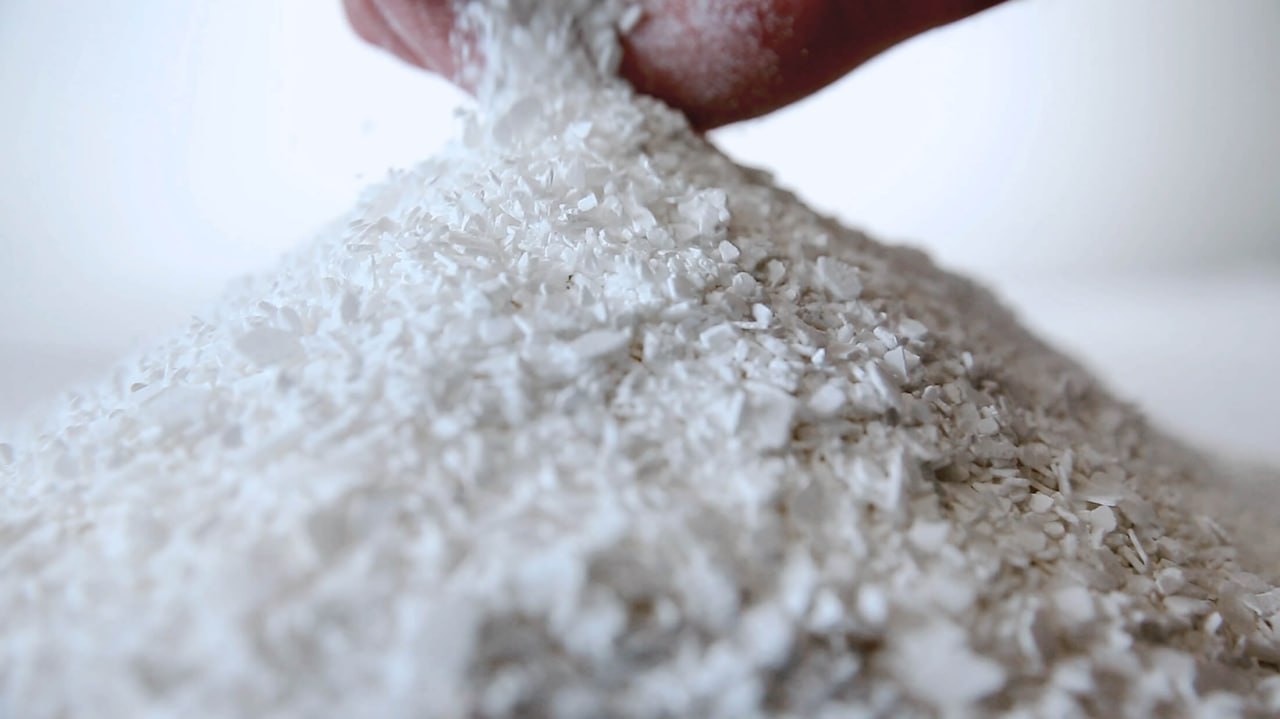
| Granular, anhydrous | 94% minimum | Our standard grade. Drilling and completion brines, de-icing, dust control, any application where freight distance makes carried water expensive |
| Flake, dihydrate | Confirmed on enquiry | Available on request. Slower, cooler dissolution suits open mixing and hand dosing. The crystal carries water, so the delivered cost per tonne of active CaCl2 runs higher |
The granular anhydrous grade is what we hold and ship as standard, and it is the form described on this page and in the published data sheet. Flake material is supplied against enquiry, with its own data sheet issued with the offer; the grade name is not enough to contract on, so ask for the sheet rather than assuming a figure.
Why the arithmetic favours the anhydrous grade on long freight routes: a tonne of 94 per cent granular delivers about 940 kg of calcium chloride, while a tonne of 77 per cent dihydrate flake delivers about 770 kg. Over the same ocean freight, the flake costs roughly 22 per cent more per kilogram of active product before the material price is even compared. On short inland deliveries that gap narrows and handling convenience can win.
Specification, granular grade
These are the guaranteed limits for the granular anhydrous grade. Every consignment also ships with a batch certificate of analysis, and it is the certificate — not this table — that governs the material you receive.
| Property | Limit |
|---|---|
| Calcium chloride, CaCl2 | 94% w/w minimum |
| Total alkalinity | 4 maximum |
| Total magnesium, as MgCl2 | 0.2 maximum |
| Calcium hydroxide, Ca(OH)2 | 0.1 maximum |
| Fluoride | 0.004 maximum |
| Appearance | White granulated |
| Particle size | 1–4 mm |
| HS code | 2827.20 |
Two of those lines matter more than buyers usually expect. The magnesium limit decides whether the brine will stay clear at working temperature, because magnesium brings its own hydroxide problem the moment the pH rises. The calcium hydroxide and alkalinity limits decide how far the brine shifts the pH of the system it enters. That is the difference between a completion fluid that stays on specification and one that starts dropping solids in the tubing. If your process is sensitive to a specific impurity, send that limit with the enquiry rather than a grade name.
Industries we supply
A calcium chloride supplier ends up serving a stranger spread of customers than almost any other chemical trade, because the same material serves industries with nothing else in common. What they share is a need for one of three properties: it dissolves to a dense brine, it pulls water out of the air, and it lowers the freezing point of water further than any other cheap salt.
Oil and gas drilling and completion
Calcium chloride brine gives a drilling or completion fluid weight without adding solids, and inhibits reactive shale by lowering the water activity of the fluid. It is also the standard internal phase of an invert emulsion mud. The function, the mixing arithmetic and the crystallization limits are covered in detail on our technical page, calcium chloride for drilling fluids.
De-icing and winter road maintenance
This is where calcium chloride earns its reputation. It stays effective to roughly −29 °C, against about −9 °C for rock salt, and because dissolution is exothermic it starts melting on contact instead of waiting for sunlight. Municipalities and airport operators use it neat on the coldest days and blended with rock salt the rest of the season, which cuts the total chloride applied for the same result. We supply de-icing buyers by the container and by the season.
Dust control and unpaved road stabilisation
Spread on a gravel road or a haul road, calcium chloride holds moisture in the surface because it draws water from the air at humidities where plain water would evaporate. The surface stays bound, the fines stay down and the aggregate loss slows. Mine sites, quarries and rural road authorities are steady buyers, and the application season is the opposite of the de-icing season, which is why the two markets balance each other.
Concrete set acceleration
Calcium chloride is the original set accelerator and remains the cheapest, used under ASTM C494 as a Type C or Type E admixture for cold-weather placing. The constraint is not performance but chloride: codes limit the chloride content of reinforced and prestressed concrete because of corrosion risk, so precast and plain concrete work use it freely while reinforced structural work usually does not. Buyers in this market should check their own code limit before specifying dosage.
Refrigeration and chiller brines
Secondary refrigeration loops in cold stores, ice rinks and process cooling run calcium chloride brine as the heat transfer fluid. The eutectic sits near −51 °C at about 30 per cent concentration, which is lower than sodium chloride brine can reach, and the fluid is non-flammable and cheap to make up. Corrosion inhibition and pH control are the operating concerns, not the salt itself.
Tyre ballast and ground anchoring
Agricultural and construction machinery is ballasted by filling tyres with calcium chloride brine rather than water: more weight per litre and no risk of a frozen tyre in winter. It is a small-volume, steady application that usually buys in bags rather than jumbo bags.
Water treatment, drying and process use
Calcium chloride adds calcium hardness to water, helps coagulation and sludge dewatering, and dries gases and organic liquids as a desiccant. Beyond that sits a long list of process applications, from paper making to tyre manufacturing. Food and pharmaceutical applications need a food-grade or pharmacopoeia-grade product with its own certification; the material described on this page is industrial grade, and we say so plainly rather than let a buyer assume otherwise.
What drives the price of calcium chloride
Buyers comparing offers often find a spread they cannot explain, and conclude that someone is quoting a lower quality. Usually the offers are not comparable in the first place. Five things move the number.
Active content
A price per tonne means nothing without the strength behind it. Convert every offer to a cost per tonne of actual CaCl2 before comparing: 94 per cent granular and 77 per cent flake are twenty per cent apart before freight.
Freight and routing
On a long route the ocean freight can approach the material cost. Which loading port suits, and whether the quotation is FOB, CFR or CIF, changes the delivered figure more than the material grade does.
Packing
25 kg bags cost more per tonne than jumbo bags, and palletising costs more than loading loose. The right choice depends on what equipment waits at the destination, not on which is cheapest at origin.
Season
De-icing demand peaks before winter in the northern hemisphere and dust-control demand peaks in summer. Ordering against the peak, rather than into it, is the simplest saving available to a buyer who can store.
Volume and continuity
One container priced spot and a quarterly programme priced as a programme are different commercial propositions. If you expect repeat volume, say so in the first enquiry and ask for the programme number.
Packing, storage and container loading
Calcium chloride is strongly hygroscopic, which is exactly why it is bought and exactly what makes packing a technical question rather than a cosmetic one. Open material left in humid air absorbs moisture, cakes and eventually deliquesces into a brine puddle at the bottom of the bag. A bag that has caked has not lost its calcium chloride, but it has become a problem for anyone trying to meter it.
Bag types and the moisture barrier
Our packing is therefore built around a moisture barrier: woven polypropylene bags with a sealed polyethylene inner liner, heat-sealed rather than stitched through the liner. Two options are available.
| Packing | Suits |
|---|---|
| 25 kg bags | Hand dosing, de-icing crews, tyre ballast, any site without a forklift, and programmes where the material is metered a bag at a time. We palletise and shrink wrap on request, which is worth specifying for long sea routes |
| Jumbo bags | Rig sites and plants handling by forklift or crane, and mixing straight into a hopper. Fewer units to count, less packaging waste, lower cost per tonne |
Container loading
Container loading follows the packing, which is why the minimum order is one full container rather than a fixed tonnage.
| Packing | Container | Load |
|---|---|---|
| Jumbo bags, loaded loose without pallets | 40 foot | 20 MT |
| 25 kg bags | 20 foot | Confirmed with the quotation, against pallet or loose loading |
Which one is cheaper delivered is not a question about the bag price. Jumbo bags cost less per tonne at origin. But if the destination has no forklift, labour at discharge spends that saving twice over. And with a hygroscopic material, a jumbo bag left half-used in a humid yard loses more than a sealed 25 kg bag ever would. Tell us what equipment waits at your end and we will say which packing to take. Pallet configuration and the exact tonnage per 20 foot container are confirmed against your chosen packing before the proforma invoice is issued.
Storing it once it reaches you
Three rules, all of which follow from the same property.
- Keep it sealed. A part-used bag should be closed, not folded over. Air is the only enemy the material has.
- Keep it off the floor and under cover. Pallets, dry warehouse, no direct contact with concrete slabs that sweat.
- Use the oldest stock first. There is no expiry date in the usual sense, but every month in an imperfect bag costs a little active content and a little free flow.
Dissolution of the anhydrous grade is strongly exothermic. A concentrated make-up in a closed or poorly ventilated vessel can reach temperatures that will scald, and adding water to solid calcium chloride rather than the reverse makes it worse. Add the solid to the water, slowly, with agitation, and allow the brine to cool before taking a density reading — a hot reading will send you chasing a specification you have already met.
Shipping and commercial terms
| Minimum order | One full container — 20 foot for bagged material, 40 foot for jumbo bags |
|---|---|
| Incoterms | FOB, CFR or CIF |
| Loading ports | Jebel Ali or Mersin |
| Payment | 50% by telegraphic transfer in advance, balance agreed with the order |
| Lead time | Confirmed per order, depending on destination and quantity |
| HS code | 2827.20 |
| Transport classification | Not classified as dangerous goods for sea or road transport |
That last line is worth a sentence of its own, because it is one of the practical advantages of calcium chloride over the other chemicals on a mud or de-icing programme. It carries no UN number and no hazard class, so there is no dangerous goods declaration, no segregation requirement in the container and no placarding on the truck. Handling precautions still apply — it is an eye irritant and the dust is unpleasant — but the paperwork is ordinary cargo paperwork. Compare that with caustic soda, which ships as UN 1823, Class 8, with everything that follows from it.
Quality, documents and inspection
Certificate of analysis
Every consignment ships with a batch certificate of analysis. It governs that shipment specifically, which is why it is the document to read rather than the general specification table.
Data sheet
The technical data sheet is published above and downloadable before you contract, not issued after the order is placed. The safety data sheet is sent with the offer.
Samples
We send samples on request where the process is sensitive to a trace impurity and a pre-shipment trial is worth the time it costs.
Independent inspection
Inspection at loading by SGS, Bureau Veritas, Intertek or the contract surveyor can be arranged at the buyer’s instruction and cost.
How to get a firm quotation
Most enquiries that reach us say only “please quote calcium chloride”, and the only possible reply is a list of questions. Send the five answers below with the first message and a firm price comes back instead of a questionnaire.
| Tell us | Why it changes the answer |
|---|---|
| Quantity and frequency | One container spot and twelve containers a year are priced differently, and the second is worth asking for explicitly |
| Destination port or city | Decides the loading port, the freight and whether FOB or CIF gives you the better delivered number |
| Form and strength needed | Granular 94 per cent as standard, or flake if your handling calls for it; if a specification imposes a different minimum, send the specification |
| Packing preferred | Lined bags, jumbo bags, palletised or loose — driven by the equipment at your end, and it changes both price and container tonnage |
| Application | A drilling brine, a de-icing programme and a concrete admixture ask different questions of the same material; knowing which lets us flag a problem before you buy |
What to check when the material arrives
Four checks, none of which needs a laboratory, and all of which are easier to do on the day of discharge than three weeks later when the invoice is in dispute.
Match the certificate to the batch
Read the batch number on the certificate of analysis against the number printed on the bags. A certificate for a different batch is a filing error most of the time and a real problem occasionally, and either way it takes thirty seconds to rule out.
Look at the bags before the contents
With a hygroscopic material the packaging tells the story. Bags that are hard at the corners, liners that have drawn in on themselves, or any sign of free liquid at the base of a pallet mean the material has been breathing somewhere between loading and delivery. Photograph it before the container is emptied.
Dissolve a sample and watch the heat
Anhydrous calcium chloride dissolving in water gets noticeably hot. Material that dissolves coolly and slowly has already taken up water, whatever the bag says, and will not give you the active content you are counting on when you make up to density.
Check free flow, not just lumps
A few soft lumps that break under hand pressure are normal after a long voyage and do not indicate off-specification material. Hard lumps that resist, or a bag that has set as one mass, do not belong in an auger or a dosing hopper and are worth raising before you commit the consignment to a programme.
Frequently asked questions
Ordering and terms
What is the minimum order quantity for calcium chloride?
One full container. Which size that is depends on the packing: bagged material ships in a 20 foot container, and jumbo bags loaded loose make up 20 MT in a 40 foot container. We do not ship part-container quantities, because the freight cost of a part load removes the reason to buy internationally in the first place.
What are the payment terms?
50 per cent by telegraphic transfer in advance, with the balance agreed with the order. The terms are set out in the proforma invoice before anything ships, so nothing is left to interpretation.
Which Incoterms and loading ports do you work on?
FOB, CFR or CIF, loading from Jebel Ali or Mersin. Which port gives the better freight depends on the destination and the routing, and we will say which one we recommend when we quote.
How long is the lead time?
There is no single figure. Lead time depends on the destination, the quantity and the packing, and it is confirmed with the quotation rather than promised in general terms.
Can you supply calcium chloride and other drilling chemicals on one shipment?
Yes. Calcium chloride is often shipped alongside potassium chloride, bentonite, caustic soda and the rest of a mud programme, which consolidates the freight and the paperwork into one consignment. Send the full list with the enquiry.
Product and specification
What purity of calcium chloride do you supply?
The standard granular grade is 94 per cent w/w minimum calcium chloride, anhydrous, white granulated, 1 to 4 mm. Flake material is available on request, with its specification confirmed in the offer.
What is the difference between anhydrous and dihydrate calcium chloride?
How much water the crystal carries. Anhydrous material is typically 94 per cent and above, dihydrate flake is typically in the high seventies, and the difference is water of crystallisation rather than contamination. Anhydrous gives more active product per tonne of freight and dissolves with more heat; dihydrate dissolves more gently, which some open mixing operations prefer.
Is your calcium chloride food grade?
No. The material described here is industrial grade, suitable for drilling, de-icing, dust control, concrete, refrigeration brine and general process use. Food and pharmaceutical applications require a product certified to the relevant food-grade or pharmacopoeia standard, and buying industrial material for those uses is not a saving.
What is the CAS number and HS code?
Anhydrous calcium chloride is CAS 10043-52-4; the dihydrate is CAS 10035-04-8. The customs tariff heading is HS 2827.20 for both.
How dense a brine can calcium chloride make?
A saturated calcium chloride brine reaches roughly 1.39 to 1.40 specific gravity, about 11.6 pounds per gallon, at close to 40 per cent by weight. Mixing to the top of that range leaves no margin for a temperature drop, so density and crystallization temperature have to be chosen together. The arithmetic is worked through on our calcium chloride for drilling fluids page.
Handling and storage
Is calcium chloride classified as dangerous goods?
No. Calcium chloride carries no UN number and no transport hazard class, so it ships as ordinary cargo with no dangerous goods declaration and no segregation requirement. It is an eye irritant and the dust is unpleasant, so goggles and gloves are sensible, but the transport paperwork is ordinary.
How should calcium chloride be stored?
Sealed, dry, off the floor and under cover. It absorbs moisture from the air, so a part-used bag must be closed rather than folded over, and stock should be rotated oldest first. Caking is a handling problem rather than a quality failure, but it is a handling problem you pay for.
What packing is available?
Two options: 25 kg bags and jumbo bags, both woven polypropylene with a sealed polyethylene inner liner against moisture. The 25 kg bags can be palletised and shrink wrapped, which is worth specifying for long sea routes. Pallet configuration and the tonnage per 20 foot container are confirmed against your chosen packing before the proforma invoice.
Shipping, inspection and documents
Can I appoint an independent inspector at loading?
Yes. Inspection at loading by SGS, Bureau Veritas, Intertek or your own contract surveyor can be arranged at your instruction and cost, and we would rather you did it than wondered.
How do I tell a real calcium chloride supplier from a reseller?
Three questions, all of them before price. First, request the technical data sheet in writing rather than a figure typed into an email. Second, check that a batch certificate of analysis ships with the consignment, and ask to read a recent one. Third, find out which loading ports they actually work from. A supplier who handles the material answers all three in one reply; a broker who has never seen a container answers with a price and a promise.
What documents ship with the consignment?
A batch certificate of analysis, the commercial invoice and packing list, the bill of lading and the safety data sheet. We issue a certificate of origin and any further documents the destination requires.
Request a quotation for calcium chloride
RAHA Gilsonite Co. is a calcium chloride supplier to industrial buyers worldwide, shipping granular material at 94 per cent minimum by the container, with a batch certificate of analysis on every shipment and the data sheet published before you contract rather than after. Send the quantity, the destination and the application, and a firm offer comes back on the first reply.
Related pages: calcium chloride for drilling fluids · caustic soda supplier · potassium chloride in drilling · bentonite in drilling · all drilling fluid products
