Gilsonite Drilling Fluid Additive

Gilsonite drilling fluid additive (Natural Asphalt / Uintaite / Mineral Bitumen) is one of the most proven and versatile additives in modern oilfield drilling operations. For over 60 years, Gilsonite has been applied in oilfield operations worldwide to solve some of the most challenging drilling problems — from fluid loss and borehole instability to differential sticking and wellbore enlargement. As a naturally occurring solid hydrocarbon with a unique combination of properties, Gilsonite delivers performance that synthetic additives struggle to match — at a fraction of the cost.
Why Gilsonite in Drilling Fluids?
When drilling through permeable formations, reactive shales, and depleted sands, conventional drilling fluids face critical challenges:
- Excessive fluid loss into the formation
- Borehole instability and wellbore enlargement
- Differential pressure sticking
- Shale swelling and sloughing
- High torque and drag in deviated wells
- Formation damage in reservoir zones
Gilsonite addresses all of these challenges through a single, naturally occurring additive — making it one of the most cost-effective solutions available to drilling engineers worldwide. The Gilsonite Asphaltic Fluid Loss Additive market reached USD 328 million in 2024 and is projected to grow at 5.7% CAGR through 2033 — driven by increasing demand for high-performance drilling fluid solutions in complex wellbore environments.
Key Functions of Gilsonite Drilling Fluid Additive
1. Fluid Loss Control (FLC)
Gilsonite is one of the most effective Fluid Loss Control (FLC) additives available for oil-based, water-based, and synthetic-based drilling fluid systems:
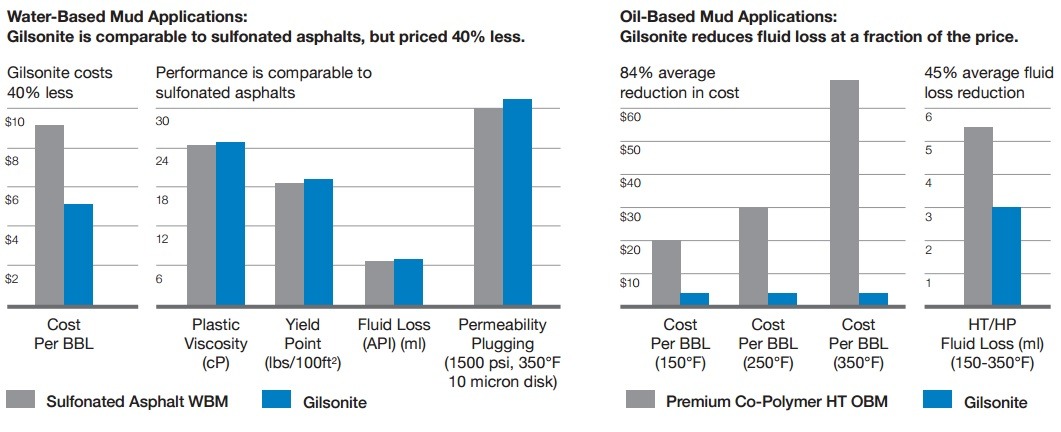
- In Oil-Based Muds (OBM): Gilsonite acts as a hydrocarbon-compatible FLC agent. Its high softening point (160–220°C) results in up to 45% reduction in fluid loss compared to standard additives.
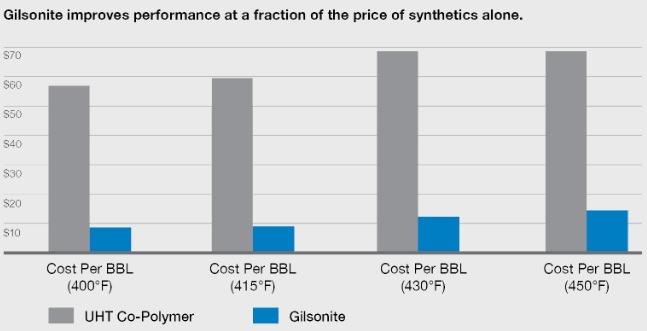
- In Synthetic-Based Muds (SBM): Gilsonite reduces costs by up to 80% compared to premium UHT co-polymers, while delivering equivalent or superior fluid loss performance.
- In Water-Based Muds (WBM): Treated (sulfonated or micronized) Gilsonite grades disperse effectively in aqueous systems, providing competitive fluid loss control. Typical concentration: 3–8 lb/bbl.
2. Shale Stabilization
Gilsonite is scientifically proven to minimize borehole collapse in formations containing water-sensitive and sloughing shales. An independent evaluation published in Offshore Magazine verified that water-based muds treated with naturally occurring Gilsonite exhibited either marked improvement or equal performance compared to sulfonated asphalt across lignite/lignosulfonate, KCl, PHPA, and lime-based drilling fluid systems — tested on a triaxial tester under simulated downhole conditions of stress and fluid flow at temperatures up to 275°F.
Gilsonite’s shale stabilization mechanism is physical rather than chemical: particles penetrate micro-fractures and pore throats, forming a physical seal that prevents filtrate invasion into water-sensitive shale formations. This physical coating mechanism is more durable than purely chemical inhibitors in long-interval shale sections.
3. Wellbore Wall Cake Development
Gilsonite contributes to the formation of a thin, tight, and strongly adherent filter cake on the wellbore wall:
- Reduces permeability of the filter cake
- Prevents excessive filtrate invasion
- Maintains wellbore gauge and reduces washout in soft formations
4. Differential Pressure Sticking Prevention
By sealing permeable zones and reducing filtrate invasion, Gilsonite significantly reduces the risk of differential pressure sticking — one of the most costly non-productive time (NPT) events in drilling operations:
- Documented cases of Gilsonite-based fluid systems saving up to $1 million per well by eliminating differential sticking incidents
- Particularly effective in high-permeability sands and carbonates
5. Lubricity Enhancement
Gilsonite improves the lubricity of drilling fluids, reducing torque and drag in highly deviated and horizontal wells, extended-reach drilling (ERD), and deepwater drilling operations. Research using hydrophilic Gilsonite nanoparticles (HGNs) in water-based mud confirmed that the addition of HGNs decreases yield point by up to 70% while simultaneously improving thermal and chemical stability — a critical combination for HPHT horizontal well applications (ScienceDirect, 2019).
6. Depleted Sand Sealing
Gilsonite acts as a bridging agent to seal depleted or low-pressure sands, preventing fluid invasion and maintaining wellbore pressure integrity during drilling through low fracture gradient zones.
7. Lost Circulation Control (LCM)
Beyond fluid loss control in normal formations, Gilsonite drilling fluid additive functions as a primary Lost Circulation Material (LCM) in severe thief zones, natural fractures, and cavernous formations — a distinctly different and more critical application than standard FLC.
When drilling encounters a thief zone, drilling fluid is lost entirely into the formation rather than forming a filter cake. Gilsonite particles — particularly granulated and lump grades — physically bridge and plug fractures, vugs, and high-permeability channels, restoring circulation without the need for costly remedial operations:
- Granulated Grade (0.5–5 mm): Primary LCM for natural fractures and fissures in carbonate and naturally fractured reservoirs
- Lump Grade (2–50 mm): Severe lost circulation in cavernous formations and large vug systems
- Blended approach: Combining lump, granulated, and micronized grades creates a particle size distribution that bridges across a wide range of fracture apertures simultaneously — the most effective approach for mixed-severity lost circulation
A key advantage of Gilsonite as LCM over conventional materials (calcium carbonate, mica, fibrous LCM) is its hydrocarbon solubility: in OBM systems, Gilsonite LCM partially softens and deforms at bottomhole temperature, conforming to irregular fracture geometries and creating a more effective seal than rigid mineral particles. This thermal deformation behavior is unique to asphaltite-based LCMs and explains their superior performance in carbonate thief zones.
Gilsonite Drilling Fluid Additive in Deepwater Drilling
Deepwater drilling presents some of the most demanding fluid engineering challenges in the oilfield — narrow mud weight windows, low fracture gradients, hydrate risk, ultra-low bottomhole temperatures near the mudline, and extreme HPHT conditions at total depth. Gilsonite drilling fluid additive addresses several of these simultaneously:
- Narrow mud weight window management: Gilsonite’s low specific gravity (1.04–1.10 g/cm³) helps maintain slurry density within tight operational windows between pore pressure and fracture gradient — critical in deepwater where this window can be as narrow as 0.5–1.0 ppg
- Low fracture gradient protection: Gilsonite particles deposit on weak formation faces and natural fractures before they propagate, acting as a preventive FLC barrier in the upper section of deepwater wells where fracture gradients are very low
- SBM cost reduction: Deepwater wells almost universally use synthetic-based mud. Gilsonite reduces SBM additive costs by up to 80% vs. UHT co-polymers — a significant saving on deepwater well economics where mud costs are a major budget line
- Compatibility with deepwater SBM formulations: Fully compatible with ester, olefin, and paraffin-based synthetic fluids at all deepwater temperatures
Gilsonite Drilling Fluid Additive in Horizontal & Extended-Reach Wells
Horizontal and extended-reach drilling (ERD) wells present unique fluid challenges that Gilsonite is specifically well-suited to address:
Differential Sticking in Long Horizontal Sections
In horizontal wells, the drill string rests on the low side of the wellbore due to gravity, maximizing contact area with permeable formations. This dramatically increases differential sticking risk — the single most expensive NPT event in horizontal drilling. Gilsonite drilling fluid additive reduces this risk through two mechanisms: reducing filtrate invasion (less differential pressure buildup) and improving lubricity (lower coefficient of friction between drill string and filter cake).
Torque and Drag Reduction in ERD Wells
Extended-reach wells with horizontal displacements exceeding 5–10 km face severe torque and drag limitations that can prevent reaching total depth. Gilsonite improves drilling fluid lubricity, directly reducing the coefficient of friction along the drill string contact zone. Field data from ERD operations documents 15–25% torque reduction in Gilsonite-treated mud systems compared to untreated base fluids.
Shale Stabilization Across Long Lateral Sections
Horizontal wells drilled through shale formations — particularly in unconventional tight oil and gas plays — expose long intervals of reactive shale to drilling fluid contact. Gilsonite’s physical sealing mechanism (micro-fracture and pore throat plugging) is particularly effective in this application because it does not rely on ionic inhibition that can be diluted or displaced over long contact times. The physical coating remains intact throughout the lateral section, maintaining wellbore stability from heel to toe.
Wellbore Strengthening in Horizontal Wells
A specialized application of Gilsonite in horizontal drilling is Wellbore Strengthening (WBS) — a technique used to deliberately increase the fracture gradient of the formation above its natural value. By pumping Gilsonite particles of specific size distributions into a formation micro-fracture and allowing them to bridge and plug the fracture tip, the fracture is sealed and the formation effectively “healed.” This allows the mud weight to be raised above the natural fracture gradient — a critical technique in ERD wells where increasing mud weight is essential to control pore pressure in deeper sections without fracturing shallower exposed sections.
Gilsonite Drilling Fluid Additive — Effect on Mud Rheology
A common engineering concern when adding any solid particle to a drilling fluid is the effect on rheological properties — particularly plastic viscosity (PV), yield point (YP), and gel strengths. Understanding Gilsonite’s rheological impact is essential for proper mud engineering:
| Rheological Parameter | Effect of Gilsonite (OBM) | Effect of Gilsonite (WBM) | Engineering Significance |
|---|---|---|---|
| Plastic Viscosity (PV) | Moderate increase at high concentrations (>15 lb/bbl) | Minor increase — micronized grades | Monitor at high concentrations; dilute if PV exceeds target |
| Yield Point (YP) | Minor increase | Decrease with HGN grades (up to 70%) | HGN grades actively improve YP in WBM — rheological benefit |
| Gel Strength | No significant effect | No significant effect | Gel strength maintained — suspension properties unaffected |
| HPHT Fluid Loss | 45–55% reduction | Competitive reduction | Primary target parameter — consistently improved |
| Emulsion Stability (OBM) | No adverse effect | N/A | Gilsonite is hydrocarbon-compatible — does not destabilize emulsion |
| Filter Cake Thickness | Reduced — tighter cake | Reduced — tighter cake | Thinner cake = less differential sticking risk |
The key engineering insight: at standard concentrations (5–15 lb/bbl OBM, 3–8 lb/bbl WBM), Gilsonite drilling fluid additive improves all target parameters — fluid loss, shale stability, differential sticking — without requiring compensatory adjustments to mud rheology. This “no side effects” profile is a significant operational advantage over synthetic polymer FLC agents, which routinely require rheological adjustment after addition.
Technical Specifications
| Property | Value | Test Method |
|---|---|---|
| Specific Gravity | 1.04–1.10 g/cm³ | ASTM D70 |
| Softening Point | 160–220°C | ASTM D36 |
| Ash Content | Max. 3% | ASTM D271 |
| Moisture Content | Max. 3% | ASTM D95 |
| Solubility in CS₂ | Min. 90% | ASTM D4 |
| Volatile Matter | 60–75% | ASTM D3175 |
| Fixed Carbon | 15–25% | ASTM D3172 |
| Particle Size (D50) | 10–600 microns | API 13A |
Gilsonite Drilling Fluid Additive — Available Grades
RAHA Gilsonite Co. supplies Gilsonite in multiple grades specifically processed for drilling fluid applications:
| Grade | Particle Size | Mud System | Primary Function |
|---|---|---|---|
| Lump Grade | 2–50 mm | OBM / SBM | Lost circulation, cementing |
| Granulated Grade | 0.5–5 mm | OBM / SBM | Fluid loss control, bridging |
| Micronized Grade (100 mesh) | 150 μm | OBM / SBM / WBM | Fluid loss control, filter cake |
| Micronized Grade (200 mesh) | 75 μm | WBM | Shale stabilization, FLC |
| Micronized Grade (325 mesh) | 45 μm | WBM / SBM | HPHT fluid loss control |
| Sulfonated Gilsonite | Powder | WBM | Shale inhibition, FLC |
Performance in Different Mud Systems
Oil-Based Mud (OBM)
Gilsonite is fully compatible with diesel, mineral oil, and synthetic base fluids. It provides FLC without adverse effect on emulsion stability or rheology, and reduces HPHT fluid loss by up to 45%. Recommended concentration: 5–15 lb/bbl.
Synthetic-Based Mud (SBM)
Gilsonite reduces additive costs by up to 80% compared to UHT co-polymers, making it the most cost-effective FLC solution for deepwater and HPHT SBM environments. Compatible with all standard SBM formulations.
Water-Based Mud (WBM)
Sulfonated or micronized treated Gilsonite grades disperse effectively in water, providing combined shale stabilization and fluid loss control. Compatible with KCl, PHPA, lime, and lignosulfonate mud systems. Recommended concentration: 3–8 lb/bbl.
HPHT Performance
In High Pressure / High Temperature (HPHT) drilling environments, Gilsonite’s high softening point (up to 220°C) provides stable fluid loss control at temperatures up to 300°F (149°C), effective bridging and sealing under high differential pressures, and no thermal degradation of filter cake integrity — superior performance compared to conventional FLC additives at elevated temperatures.
Research on hydrophilic Gilsonite nanoparticles (HGNs) in water-based mud at high temperatures confirms improved thermal stability and rheological performance at concentrations as low as 0.5–1.5% by weight — opening new applications for Gilsonite in next-generation HPHT WBM formulations.
HSE Advantages
Gilsonite is a non-carcinogenic, naturally occurring mineral, offering significant HSE advantages over synthetic alternatives:
- ✅ Non-toxic — no adverse health effects during handling
- ✅ Biodegradable — environmentally acceptable in sensitive locations
- ✅ No hazardous reaction products
- ✅ Compliant with North Sea, Gulf of Mexico, and international environmental regulations
- ✅ Preferred over sulfonated asphalt in environmentally sensitive drilling areas
Field Performance Data
| Parameter | Without Gilsonite | With Gilsonite | Improvement |
|---|---|---|---|
| HPHT Fluid Loss | 18–25 mL | 8–12 mL | 45–55% reduction |
| Torque (deviated wells) | Baseline | 15–25% lower | Significant |
| Stuck pipe incidents | High risk | Significantly reduced | NPT eliminated |
| Cost vs. UHT co-polymers | Baseline (100%) | 20% of baseline | 80% savings |
| Borehole enlargement | 15–20% over-gauge | Near-gauge | Significant |
| WBM Yield Point (HGN) | Baseline | 70% reduction | Rheology improved |
Packaging and Logistics
| Package Type | Net Weight | Suitable For |
|---|---|---|
| Multi-Wall Paper Bag | 25 kg | All grades |
| Jumbo Bag | 500–1,000 kg | Field operations |
| Super Sack | 1,000 kg | Bulk rig supply |
| Lump in Jumbo Bag | 500–1,000 kg | Lump grade |
Export Capability:
- FCL (Full Container Load) — 20′ and 40′ containers
- LCL — for smaller volumes
- Bulk shipment — available for large contracts
- 🇦🇪 Stocked in Dubai (Jebel Ali Port) — fast delivery to Middle East, Africa & South Asia
- 🇹🇷 Stocked in Mersin, Turkey — fast delivery to Europe, Mediterranean & Black Sea markets
Standard documentation: COA, MSDS/SDS, API 13A compliance, SGS/Intertek inspection on request, REACH compliance for European markets.
Gilsonite Drilling Fluid Additive vs. Other Drilling Additives — Complete Comparison
Drilling engineers select fluid additives based on five criteria: fluid loss performance, shale stabilization, HSE profile, operational simplicity, and cost. The table below shows how Gilsonite drilling fluid additive compares to the most commonly used alternatives:
| Feature | Gilsonite | Sulfonated Asphalt | Synthetic Polymers | Graphite | Diesel/Mineral Oil |
|---|---|---|---|---|---|
| Fluid Loss Control (OBM) | Excellent | Poor | Good | Moderate | Good |
| Fluid Loss Control (WBM) | Excellent | Excellent | Good | Moderate | Not applicable |
| Shale Stabilization | Excellent | Excellent | Good | Poor | Poor |
| Differential Sticking Prevention | Excellent | Good | Moderate | Good | Good |
| Lubricity Enhancement | Good | Moderate | Poor | Excellent | Excellent |
| HPHT Performance | Excellent | Moderate | Variable | Good | Poor |
| OBM & WBM Compatibility | Both systems | WBM only | WBM only | Both | OBM only |
| HSE / Environmental | Non-toxic, natural | Chemical load | Synthetic — restrictions apply | Good | Regulated |
| Cost | Low | Medium | High | Medium | Medium |
| WBM Cost vs. Sulfonated Asphalt | 40% cheaper | Baseline | Higher | Similar | N/A |
Why Gilsonite Outperforms Synthetic Alternatives
Gilsonite drilling fluid additive delivers a combination of properties that no single synthetic alternative can replicate:
- Dual system compatibility: Gilsonite is the only FLC additive that performs effectively in both OBM and WBM — eliminating the need for separate additives for different mud systems on the same drilling program.
- Physical shale sealing: Unlike chemical inhibitors that rely on ionic interaction, Gilsonite physically coats micro-fractures and pore throats — providing more durable shale stabilization in long shale intervals.
- Natural hydrocarbon chemistry: Gilsonite’s asphaltene-rich chemistry makes it naturally compatible with OBM base fluids — no chemical treatment required, no compatibility testing needed.
- 40% cost advantage vs. sulfonated asphalt in WBM applications — with equal or better performance confirmed by independent laboratory evaluation.
- 80% cost savings vs. UHT co-polymers in SBM applications — making it the most economical high-performance FLC solution for synthetic-based mud systems.
- Environmentally preferred: As environmental regulations in offshore and sensitive-area drilling become stricter, Gilsonite’s natural, non-toxic, biodegradable profile is an increasing operational advantage — especially in North Sea, West Africa, and Southeast Asia offshore operations.
Engineering Summary: For drilling engineers managing fluid loss, shale instability, and differential sticking across multiple mud systems and well environments, Gilsonite drilling fluid additive offers the broadest performance envelope of any single natural additive — at the lowest total cost of ownership. No synthetic alternative delivers fluid loss control, shale stabilization, and differential sticking prevention simultaneously across both OBM and WBM at comparable cost.
Quality Assurance
Every shipment is tested and certified against API 13A and ASTM standards. Full documentation: COA, MSDS/SDS, SGS/Intertek inspection on request, REACH Compliance for European markets. View all oil and gas applications →
Recent Scientific Advances in Gilsonite Drilling Fluid Additive Technology
Research into nano-scale and functionalized Gilsonite grades is expanding the performance envelope of this proven Gilsonite drilling fluid additive in next-generation mud systems:
Hydrophilic Gilsonite Nanoparticles (HGNs) in WBM
A peer-reviewed study (ScienceDirect) demonstrated that hydrophilic Gilsonite nanoparticles (HGNs), produced by acid functionalization of natural Gilsonite and ball-milled to an average particle size of 229–356 nm, significantly improve water-based drilling mud performance at high temperatures. Key findings: yield point reduced by 70%, thermal stability improved, and rheological properties enhanced. This research opens commercial pathways for Gilsonite drilling fluid additive in HPHT WBM applications where conventional micronized grades face limitations.
Gilsonite as a Mechanically Stable Plugging Agent
Research published in Minerals (MDPI, 2024) on advanced shale mechanical inhibitors confirms that Gilsonite-based materials remain effective for plugging larger formation pore throats and microfractures — with best results achieved when combined with complementary bridging agents of different particle sizes to optimize the bridging process across a range of pore throat diameters.
Market Validation of Gilsonite Drilling Fluid Additive Performance
The global Gilsonite Asphaltic Fluid Loss Additive market reached USD 328 million in 2024 and is forecast to grow at 5.7% CAGR through 2033, reaching USD 542 million. Major oilfield service companies including SLB, Halliburton, and Scomi actively use Gilsonite drilling fluid additive in their operations worldwide — confirming industry-wide validation of its performance and reliability.
Gilsonite Drilling Fluid Additive vs. Sulfonated Asphalt
Sulfonated asphalt is the most direct competitor to Gilsonite drilling fluid additive in WBM shale stabilization and fluid loss control. The independent evaluation published in Offshore Magazine provides the most authoritative comparison:
| Property | Gilsonite Drilling Fluid Additive | Sulfonated Asphalt (Synthetic) |
|---|---|---|
| Origin | Natural mineral | Synthetic processed product |
| Shale Stabilization (WBM) | Equal or better performance | Standard benchmark |
| Fluid Loss Control | Equal or better performance | Standard benchmark |
| HSE Profile | Non-toxic, biodegradable | Sulfonation adds chemical load |
| Environmental Regulations | Preferred in sensitive areas | Restricted in some jurisdictions |
| Cost | Lower | Higher |
| OBM Compatibility | Excellent — natural hydrocarbon | Limited |
| Temperature Stability | Up to 220°C softening point | Lower thermal stability |
Conclusion: Independent laboratory evaluation confirms that Gilsonite drilling fluid additive matches or outperforms sulfonated asphalt in shale stabilization and fluid loss control across all four major WBM systems tested — while offering superior HSE profile, lower cost, and better OBM compatibility. For applications in environmentally sensitive drilling areas (North Sea, offshore, deepwater), Gilsonite is the preferred choice over sulfonated asphalt.
Related Products & Applications
- Gilsonite in Oil Well Cementing — low-density slurry design and lost circulation control
- Bentonite in Drilling — suspension agent and viscosity builder
- KCL in Drilling Fluids — shale inhibitor for WBM systems
- PAC LV — fluid loss control for WBM
- Gilsonite Price Guide 2026 — current rates by grade and mesh size
Frequently Asked Questions About Gilsonite Drilling Fluid Additive
What is Gilsonite drilling fluid additive used for?
Gilsonite drilling fluid additive is used for fluid loss control (FLC), shale stabilization, differential pressure sticking prevention, lubricity enhancement, and depleted sand sealing. It is effective in oil-based (OBM), water-based (WBM), and synthetic-based (SBM) mud systems, and has been used in commercial drilling operations since the 1960s.
What concentration of Gilsonite drilling fluid additive is recommended?
Typical concentrations are 5–15 lb/bbl in OBM and 3–8 lb/bbl in WBM. Higher concentrations up to 10 lb/bbl are used in HPHT applications. The exact concentration depends on wellbore temperature, differential pressure, formation type, and target fluid loss specification.
How does Gilsonite drilling fluid additive control fluid loss?
Gilsonite particles deposit on the wellbore wall and within the filter cake, reducing cake permeability and preventing excessive filtrate invasion. In OBM, its hydrocarbon chemistry provides natural compatibility with the base fluid, forming a stable low-permeability filter cake. In WBM, sulfonated or micronized grades disperse in water and provide equivalent sealing performance.
Can Gilsonite drilling fluid additive be used in water-based mud (WBM)?
Yes. Sulfonated and micronized Gilsonite grades (200 and 325 mesh) are specifically processed for WBM compatibility. Independent evaluation published in Offshore Magazine confirmed that WBMs treated with Gilsonite match or outperform sulfonated asphalt in shale stabilization across KCl, PHPA, lignite/lignosulfonate, and lime-based mud systems.
What is the difference between Gilsonite drilling fluid additive and sulfonated asphalt?
Both are used for shale stabilization and fluid loss control in WBM. Gilsonite is a natural mineral requiring minimal processing; sulfonated asphalt is chemically modified. Independent testing confirms Gilsonite equals or outperforms sulfonated asphalt in performance while offering superior HSE profile, lower cost, and better OBM compatibility. In environmentally sensitive areas, Gilsonite is the preferred choice.
Does Gilsonite drilling fluid additive work in HPHT wells?
Yes. Gilsonite grades with softening points up to 220°C provide stable performance at temperatures up to 300°F (149°C). For ultra-HPHT applications, hydrophilic Gilsonite nanoparticles (HGNs) have demonstrated improved thermal stability and rheological performance in WBM in peer-reviewed research (ScienceDirect, 2019).
What particle size of Gilsonite drilling fluid additive is used for fluid loss control?
Micronized grades are the primary choice: 100 mesh (150 μm) for OBM/SBM, 200 mesh (75 μm) for WBM shale stabilization and FLC, and 325 mesh (45 μm) for HPHT fluid loss control. Granulated grades (0.5–5 mm) are used for lost circulation and bridging in OBM/SBM systems.
Is Gilsonite drilling fluid additive environmentally safe?
Yes. Gilsonite is a non-toxic, naturally occurring mineral with no hazardous reaction products. It is biodegradable and compliant with North Sea, Gulf of Mexico, and international environmental drilling regulations — actively preferred over sulfonated asphalt in environmentally sensitive drilling areas.
Contact RAHA Gilsonite Co.
For technical data sheets, API 13A compliance documentation, grade selection assistance, and competitive pricing for your specific drilling program:
- 📧 info@gilsoniteco.com
- 📱 WhatsApp: +905395277445
- 🌐 Submit a Technical Enquiry →
RAHA Gilsonite Co. · Dubai · Ankara · API 13A Compliant Supplier · FOB Mersin
