Caustic soda — sodium hydroxide, NaOH — is the additive that sets the chemical environment every other product in a water-based mud depends on. Thinners will not dissolve without it, polymers underperform below their working pH, and the drill string corrodes faster. RAHA Gilsonite Co. supplies drilling-grade caustic soda in flake and pearl form at 98.5 per cent minimum NaOH, with a batch certificate of analysis on every shipment.
What caustic soda does in a water-based drilling fluid
Caustic soda is not a viscosifier, a weighting agent or a fluid loss additive. It does one thing — it raises and holds the alkalinity of the mud — and almost everything else in the system depends on that one thing being right.
1. It sets and holds the pH of the system
Most water-based muds are run between pH 9.5 and 10.5. Below that window, thinners stop working and corrosion accelerates; well above it, some shales disperse rather than stay intact. Caustic soda is how that window is reached and how it is held through a shift, because pH falls continuously as the mud picks up acid gases, formation water and drilled solids.
On the mud report, alkalinity is carried as three figures: Pm, the phenolphthalein alkalinity of the whole mud; Pf, the phenolphthalein alkalinity of the filtrate; and Mf, the methyl orange alkalinity of the filtrate. Pf and Mf read together tell the engineer whether the alkalinity in the system is hydroxide, carbonate or bicarbonate — which decides whether more caustic is the right answer or the wrong one.
2. It makes lignosulphonate and lignite thinners work at all
This is the function most often left out. Lignite and lignosulphonate deflocculants are only sparingly soluble in neutral water. They require a high-pH environment to disperse and to function as thinners, which is why caustic soda is mixed with them rather than merely alongside them — causticised lignite is lignite that has been reacted with caustic soda for exactly this reason.
If a mud is flocculating and the thinner is not holding the rheology down, the pH is the first thing to check, not the thinner concentration. Adding more lignosulphonate to a system that has drifted below its working pH treats the symptom and wastes the product.
3. It precipitates magnesium out of hard make-up water and seawater
Calcium and magnesium ions flocculate clays, interfere with polymers and drive up filtrate. Caustic soda raises the pH high enough to precipitate magnesium as magnesium hydroxide, taking it out of solution. This is the main reason caustic appears in the chemical list of any offshore or hard-water operation. Calcium is a separate problem with a separate answer, covered in the next section.
4. It lets polymers hydrate and perform
Polyanionic cellulose and carboxymethyl cellulose both work best in an alkaline system. At controlled pH their carboxyl groups stay dissociated, the chains extend in solution, and the polymer delivers the filtrate control it was bought for. In an under-alkaline mud the same tonnage of PAC LV or CMC gives measurably less.
5. It neutralises acid gases entering the mud
Carbon dioxide and hydrogen sulphide both enter the mud from the formation and both drive the pH down. Caustic soda neutralises them and restores alkalinity. It should be said plainly that caustic soda is not itself a hydrogen sulphide scavenger — a zinc-based scavenger does that job — but holding the pH high keeps sulphide in its ionic form rather than as free, volatile hydrogen sulphide, which is why pH control is the first line of defence in any sour well.
6. It slows corrosion of the drill string
Steel corrodes slowly in alkaline conditions and rapidly in acidic ones. Keeping the mud above roughly pH 10 is the cheapest corrosion control available on a rig, and it protects the bit nozzles and pump fluid ends as much as the pipe.
Caustic soda or soda ash: which contaminant each one treats
These two products are routinely confused, and using the wrong one makes the problem worse rather than better. They are not interchangeable. The rule is simple enough to keep on the mud report.
| Problem in the mud | Treat with | Why |
|---|---|---|
| Low pH, low alkalinity | Caustic soda | Raises hydroxide alkalinity directly without adding carbonate to the system. |
| Calcium contamination | Soda ash | Carbonate precipitates calcium as calcium carbonate. Caustic soda alone will not remove calcium and simply raises pH. |
| Magnesium contamination, seawater | Caustic soda | High pH precipitates magnesium hydroxide. Soda ash is not effective on magnesium. |
| Cement or lime contamination | Sodium bicarbonate or SAPP | The mud is already over-alkaline and loaded with calcium. Adding caustic soda here makes the problem worse. |
| Carbonate and bicarbonate build-up | Lime or gypsum | Calcium is needed to precipitate the carbonate. Caustic soda converts bicarbonate to carbonate but does not remove it. |
A practical consequence: caustic soda is an alkalinity tool, not a general contamination cure. Read Pf and Mf before treating, because the same low-pH symptom can have opposite correct answers.
Flakes or pearls: how the two forms differ
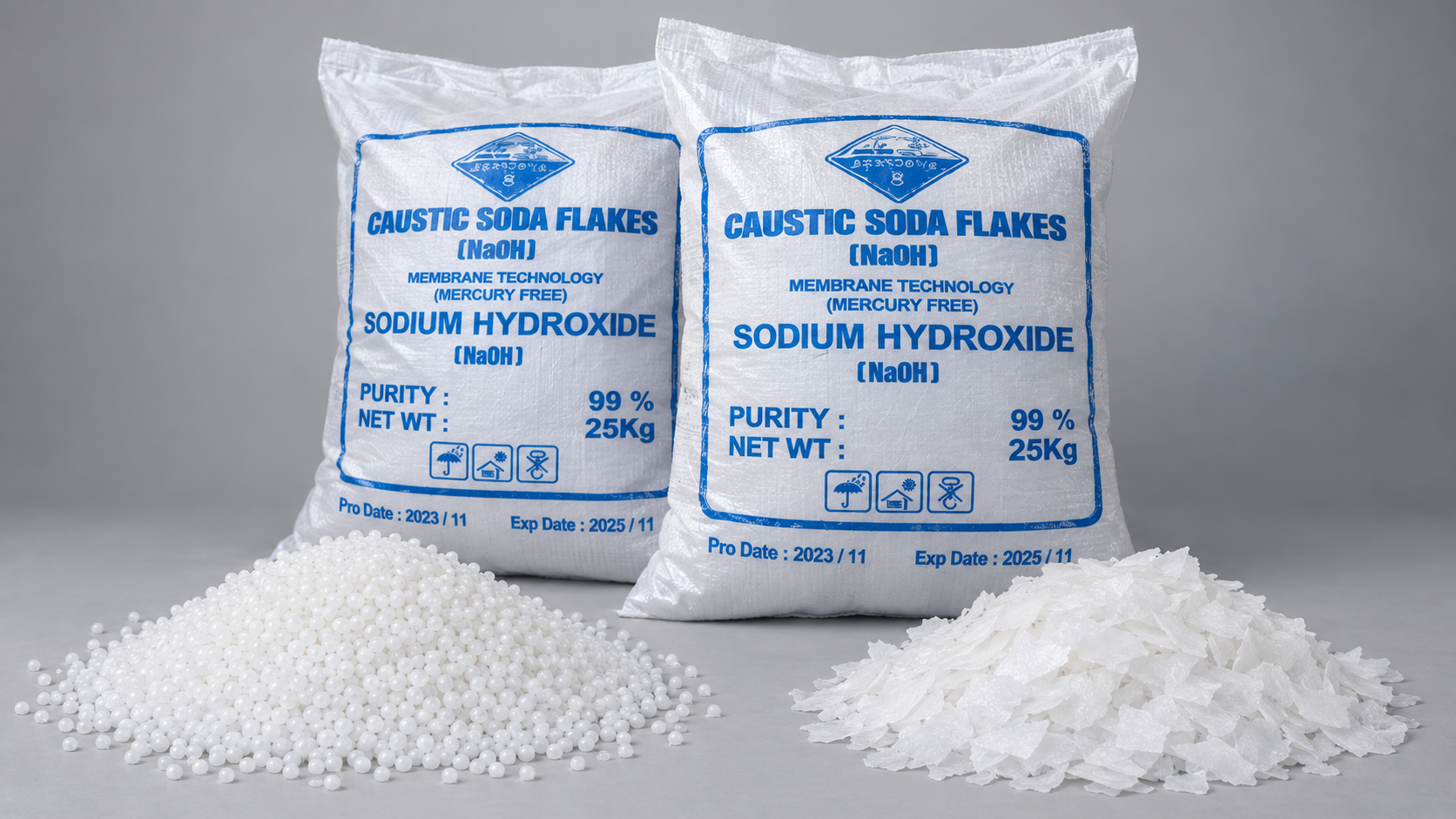
Caustic soda flakes and caustic soda pearls — also called prills or beads — are the same chemical at the same purity. Nothing about the mud chemistry changes between them. The choice is entirely about handling at the mixing hopper and about the climate the material has to be stored in.
In drilling, flake is the form normally supplied and the form most crews are already set up to handle. Pearls are available on request, usually where dust control at an open hopper is the priority or where the material has to be stored in a humid climate.
| Property | Flakes | Pearls |
|---|---|---|
| Appearance | Thin, irregular white flakes | Small, near-spherical white beads |
| Dust generated | Higher — flakes fracture and generate caustic dust when poured | Markedly lower, which matters most at an open mixing hopper |
| Flow and handling | Can bridge and clump in hoppers and feeders | Free-flowing, easier to pour evenly and to meter |
| Dissolution rate | Faster — more surface area per kilogram | Slightly slower, usually irrelevant at normal mixing rates |
| Behaviour in humid climates | More prone to caking into a solid mass in a damaged bag | More tolerant, though both are hygroscopic and both need sealed storage |
| Usually chosen for | Established operations, bulk consumption, lowest cost per tonne | Crews prioritising dust control and clean handling, humid regions |
Both forms are supplied against the same purity. If the specification names one form, state it in the enquiry, because it affects packing and lead time rather than price alone.
Specification: caustic soda flakes and pearls 98.5–99%
The figures below are taken from our data sheet for drilling-grade caustic soda. Both forms are supplied against this same specification, because flakes and pearls differ in physical form only and not in chemistry or purity. Every consignment ships with a certificate of analysis for that batch.
| Tested property | Limit | Value |
|---|---|---|
| NaOH concentration | Min | 98.50% |
| Sodium carbonate (Na2CO3) | Max | 0.40 wt% |
| Sodium chloride (NaCl) | Max | 200 ppm |
| Sodium sulphate (Na2SO4) | Max | 200 ppm |
| Chlorate (NaClO3) | Max | 10.0 ppm |
| Iron (Fe) | Max | 3.0 ppm |
| Ferric oxide (Fe2O3) | Max | 8.0 ppm |
| Mercury (Hg) | — | Not detected |
| Nickel (Ni) | Max | 5.0 ppm |
| Aluminium (Al) | Max | 2.0 ppm |
| Arsenic (As) | Max | 0.05 ppm |
| Cadmium (Cd) | Max | 0.10 ppm |
| Copper (Cu) | Max | 2.0 ppm |
| Lead (Pb) | Max | 10.0 ppm |
| Manganese (Mn) | Max | 4.0 ppm |
| Hardness as calcium (Ca) | Max | 3.0 ppm |
| Zinc (Zn) | Max | 5.0 ppm |
Sodium carbonate content is the figure to watch for a mud application. Carbonate carried in with the caustic adds to the carbonate load the system is already fighting, which is why a drilling grade is held to a tighter limit than a general industrial grade.
Physical properties
| Property | Value |
|---|---|
| Appearance | White solid, odourless |
| Molecular weight | 40 g/mol |
| Melting point | 323 °C |
| Boiling point | 1388 °C |
| Specific gravity | 2.13 (water = 1) |
| pH of 1% solution | 13.5 |
| Solubility in water | Readily soluble in cold water, strongly exothermic |
| Hygroscopic | Yes — absorbs moisture and carbon dioxide from air |
Treating rates and how to add it to the system
Caustic soda is dosed to a pH target, not to a fixed concentration, so a treating rate is a starting point rather than a recipe. As an order of magnitude, routine maintenance of an active water-based system usually falls between 0.1 and 0.5 pounds per barrel, while building pH on a fresh mud or recovering from acid gas or hard-water contamination can take considerably more. The correct figure is whatever brings Pf into the range the mud programme specifies, measured rather than assumed.
Adding it correctly
Add caustic soda slowly through the mixing hopper with the mud pump circulating, never as a dump into a static pit. Dumping produces a slug of extremely high pH that flocculates clay locally and can shock polymers before it disperses. Where accuracy matters, or where the addition is large, pre-dissolve the caustic in a separate mixing tank of fresh water and meter the solution in.
Do not add caustic soda through the same hopper as an acid-gas scavenger or an acidic product in the same operation. Allow the system to circulate and take a reading between treatments.
Mixing safely: the rule that matters most
Always add caustic soda to water. Never add water to caustic soda. Dissolving sodium hydroxide releases a large amount of heat, and water poured onto solid caustic can boil locally and spit a concentrated alkaline solution back out of the vessel. The order of addition is the single most important handling instruction for this product, and it is the one most often got wrong by crews who have not handled it before.
Caustic soda is classified as a corrosive solid. Contact with the eyes can cause corneal damage; contact with skin causes burns that penetrate deeply and are often not felt immediately. Dust irritates and burns the respiratory tract.
Minimum precautions at the mixing point
-
Personal protection
Splash goggles and face shield, chemical gauntlets, apron or chemical suit, and a dust respirator when handling the solid in the open.
-
Eyewash and shower
A working eyewash station and safety shower within reach of the mixing hopper, checked before the job rather than after an incident.
-
Ventilation
Local exhaust or open-air mixing so airborne dust stays below exposure limits. Do not breathe the dust.
-
First aid
Flush eyes or skin with plenty of water for at least 15 minutes, removing contaminated clothing while flushing, and get medical attention immediately.
A full safety data sheet is supplied with every shipment and should be read by everyone who will handle the material. The summary above is not a substitute for it.
Caustic soda and aluminium: a warning specific to drilling
Sodium hydroxide attacks aluminium, zinc and tin in the presence of moisture, and that reaction liberates hydrogen gas. On a rig this matters in two places. Where aluminium drill pipe or aluminium downhole components are in use, a high-pH mud will corrode them in a way it does not corrode steel, so the mud programme has to be written around the metallurgy. And in storage or in a confined mixing area, hydrogen generated from caustic in contact with aluminium fittings or containers is a flammable gas in an enclosed space.
Never store or mix caustic soda in aluminium or galvanised vessels. Use steel, polyethylene or lined containers.
Packing, storage and shipping
Packing
Caustic soda is supplied in 25 kg polyethylene-lined bags, palletised and shrink-wrapped, or in 1 MT jumbo bags where handling equipment is available at the destination. Minimum order quantity is one full 20 foot container. Loading is from Jebel Ali or Mersin on FOB, CFR or CIF terms.
Storage
Store dry, under cover, pallets clear of the ground and bag seals intact. Caustic soda is hygroscopic: it absorbs water and carbon dioxide from the air, and a bag left open or damaged will cake into a hard mass that no longer flows and is difficult to dissolve. Keep it away from acids, from aluminium and galvanised metal, and from anywhere water could reach the material. Stock does not degrade chemically in sealed packing — the enemy is moisture, not time.
Shipping classification
Sodium hydroxide, solid, is UN 1823, hazard Class 8 (corrosive), packing group II. The HS code is 2815.11, which covers solid sodium hydroxide. National tariff schedules add further digits, so confirm the full code with your customs broker before shipping.
Frequently asked questions
What does caustic soda do in drilling mud?
It raises and maintains the alkalinity of the mud. That single function does six jobs: it holds the system in its working pH window, it dissolves and activates lignite and lignosulphonate thinners, it precipitates magnesium out of hard water and seawater, it lets cellulose polymers hydrate and control filtrate properly, it neutralises carbon dioxide and hydrogen sulphide entering from the formation, and it slows corrosion of the drill string.
What pH should a water-based drilling mud be kept at?
Most water-based systems are run between 9.5 and 10.5. Below that, thinners lose effectiveness and corrosion accelerates. Well above it, some shales disperse instead of staying intact. The exact target comes from the mud programme for the well, and it is held by reading Pf and Mf rather than by dosing to a fixed rate.
Should I use caustic soda or soda ash?
They treat different problems. Use caustic soda to raise pH and hydroxide alkalinity, and to precipitate magnesium from hard water or seawater. Use soda ash to remove calcium contamination, which caustic soda cannot do. For cement or lime contamination use neither — the mud is already over-alkaline, and sodium bicarbonate or SAPP is the correct treatment.
What is the difference between caustic soda flakes and pearls?
Only the physical form. Both are sodium hydroxide at the same purity and behave identically in the mud. Flakes are thin and irregular, dissolve slightly faster and cost less per tonne, but generate more dust and are more likely to cake in a damaged bag. Pearls are free-flowing beads that produce much less dust and pour more evenly, which matters at an open mixing hopper and in humid climates.
How much caustic soda is used per barrel of drilling mud?
Routine maintenance of an active water-based system is typically 0.1 to 0.5 pounds per barrel, with considerably more needed to build pH on a fresh mud or to recover from acid gas or hard-water contamination. These are starting points only. Caustic soda is dosed to a measured alkalinity target, not to a fixed concentration.
How should caustic soda be added to the mud system?
Slowly through the mixing hopper with the pump circulating. Never dump it into a static pit: that creates a local slug of very high pH that flocculates clay and can shock polymers before it disperses. For large or accuracy-critical additions, pre-dissolve it in a separate tank of fresh water and meter the solution into the system.
Why must water never be added to caustic soda?
Because dissolving sodium hydroxide releases a large amount of heat. Water poured onto solid caustic concentrates that heat at the surface, where it can boil and spit concentrated alkaline solution back out of the vessel. Adding the caustic to the water instead spreads the heat through the whole volume. This is the most important handling rule for the product.
Does caustic soda remove hydrogen sulphide?
Not on its own. A zinc-based scavenger is what removes sulphide from the system. What caustic soda does is hold the pH high enough that sulphide stays in its ionic form rather than existing as free, volatile hydrogen sulphide, which is why pH control is the first line of defence on a sour well and why caustic consumption rises sharply when a sour zone is drilled.
Can caustic soda be used with aluminium drill pipe?
It needs care. Sodium hydroxide attacks aluminium in the presence of moisture and liberates hydrogen gas, so a high-pH mud corrodes aluminium components in a way it does not corrode steel. Where aluminium pipe or downhole components are in use the mud programme has to be written around that metallurgy. Caustic soda should never be stored or mixed in aluminium or galvanised vessels.
What purity of caustic soda is used in drilling fluids?
98.5 per cent minimum NaOH. For a mud application the sodium carbonate limit matters as much as the headline purity, because carbonate carried in with the caustic adds to the carbonate load the system is already managing. Our drilling grade is held to 0.40 wt% maximum sodium carbonate.
Does caustic soda affect PAC and CMC performance?
Yes, substantially. Polyanionic cellulose and carboxymethyl cellulose both perform best in an alkaline system, where their carboxyl groups stay dissociated and the polymer chains extend in solution. In an under-alkaline mud the same tonnage of polymer delivers measurably less filtrate control, so poor polymer performance is often a pH problem rather than a polymer problem.
How should caustic soda be stored?
Dry, under cover, pallets off the ground and bags sealed. It is hygroscopic and absorbs both water and carbon dioxide from the air; an open or damaged bag cakes into a hard mass that will not flow and is hard to dissolve. Keep it away from acids, from aluminium and galvanised metal, and from any source of water. In sealed packing it does not degrade with time.
What is the UN number and hazard class for caustic soda?
Sodium hydroxide, solid, is UN 1823, hazard Class 8 (corrosive material), packing group II.
What is the HS code for caustic soda?
HS 2815.11, which covers sodium hydroxide in solid form. Aqueous solutions fall under 2815.12. National tariff schedules add further digits, so confirm the full code with your customs broker before shipping.
What is the minimum order quantity and how is it packed?
One full 20 foot container. Caustic soda ships in 25 kg polyethylene-lined bags, palletised and shrink-wrapped, or in 1 MT jumbo bags where the destination has the handling equipment. Loading is from Jebel Ali or Mersin on FOB, CFR or CIF terms.
Request a quotation for caustic soda
Tell us the form you need — flakes or pearls — the quantity, the packing and the destination port, and we will confirm the specification, lead time and price. Samples and a certificate of analysis are available on request, and every shipment carries a batch certificate. Independent inspection at loading by SGS, Bureau Veritas, Intertek or the contract surveyor can be arranged at the buyer’s instruction.
Related products: Bentonite for drilling mud · PAC LV · PAC HV · CMC · KCl in drilling
