
Magnesium chloride is sold under one name as two completely different materials, and most buyers are quoted one while budgeting for the other. Hexahydrate flake runs about 47 per cent MgCl2; anhydrous powder runs 99 per cent. A tonne of the second carries twice the magnesium chloride of a tonne of the first, so a price per tonne means nothing until the hydration is settled. RAHA Gilsonite Co. supplies and exports magnesium chloride hexahydrate flake — MgCl2·6H2O, 46.5 per cent minimum — in 25 kg bags and bulk bags, by the container. This page sets out what the 46 per cent figure actually means, what every line of the analysis does in service, where the material is used, and what to send with an enquiry so a firm quotation comes back on the first reply.
Why buy magnesium chloride from RAHA Gilsonite Co.
Search for a magnesium chloride supplier and the results are mostly marketplace listings: a photograph, a price band, and a purity figure with no indication of whether it refers to the flake or to the salt inside it. That ambiguity is not an accident. It is the single easiest way to make an offer look cheaper than it is, and it is the reason two quotations for the same product can differ by a factor of two for no visible reason.
We state the hydration first
Every offer says hexahydrate or anhydrous before it says a price, and the specification on this page is published in full rather than reduced to a single headline number. You can compare our figure against anyone else’s without having to ask what it refers to.
The whole analysis, not the highlights
Calcium, sulphur, sodium, potassium, iron, nitrate and phosphate are all on this page, exactly as the data sheet reports them. Those are the lines that decide whether the material suits a white Sorel board or a dust control programme, and they are the lines most sellers omit.
One desk for the whole order
Calcium chloride, sodium chloride, caustic soda, barite and the drilling polymers ship from the same desk — one consignment, one set of documents, one person to call when something needs answering.
Two routings, not one
We load from Jebel Ali and from Mersin. Magnesium chloride is a heavy, low-value cargo where freight often decides the delivered price, and working both ports means we can tell you which one wins on your route rather than quoting the only one we have.
Technical answers, not brochures
Ask how much flake it takes to make up a 30 per cent anti-icing brine, or what the iron figure means for a white flooring board, and you get the arithmetic rather than a sales sheet.
Inspection welcomed
We arrange independent inspection and sampling at loading by SGS, Bureau Veritas, Intertek or your own surveyor whenever you ask for it.
Specification
This is the data sheet for the grade we supply, reproduced as issued. A magnesium chloride supplier should publish it before you ask, including the trace lines, because those are what separate one 46 per cent flake from another.
| Characteristic | Unit | Typical | Specification |
|---|---|---|---|
| Magnesium chloride, MgCl2 | % | 47.3 | 46.50 min. |
| Magnesium, Mg | % | 11.9 | 11.50 min. |
| Chlorine, Cl | % | 38.2 | 36.00 max. |
| Calcium, Ca | % | 0.01 | 0.01 max. |
| Sulphur, S | % | 0.12 | 0.12 max. |
| Sodium, Na | % | 0.22 | 0.22 max. |
| Potassium, K | % | 0.14 | 0.15 max. |
| Iron, Fe | ppm | 16 | 20 max. |
| Nitrate, NO3 | ppm | 5 | 10 max. |
| Phosphate, PO4 | ppm | <1 | 1 max. |
| Identification | Value |
|---|---|
| Chemical formula | MgCl2·6H2O |
| CAS number, hexahydrate | 7791-18-6 |
| HS code | 2827.31 |
| Appearance | White to off-white flake |
| Solution pH, 5% at 20 °C | Approximately 5 to 6.5 |
| Melting point | Approximately 117 °C, in its own water of crystallisation |
| Transport classification | Not classified as dangerous goods |
Particle size is not fixed on this data sheet. Flake dimensions matter where the material is dissolved continuously into a brine make-up system, because flake thickness governs how fast it goes into solution. Tell us the dissolving arrangement and we will confirm the flake size against your batch before shipment.
Hexahydrate or anhydrous: what the 46 per cent figure means
This is the question that decides the whole purchase, and it is worth settling before anything else on the page. The specification says 46.5 per cent MgCl2 minimum. Set against a competing offer of 99 per cent, that looks like a quality gap. It is not. It is a hydration difference, and the arithmetic settles it in two lines.
The magnesium figure proves the hydration
Magnesium chloride hexahydrate has a formula weight of 203.3. The MgCl2 part of that weighs 95.2 and the six waters weigh 108.1, so the salt accounts for 46.8 per cent of the crystal and water accounts for the remaining 53.2 per cent. Magnesium itself is 24.3 of the 203.3, or 11.96 per cent.
The analysis reports magnesium at 11.9 per cent. That is the hexahydrate figure almost exactly. Working the same sum in reverse, magnesium is 25.5 per cent of anhydrous MgCl2 by mass, so 11.9 divided by 0.255 gives 46.6 per cent magnesium chloride — which is what the first line of the table reports. The two independent figures agree, and they agree on hexahydrate.
A 99 per cent material is the anhydrous salt, with the water of crystallisation driven off. It is a different product with a different CAS number, a different handling profile and a different price per tonne, and it is manufactured for applications that cannot tolerate water. It is not a better version of this one.
What that costs per tonne of actual magnesium chloride
The comparison that matters is the delivered weight of magnesium chloride, not the delivered weight of material. One tonne of this flake carries about 473 kg of MgCl2. One tonne of a 99 per cent anhydrous grade carries about 990 kg. The anhydrous material therefore replaces a little over two tonnes of flake.
| Comparison | Hexahydrate flake | Anhydrous |
|---|---|---|
| Stated MgCl2 | 46.5% min, 47.3% typical | 99% typical |
| Magnesium content | 11.9% | 25.5% |
| Water of crystallisation | About 53% | None |
| MgCl2 per tonne shipped | About 473 kg | About 990 kg |
| Tonnes for the same MgCl2 | 2.09 | 1.00 |
| Heat on dissolving | Slight cooling | Strongly exothermic |
| CAS number | 7791-18-6 | 7786-30-3 |
So two offers can be compared properly only after both are converted to a price per tonne of contained MgCl2. On that basis the flake is usually the cheaper of the two, because removing the water costs energy and the anhydrous grade carries that cost. The exception is a long freight leg: where the sea and inland haul are expensive relative to the material, paying to ship water starts to tell, and the anhydrous grade can win on landed cost even at twice the price per tonne. We will do that comparison with you for your route rather than asserting an answer.
For almost every bulk application — de-icing, dust control, Sorel cement, brine make-up — the water in the hexahydrate is harmless, because the material is dissolved in water at the point of use anyway. Anhydrous grades exist for applications where water is a contaminant rather than a diluent, and those are a small share of the market.
What the rest of the analysis tells you
After the headline figure, the trace lines are what distinguish one supplier’s flake from another’s. Each one maps onto a specific failure in a specific application.
Iron at 16 ppm
Iron is the figure that decides whether the material can go into a white or light-coloured Sorel cement board, a decorative flooring screed or an artificial stone. Staining appears on cure and cannot be corrected afterwards. At 16 ppm against a 20 ppm limit this grade is comfortably inside what a white board needs.
Sulphur at 0.12 per cent
Sulphate is the classic enemy of magnesium oxychloride cement, because sulphate competes with chloride in the setting reaction and weakens the phase that gives the product its strength. A low sulphur figure is the single most useful line on the sheet for a Sorel cement producer.
Calcium at 0.01 per cent
Here it is almost absent, which is unusual and useful. Calcium chloride contamination in a magnesium chloride feed shifts the freezing curve of a de-icing brine away from where it was designed, and in Sorel cement it interferes with phase formation. At 0.01 per cent it is a non-issue here.
Sodium and potassium, 0.22 and 0.14 per cent
These are inert diluents. They contribute nothing to freezing point depression or to the setting reaction, they occupy weight you have paid freight on, and in a de-icing brine they raise the eutectic rather than lowering it. Both are low here.
Nitrate at 5 ppm
Nitrate matters where the material reaches soil or water — roadside dust control and winter maintenance run-off, in particular, where regulators look at nutrient loading. A single-figure ppm result keeps the material well clear of that conversation.
Phosphate below 1 ppm
The same argument as nitrate, with the added point that phosphate is the nutrient most closely watched in surface water. Reporting it at all is unusual; reporting it below 1 ppm removes a question before it is asked.
Every consignment ships with its own certificate of analysis against this specification. The figures above are the typical values from the grade’s data sheet, not a substitute for the batch certificate, and we do not ask anyone to contract against typicals alone.
De-icing and winter maintenance
Winter maintenance is the largest single market for magnesium chloride, and the reason is temperature. Rock salt is cheaper by a wide margin and does most of the work in most climates, but it stops being effective at around −9 °C in practice, well before its theoretical eutectic. Magnesium chloride keeps working below that.
| Salt | Eutectic temperature | Practical working limit | Typical brine strength |
|---|---|---|---|
| Sodium chloride | −21 °C | About −9 °C | 23% |
| Magnesium chloride | −33 °C | About −15 °C | 27 to 30% |
| Calcium chloride | −51 °C | About −29 °C | 32% |
The eutectic column is the laboratory limit and the practical column is what a highway authority actually plans around. The gap between them is large because a road surface is not a beaker: the brine is diluted by melting snow as it works, traffic throws it off the carriageway, and the surface temperature is not the air temperature. Specifying to the eutectic figure is the most common mistake in winter maintenance procurement.
Anti-icing rather than de-icing
The more interesting use is anti-icing, where brine is applied before the storm rather than solid salt afterwards. A magnesium chloride solution at 27 to 30 per cent is sprayed onto a dry pavement several hours ahead of snowfall. It dries to a salt film that prevents the first layer of ice from bonding to the surface, so what falls can be ploughed off mechanically instead of being melted chemically.
The economics favour it heavily. Anti-icing uses a fraction of the chloride per lane kilometre of a reactive de-icing programme, because it works on the bond rather than on the ice. It also places the chloride where it is wanted instead of letting it bounce and scatter, which is where most of the loss occurs with solid application. Magnesium chloride is well suited to this because it stays in solution at working strength and because it is hygroscopic enough to pull moisture back out of the air, keeping the film active rather than letting it blow away as dust.
The honest limitation
Every chloride de-icer corrodes steel, and magnesium chloride is no exception. Vehicle underbodies, bridge reinforcement and guard rail all see the same chemistry, which is why corrosion-inhibited grades exist and why inhibitor is usually blended at the brine plant rather than bought in the salt.
Concrete deserves a more careful statement than it usually gets. Magnesium chloride is frequently sold as the gentler alternative to calcium chloride, and on steel that claim is defensible. On hardened cement paste it is not straightforward: magnesium can react with the calcium silicate hydrate that gives concrete its strength, converting it to a magnesium silicate hydrate that has far less binding capacity. Published work on this is clear enough that nobody should be told magnesium chloride is harmless to concrete. If the application is a concrete structure rather than asphalt, that belongs in the specification conversation, and we would rather raise it than have it discovered later.
Dust control on unpaved roads
The second large market works on the opposite principle to de-icing. Magnesium chloride is deliquescent: above about 33 per cent relative humidity it pulls water vapour out of the air and holds it. Applied to a gravel haul road or an unsealed rural road, it keeps the surface fines damp, and damp fines stay bound into the road instead of leaving as dust behind every vehicle.
The benefit is not only air quality. The fines in an unsealed road are its binder. Once they blow away, what remains is loose aggregate with nothing holding it together, the surface ravels, and the road needs regrading and regravelling far sooner. Dust suppression is therefore a surface maintenance measure that happens to improve air quality, and the budget case is usually made on the gravel saved rather than on the dust.
Magnesium chloride or calcium chloride for dust control
Both work and both are widely used. Calcium chloride deliquesces at a lower humidity, around 29 to 31 per cent, so it keeps pulling moisture in drier air and is the stronger choice in genuinely arid conditions. Magnesium chloride is the more common choice where humidity is moderate and where cost per treated kilometre decides the programme, and it is generally considered easier on equipment.
Application is normally as a solution rather than as flake, at roughly 25 to 35 per cent, applied after grading so that it penetrates the loosened surface rather than sitting on a crust. A treatment lasts a season in moderate conditions and needs topping up after heavy rain, which washes chloride out of the surface. Dry flake scattered on an untreated road does very little, because it needs moisture to activate and there is none to draw on until the humidity rises.
Magnesium oxychloride cement
Magnesium oxychloride cement, usually called Sorel cement, is made by mixing calcined magnesia with a magnesium chloride solution. It sets without any Portland cement, develops compressive strength faster than Portland, takes pigment well, bonds to timber and other organic fillers that ordinary cement attacks, and resists abrasion. It is used for industrial and decorative flooring, fire-rated wall and ceiling board, grinding wheels, artificial stone and sanded insulation panels.
The ratios are the whole product
Sorel cement is unusually sensitive to proportions. The phase that carries the strength is the one chemists call phase 5, with a composition of 5Mg(OH)2·MgCl2·8H2O. Getting it rather than the weaker phase 3 depends on the molar ratio of magnesia to magnesium chloride, conventionally held near 5 to 1, and on the water to magnesium chloride ratio, conventionally near 13 to 1.
Those are molar ratios, and this is exactly where the hydration question becomes a production problem rather than a commercial one. A formulation written for anhydrous magnesium chloride and batched with hexahydrate flake by the same weight will be badly short of magnesium chloride and badly long on water, twice over. The batch will set, and it will be weak, and the cause is not obvious on the floor. Anyone converting a formulation between the two grades has to redo the batch sheet from the molar ratios, not scale the weights.
Why the trace lines matter here more than anywhere
Sorel cement is the application where the small numbers on the analysis earn their place. Sulphate competes with chloride in the setting reaction and undermines phase 5, so the 0.12 per cent sulphur figure is directly load-bearing. Iron discolours a product that is often sold on its appearance, which is why 16 ppm matters for a white board and would not matter at all for a haul road. Calcium interferes with phase formation and is effectively absent here. A magnesium chloride supplier who publishes only the MgCl2 percentage is withholding the three figures a Sorel cement producer needs most.
Magnesium chloride in drilling and completion
Magnesium chloride is not a routine drilling chemical, and it would be dishonest to present it as one. Sodium chloride, potassium chloride and calcium chloride do almost all of the salt work in drilling fluids. There are two specific situations where magnesium chloride is the right answer, and both are worth knowing because the alternative is an expensive hole problem.
Magnesium-bearing salt sections
Evaporite sequences are not all halite. Bischofite is magnesium chloride hexahydrate as a natural mineral — the same compound as this flake — and carnallite is a mixed potassium and magnesium chloride. Both are far more soluble than halite, and both dissolve readily into a mud that is saturated with sodium chloride but carries no magnesium.
The consequence is a washout. Hole cleaning deteriorates as annular velocity collapses in the enlarged section, logging and casing running become difficult, and the cement job in that interval is compromised before it starts. Saturating the water phase with respect to the magnesium salt as well, which means adding magnesium chloride to the mud, is what prevents it. A mud saturated with sodium chloride alone will still dissolve carnallite and bischofite.
Formation compatibility and brine blending
The second case is compatibility. Where a completion or workover brine will contact a formation water rich in magnesium, blending magnesium into the brine avoids the precipitation that occurs when two incompatible waters meet in the near wellbore region. The damage from that precipitation is permanent and sits exactly where it does the most harm to productivity.
There is a neat symmetry worth noting. Magnesium is precisely what caustic soda is used to remove when a mud is made up on seawater, because magnesium hydroxide precipitation is what lets the system treat out hardness. Magnesium is a contaminant in one context and the designed additive in another — which is why a mud programme that calls for magnesium chloride needs its alkalinity treatment reviewed at the same time rather than left on the default.
Other industries we supply
Magnesium metal production
Electrolytic magnesium production runs on molten magnesium chloride. The feed for that process is the anhydrous salt, since water in the cell feed is destructive, so this hexahydrate flake is a precursor to that route rather than a feed for it.
Agriculture and animal nutrition
Magnesium is an essential plant nutrient and the central atom of chlorophyll, and magnesium chloride is a soluble, fast-acting correction for magnesium deficiency through fertigation or foliar application. Feed applications require a grade certified for that use.
Textile and paper processing
Used as a fire retardant treatment, in sizing and finishing, and as a humectant in paper where a controlled moisture content is wanted in the finished sheet.
Wastewater and process water
Magnesium salts are used in struvite precipitation for phosphorus recovery from wastewater, and as a source of magnesium where a process needs it in soluble form without introducing sulphate.
Refrigeration and heat transfer brines
Magnesium chloride brine is used as a secondary coolant in industrial refrigeration where its freezing curve suits the duty and where its lower corrosivity to equipment than some alternatives is an advantage.
Ceramics and construction products
A binder and setting agent in specialist ceramic and refractory bodies, and in construction products that use the oxychloride system rather than a Portland cement system.
A word on catalyst applications. Magnesium chloride is a well-known support for Ziegler-Natta polyolefin catalysts, and it appears on many sellers’ application lists for that reason. Catalyst work requires the anhydrous salt, prepared to a controlled crystal structure, and water is a catalyst poison in that chemistry. Hexahydrate flake is not a catalyst grade and we will not offer it as one. If that is your application, say so and we will tell you plainly whether we can serve it rather than shipping something that will fail.
Handling and storage
Magnesium chloride hexahydrate is not hazardous, but it is demanding about storage, and almost every complaint about the material traces back to how it was kept rather than how it was made.
| Property | What it means in the warehouse |
|---|---|
| Deliquescent | Above about 33% relative humidity it absorbs water from the air and will eventually dissolve in what it has absorbed. Bags must be kept sealed and off the floor. |
| Cakes on storage | Absorbed moisture bridges the flakes into a solid mass. A caked bag is not spoiled material and dissolves normally, but it has to be broken up before it can be handled. |
| Melts at about 117 °C | It melts in its own water of crystallisation rather than decomposing cleanly. Keep it away from heat sources and out of direct sun in hot climates. |
| Dissolves without heating | Unlike anhydrous magnesium chloride or calcium chloride, the hexahydrate does not release heat on dissolving. Brine make-up needs no cooling and no special sequencing. |
| Mildly acidic in solution | A solution runs around pH 5 to 6.5. Over time it is aggressive to bare mild steel, so brine tanks and lines should be lined, plastic or stainless. |
| Not dangerous goods | No UN number, no hazard class, no segregation requirement. It ships as ordinary cargo. |
Practically, that means a covered dry store, bags kept closed, pallets rather than a concrete floor, and first in first out. Material held in a humid port warehouse through a monsoon will cake; the same material in a closed dry store will not. Where stock has to sit for months in a humid climate, bulk bags with a sealed polyethylene liner hold condition considerably better than open-mouthed packing.
Packing and container loading
| Packing | Description | Suits |
|---|---|---|
| 25 kg bags | Woven polypropylene with an inner polyethylene liner, heat sealed, palletised and shrink wrapped | Manual batching, sites without lifting equipment, Sorel cement production, distribution in smaller lots |
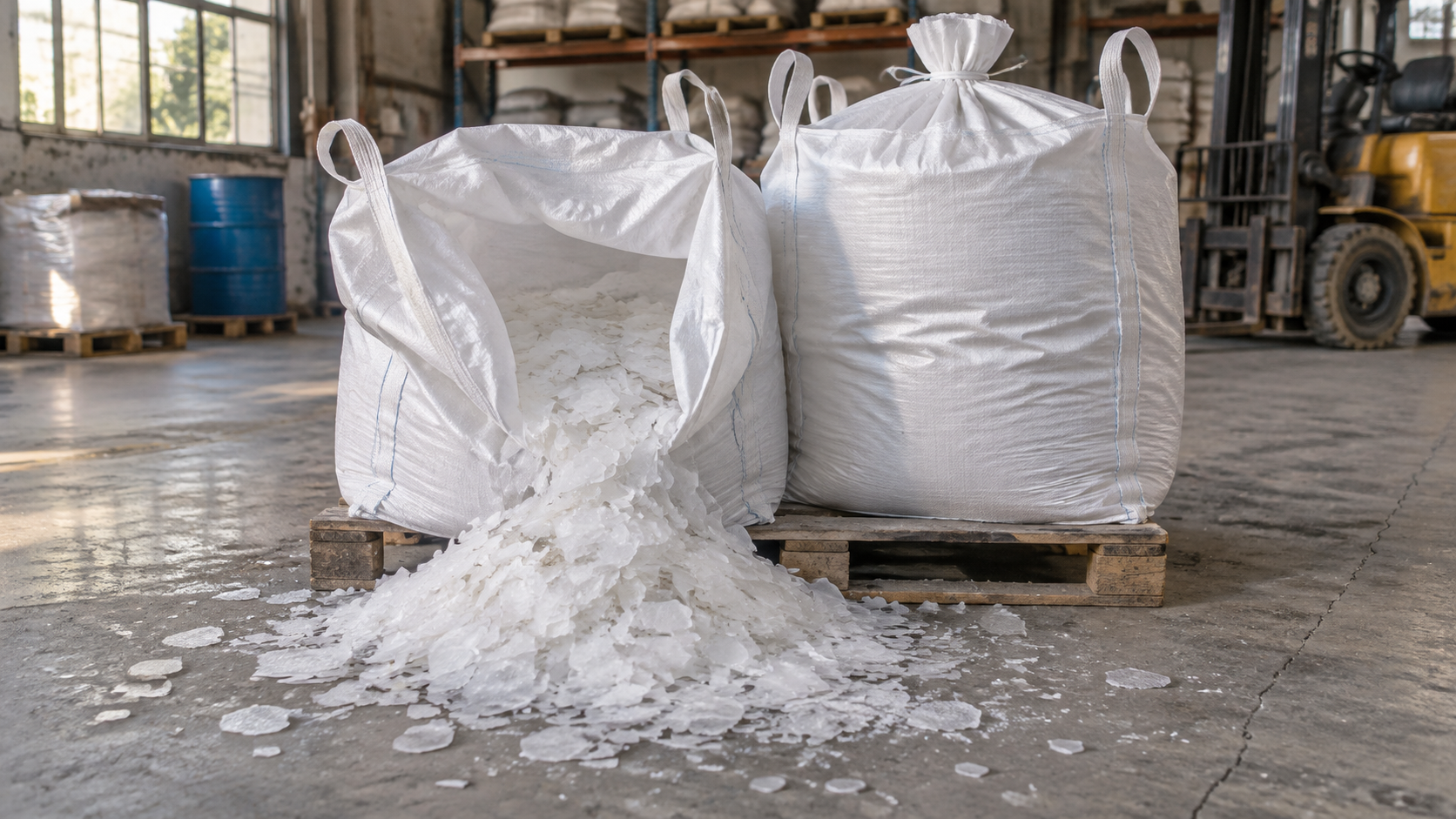
| 1 MT and 1.5 MT bulk bags | Woven polypropylene FIBC with liner, lifting loops, discharge spout to order | Brine plants, dust control programmes, anywhere with a forklift and a dissolving hopper |
Both packings carry a liner, and the liner is not optional for this product. Woven polypropylene alone is not a moisture barrier, and a deliquescent salt behind an unlined bag will cake in transit through a humid leg even if the warehouse at both ends is dry.
Container loading is settled on the proforma invoice, because it depends on the packing chosen and on the carrier’s payload limit for the route rather than on the product alone. Magnesium chloride is dense enough that the weight limit is reached before the space is filled, so a 20 foot container is the practical unit and 40 foot containers are not normally used.
Shipping and commercial terms
| Term | Basis |
|---|---|
| Minimum order | One full 20 foot container |
| Incoterms | FOB, CFR or CIF |
| Loading ports | Jebel Ali or Mersin |
| Payment | 50 per cent by telegraphic transfer in advance, balance agreed with the order |
| Lead time | Confirmed per destination at the time of quotation |
| Documents | Commercial invoice, packing list, bill of lading, certificate of analysis, certificate of origin, insurance certificate on CIF |
Which port gives the better delivered price depends on the destination and on what else is moving in the same consignment. We quote both where both are workable and say which one we would use. For repeat offtake we price the programme rather than the shipment, which is normally worth something on a commodity where freight is a large share of the landed cost.
Quality, documents and inspection
Certificate of analysis per batch
Every consignment ships with its own certificate against the specification on this page, with the actual figures for that batch rather than the typical values.
Independent inspection at loading
We arrange inspection and sampling at loading by SGS, Bureau Veritas, Intertek or the surveyor named in your contract, whenever you ask for it.
Retained samples
Samples are retained against each shipment, so a question raised after arrival can be settled against the material that actually loaded rather than by argument.
Pre-shipment samples
A sample can be sent for approval before the order is confirmed where the application justifies it, particularly for Sorel cement work where trace figures govern the result.
How to get a firm quotation
Most enquiries for magnesium chloride arrive with the quantity and nothing else, which means two more emails before anything useful can be priced. Five lines in the first message avoids that entirely.
| Tell us | Why it changes the offer |
|---|---|
| The application | De-icing, dust control, Sorel cement, oilfield or agriculture. It decides which figures on the analysis have to be held tightly and which are irrelevant. |
| Hexahydrate or anhydrous | If you are comparing our offer against a 99 per cent quotation, say so and we will put both on the same basis rather than leaving you to do it. |
| Quantity and frequency | One container prices differently from a seasonal programme. Winter maintenance volumes in particular are priced better when booked ahead of the season. |
| Packing | 25 kg bags or bulk bags. It affects the price, the container payload and the discharge arrangement at your end. |
| Destination port and Incoterm | Freight is a large share of the landed cost on this product, and the destination decides which of our two loading ports we quote from. |
What to check when the material arrives
Four checks at discharge, before the container leaves, settle almost everything that is ever disputed later.
| Check | What you are looking for |
|---|---|
| Bag condition and liner | Liners intact and seals unbroken. A torn liner on a humid route is the usual cause of caking, and it is visible at discharge. |
| Free-flowing flake | Flake that pours rather than a solid block. Light caking that breaks under hand pressure is normal after a long leg; a bag that has to be cut open is not. |
| Colour | White to off-white. A yellow or brown tint points to iron, and if the material is destined for a white Sorel board that is worth checking against the certificate before use. |
| Dissolve a sample | A known weight in a known volume of water. It should dissolve clear with little residue, and the solution should run mildly acidic rather than neutral or alkaline. |
If anything on that list looks wrong, photograph it at discharge and send it the same day. A retained sample exists for every shipment and a question raised with photographs at discharge is straightforward to settle; the same question raised three months later, after the material has been in your warehouse through a wet season, is not.
Frequently asked questions
The 46 per cent question
Is 46 per cent magnesium chloride low quality?
No. It is the figure a hexahydrate flake is supposed to show. Magnesium chloride hexahydrate is 46.8 per cent MgCl2 by formula, the rest being water of crystallisation, so a result of 46.5 to 47.5 per cent means the crystal is what it should be. A 99 per cent figure refers to the anhydrous salt, which is a different product rather than a better one.
How do I compare a 46 per cent offer against a 99 per cent offer?
Convert both to a price per tonne of contained magnesium chloride. A tonne of hexahydrate flake carries about 473 kg of MgCl2 and a tonne of 99 per cent anhydrous carries about 990 kg, so one tonne of anhydrous replaces a little over two tonnes of flake. On that basis the flake is usually cheaper, except on long freight legs where the cost of shipping the water starts to matter.
How can I tell from the analysis which one I have been offered?
Look at the magnesium figure rather than the magnesium chloride figure. Magnesium is 11.96 per cent of the hexahydrate and 25.5 per cent of the anhydrous salt, so the two are impossible to confuse. The CAS number also differs: 7791-18-6 for the hexahydrate and 7786-30-3 for the anhydrous.
Can I substitute hexahydrate flake for anhydrous in my formulation?
Not by weight. You need roughly 2.1 times the weight of flake for the same magnesium chloride, and you have to subtract the water the flake brings with it from the water in the batch, since the flake is about 53 per cent water. In Sorel cement especially, rework the batch sheet from the molar ratios rather than scaling the weights.
De-icing, anti-icing and dust control
What is the difference between magnesium chloride and calcium chloride for de-icing?
Calcium chloride works to a lower temperature, around −29 °C in practice against about −15 °C for magnesium chloride, and releases heat as it dissolves, which helps it get started on cold ice. Magnesium chloride is usually cheaper per treated kilometre and is widely preferred for anti-icing brine. Where the climate genuinely demands it, calcium chloride is the right answer and we supply that too.
Is magnesium chloride safe for concrete?
It is less corrosive to steel than some alternatives, but it is not harmless to concrete. Magnesium can react with the calcium silicate hydrate that gives hardened cement paste its strength and convert it to a weaker magnesium silicate hydrate. On asphalt this does not arise. On a concrete structure it belongs in the specification discussion, and we would rather say so than let it be found out later.
At what humidity does magnesium chloride start absorbing water?
Around 33 per cent relative humidity at ordinary temperatures. Below that it stays dry; above it, it absorbs moisture continuously and will eventually dissolve in what it has taken up. That is a problem in the warehouse and the whole point of the product on a dust control programme.
What strength brine do I need for anti-icing?
Commercial anti-icing brine is usually 27 to 30 per cent magnesium chloride. Because the flake is about 53 per cent water of crystallisation, you need roughly twice the weight of flake you would need of an anhydrous grade, and the water the flake brings has to be counted in the make-up volume. We will work the figures for your tank and your target concentration if you send them.
Handling and storage
My bags have caked solid. Is the material spoiled?
Almost certainly not. Caking is absorbed moisture bridging the flakes together, and caked material dissolves and performs normally once it is broken up. It is a handling nuisance rather than a quality failure. Keeping bags sealed, off the floor and in a dry covered store prevents it.
Does it get hot when it dissolves?
No, and this is a real difference from the anhydrous grade and from calcium chloride, both of which release considerable heat. The hexahydrate dissolves with a slight cooling effect, so brine make-up needs no cooling, no staged addition and no special sequencing.
Sorel cement, catalysts and drilling
Why does the sulphur figure matter for Sorel cement?
Sulphate competes with chloride in the setting reaction and undermines the 5Mg(OH)2·MgCl2·8H2O phase that carries the strength of magnesium oxychloride cement. A low sulphur result, 0.12 per cent on this grade, is one of the most useful numbers on the sheet for a producer, and it is one of the first a seller leaves off.
Is this grade suitable for a white flooring or board product?
The iron figure says yes. Iron is what discolours a white oxychloride product and the discolouration cannot be corrected after cure. This grade reports 16 ppm against a 20 ppm limit, which is comfortably inside what a white board needs. For a first production run we would send a pre-shipment sample rather than ask you to take that on trust.
Can I use this as a catalyst support?
No. Ziegler-Natta catalyst supports require anhydrous magnesium chloride prepared to a controlled crystal structure, and water is a poison in that chemistry. Hexahydrate flake is not a catalyst grade and we will not offer it as one. Tell us if that is your application and we will give you a straight answer on whether we can serve it.
Where is magnesium chloride used in drilling?
Mainly where the formation itself contains magnesium salts. Bischofite and carnallite are far more soluble than ordinary halite and will dissolve into a mud saturated only with sodium chloride, washing the hole out through that interval. Saturating the water phase with respect to magnesium as well prevents it. It is also used to make a completion brine compatible with a magnesium-rich formation water.
Supply, packing and commercial terms
Is magnesium chloride classified as dangerous goods?
No. It carries no UN number and no transport hazard class, so it ships as ordinary cargo with no dangerous goods declaration and no segregation requirement in the container.
What packing is available and what is the minimum order?
25 kg bags and 1 MT or 1.5 MT bulk bags, both woven polypropylene with a polyethylene liner against moisture. The minimum is one full 20 foot container. We do not ship part-container quantities, because the freight on a part load removes the reason to buy internationally at all.
How many tonnes fit in a container?
The material is dense enough that the payload limit is reached before the space is filled, so a 20 foot container is the practical unit and 40 foot containers are not normally used. The exact tonnage depends on the packing and the carrier’s limit for the route, and is confirmed on the proforma invoice.
What are the payment terms and loading ports?
50 per cent by telegraphic transfer in advance with the balance agreed with the order, FOB, CFR or CIF, loading from Jebel Ali or Mersin. Which port gives the better delivered price depends on the destination, and we say which one we recommend when we quote.
Can magnesium chloride ship with other products?
Yes, and it usually should. It consolidates with calcium chloride, sodium chloride, caustic soda, barite and the drilling polymers into one consignment with one set of documents, which is normally cheaper on freight and always simpler on paperwork.
Request a quotation for magnesium chloride
RAHA Gilsonite Co. is a magnesium chloride supplier to winter maintenance authorities, construction product manufacturers, drilling contractors and industrial buyers worldwide, supplying and exporting hexahydrate flake by the container, with the full analysis published before you contract and a batch certificate on every shipment. Send the application, the quantity, the packing and the destination, and a firm offer comes back on the first reply.
Related products: Calcium chloride supplier · Sodium chloride supplier · Caustic soda supplier · Barite supplier · KCl in drilling · Bentonite for drilling mud
