
Gilsonite Molecular Structure and Functional Groups
The gilsonite molecular structure is a condensed aromatic core carrying nitrogen functional groups, fringed with paraffinic chains, at an average molecular weight near 3,000. That architecture is why the material behaves semi-polymerically, resists free radical oxidation and wets surfaces the way it does. This page sets out what the analytical work established, how component composition shifts across the softening point grades, and which deposit the published figures actually describe.
Published figures for Uintah Basin material. The section on deposits below explains why that distinction matters before any of these values enters a specification.
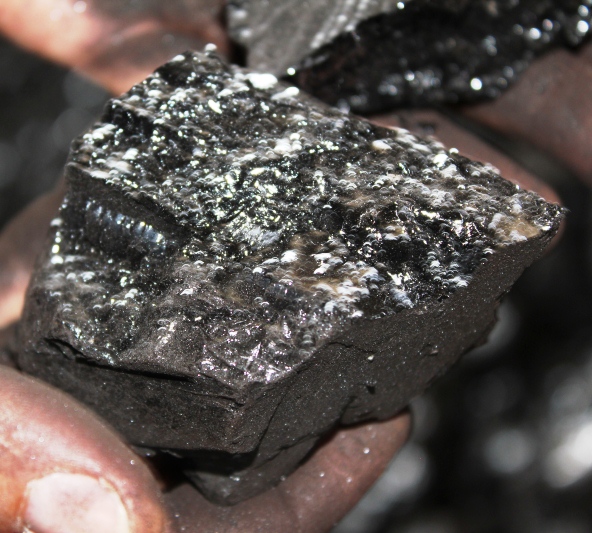
How the structure was established
No single instrument reveals a molecular structure of this kind. The published characterisation of gilsonite rests on a battery of methods, each answering a narrow question, and the picture emerges from reading them together.
| Method | What it determines |
|---|---|
| Nuclear magnetic resonance (NMR) | How much of the hydrogen and carbon sits in aromatic rather than aliphatic environments |
| Fourier transform infrared spectrometry (FTIR) | Which functional groups are present — the nitrogen, phenolic and carbonyl signatures |
| Vapour pressure osmometry (VPO) | Average molecular weight in solution |
| Vacuum thermogravimetric analysis (TGA) | Mass loss against temperature, which indexes thermal stability |
| High-performance liquid chromatography (HPLC) | Separation of the material by polarity into its component families |
| Rapid capillary gas chromatography (RCAP) | The lighter, volatile end of the distribution |
| Solvent fractionation | The asphaltene, resin and oil split described further down this page |
Two of these carry most of the conclusions. NMR together with the hydrogen-to-carbon ratio establishes how aromatic the material is, while FTIR identifies the functional groups hanging off that aromatic core. Everything else fills in detail.
The aromatic core
H/C ratios and NMR both point the same way: a substantial aromatic fraction, with most of the aromatics sitting in stable conjugated systems rather than as isolated rings. The remainder of the molecule consists of long paraffinic chains attached to that core.
Conjugation is the operative word. A conjugated aromatic system delocalises its electrons across the whole ring assembly, and a delocalised system is thermodynamically stable — it has no easy route to react. This is the structural reason gilsonite holds up thermally where a paraffinic material would crack, and why it survives weathering that degrades softer bitumens.
The condensed core also explains the mechanical behaviour covered on the technical advantages page. Stacked aromatic sheets slide past each other poorly, so the material registers penetration zero and fractures rather than flowing.
Nitrogen functional groups
Where nitrogen appears in this material, it appears mainly as three functional groups, and their identity matters more than the raw percentage.
Pyrrole, pyridine and amide
Pyrrole is a five-membered ring where the nitrogen contributes its lone pair into the aromatic system, which makes it weakly acidic rather than basic. Pyridine is six-membered, and its nitrogen lone pair sits outside the ring, available to donate — which makes it basic. Amide groups bring both a carbonyl and a nitrogen into the same site.
Why basic functionality matters
Published work notes that the oxygen content is low relative to the nitrogen, and infers from that ratio that much of the nitrogen carries basic functionality. That inference has two practical consequences.
Basic nitrogen sites adsorb readily onto acidic mineral surfaces, which is the mechanism behind the surface wetting behaviour the material shows — and it is directly relevant to shale stabilisation, where the additive has to interact with a clay surface. Second, basic nitrogen sites act as radical scavengers, which contributes to the resistance to free radical oxidation that keeps the material from hardening further in service.
Phenolic and carbonyl groups are also present. Both are polar, and they add to the adhesion behaviour that makes gilsonite useful in coatings and in asphalt modification.
Porphyrins and the geological fingerprint
Published work describes the stable conjugated aromatic systems in gilsonite as probably porphyrin-like, and that observation connects the chemistry to the origin of the deposit.
Porphyrins are large conjugated macrocycles derived from the chlorophyll and haem of ancient biological material. They survive burial and maturation, which makes them one of the most durable biomarkers in geochemistry. Finding porphyrin-like structures in gilsonite indicates a source rock rich in organic matter — consistent with a hydrocarbon that migrated as a fluid and hardened in place rather than a mineral that crystallised.
Porphyrins also explain a figure that otherwise looks odd on the trace metal analysis. Nickel and cobalt sit at around 40 ppm each, while the sulfide-associated metals — mercury, cadmium, lead — are at or below detection. Nickel and vanadium coordinate into the centre of a porphyrin ring, so an organic deposit concentrates exactly those metals and almost nothing else. The trace metal profile and the molecular structure are telling the same story.
Molecular weight and semi-polymeric behaviour
Published determinations put the average molecular weight of gilsonite near 3,000, which is high relative to other asphalt products and to most synthetic resins.
That figure carries a caveat worth stating. Vapour pressure osmometry measures molecular weight in solution, and asphaltenes associate in solution, so a measured average of this kind partly reflects aggregation rather than individual molecules. The number is useful comparatively — it places gilsonite well above a typical hydrocarbon resin — but it should not be read as a precise molecular formula weight.
What follows from it is the semi-polymeric behaviour the material shows when used as a modifying resin in polymeric and elastomeric systems. At this molecular size the material begins to behave like a low polymer: it entangles, it contributes to melt viscosity disproportionately to its loading, and it modifies a system rather than simply dissolving into it.
Reactivity
Gilsonite is often treated as inert. It is not entirely, and the reactive potential matters to anyone formulating with it.
Researchers have observed both crosslinking and addition-type reactions, and the material reacts with formaldehyde compounds under certain conditions. The phenolic groups that FTIR identifies make the likely site, since phenol-formaldehyde chemistry is well established and a phenolic group embedded in a large aromatic structure remains available to it.
For a formulator this cuts two ways. In a phenolic or formaldehyde-containing system the material can become part of the network rather than remaining a dispersed filler, which may be exactly what is wanted. Where it is not wanted, it is a source of unexpected viscosity build on storage. Either way, trial any formulation that combines gilsonite with formaldehyde chemistry for stability rather than assuming it inert.
Component composition across the softening point grades
The trade grades gilsonite on softening point, and those grades are not arbitrary labels. Each one corresponds to a measurably different composition, which is why a grade change alters behaviour rather than just a number on a certificate.
| Component | 290 °F / 143 °C | 320 °F / 160 °C | 350 °F / 177 °C | 375 °F / 191 °C |
|---|---|---|---|---|
| Asphaltenes | 57 | 66 | 71 | 76 |
| Resins (maltenes) | 37 | 30 | 27 | 21 |
| Oils | 6 | 4 | 2 | 3 |
| Total | 100 | 100 | 100 | 100 |
Read across the table and the grading logic becomes obvious. Asphaltene content climbs from 57 to 76% while resins fall from 37 to 21% and oils all but disappear. Softening point therefore works as a proxy: the buyer is really choosing asphaltene content, and softening point simply indexes it cheaply and repeatably.
Three consequences follow for anyone choosing a grade.
A higher grade brings more of the structure that does the work, so hardness, thermal stability and colour body all strengthen. At the same time the resin fraction falls, and resins are what keep asphaltenes dispersed — so a high grade is less forgiving in a blend and more likely to separate from an unsuitable base. The oil fraction, which is already small, essentially vanishes above 350 °F, which removes what little plasticising effect the material had.
The practical reading: select the lowest grade that meets the requirement rather than the highest available. A 375 °F grade is not a better product than a 290 °F grade, it is a different one, and in a blending application it is often the harder of the two to work with. The chemical characterization page covers the colloidal stability question in more detail.
Solubility, stated precisely
Solubility statements about gilsonite circulate in forms that appear to contradict each other, and the contradiction dissolves once the grade and the fraction are separated.
| Solvent class | Behaviour |
|---|---|
| Aromatic hydrocarbons (toluene, xylene) | Dissolves readily across all grades |
| Chlorinated hydrocarbons | Dissolves readily |
| Aliphatic hydrocarbons | Soluble, but grade-dependent — see the note below |
| Ketones | Limited; dissolves in mixed aromatic solvents containing a ketone component |
| Water, alcohols, acetone | Not soluble |
The aliphatic row is where the apparent contradiction lives, and the table above the solubility table explains it. The operational definition of an asphaltene is the fraction that will not dissolve in n-heptane but will dissolve in toluene. Since asphaltene content runs from 57% at the lowest grade to 76% at the highest, aliphatic solubility necessarily falls as the grade rises. A low grade with 37% resins behaves quite differently in a paraffinic solvent from a high grade with 21%.
So a formulator working in an aliphatic vehicle should not read a general solubility claim and proceed. Specify the grade, and trial it in the actual solvent system at the actual concentration.
Which material these figures describe
Every figure on this page — the molecular weight, the nitrogen functional groups, the component analysis across grades — comes from published work on material from the Uintah Basin in Utah.
Gilsonite occurs in commercial quantity in two places: the Uinta Basin of Utah and Colorado, and the Kermanshah region of western Iran. Researchers have worked overwhelmingly on Utah material, and the chemistry of the two deposits is not identical. Sulfur and nitrogen show the divergence most clearly, which the chemical characterization page sets out in full against our own analysis.
The structural picture — a condensed aromatic core, nitrogen heterocycles, paraffinic fringes, asphaltene content rising with softening point — holds for the material class. Specific numbers do not transfer between deposits. Where a figure governs a formulation or a contract, work from the certificate of analysis for the grade and the deposit you are buying, not from any published value on this page or elsewhere.
What the structure means in a formulation
| Structural feature | What it produces |
|---|---|
| Condensed, conjugated aromatic core | Thermal stability, hardness, penetration zero, deep black mass colour |
| Basic nitrogen heterocycles | Adsorption onto mineral surfaces, surface wetting, radical scavenging |
| Phenolic and carbonyl groups | Adhesion, and reactivity toward formaldehyde chemistry |
| Molecular weight near 3,000 | Semi-polymeric behaviour in polymeric and elastomeric systems |
| Paraffinic fringes on the core | Compatibility with hydrocarbon media; the bridge between core and solvent |
| High asphaltene fraction | Stiffening power, but reduced tolerance of a paraffinic base |
Supply and commercial terms
RAHA Gilsonite supplies lump, powder and micronized grades, selected on softening point, ash and mesh. The full specification carries the physical and thermal data that accompanies the chemistry described here.
| Payment | 50% TT in advance, balance agreed with the order |
|---|---|
| Incoterms | FOB, CFR or CIF |
| Loading ports | Jebel Ali or Mersin |
| Minimum order | One full 20′ container |
| Lead time | Quoted per destination |
| Documentation | Specification sheet, SDS and batch certificate |
Independent inspection at loading can be arranged on request — SGS, Bureau Veritas, Intertek or the surveyor named in your contract. Describe the system you are formulating into and the solvent or base involved, and the grade follows from that.
Frequently asked questions
The structure itself
What is the molecular structure of gilsonite?
A condensed aromatic core, with most of the aromatics in stable conjugated systems described as probably porphyrin-like, carrying nitrogen functional groups and fringed with long paraffinic chains. Phenolic and carbonyl groups are also present. Average molecular weight is reported at about 3,000, which is high relative to other asphalt products and most synthetic resins.
What is the molecular weight of gilsonite?
About 3,000 on average, determined by vapour pressure osmometry. That method measures molecular weight in solution and asphaltenes associate in solution, so the figure partly reflects aggregation rather than individual molecules. It is reliable as a comparison — gilsonite sits well above a typical hydrocarbon resin — but it is not a precise formula weight.
Which nitrogen functional groups are present in gilsonite?
Mainly pyrrole, pyridine and amide. Pyrrole contributes its nitrogen lone pair into the aromatic ring and is weakly acidic; pyridine keeps its lone pair available and is basic; amide brings a carbonyl and a nitrogen to the same site. Published work infers from the low oxygen-to-nitrogen ratio that much of the nitrogen carries basic functionality.
Why are porphyrins significant in gilsonite?
Porphyrins are conjugated macrocycles derived from chlorophyll and haem in ancient biological material, and they survive burial, which makes them durable geochemical biomarkers. Their presence indicates an organic source. They also explain the trace metal profile: nickel and vanadium coordinate into the porphyrin centre, so an organic deposit concentrates those metals while sulfide-associated metals stay at or below detection.
Grades and composition
How does composition change across the softening point grades?
Asphaltenes rise from 57% at 290 °F to 76% at 375 °F, resins fall from 37% to 21%, and oils drop from 6% to around 2 or 3%. Softening point is effectively a proxy for asphaltene content, which is the property actually being selected.
Is a higher softening point grade a better product?
No, it is a different one. A higher grade brings more asphaltene content and therefore more hardness, thermal stability and colour body, but the resin fraction falls at the same time and resins are what keep asphaltenes dispersed. A high grade is consequently less forgiving in a blend. Select the lowest grade that meets the requirement.
Why does asphaltene content track softening point?
Because asphaltenes are the condensed aromatic fraction, and a more condensed structure resists softening to a higher temperature. A softening point test costs little and repeats reliably while a full fractionation does neither, so the industry grades on the proxy rather than on the property itself.
Solubility and reactivity
What solvents dissolve gilsonite?
Aromatic and chlorinated hydrocarbons dissolve it readily across all grades. Aliphatic hydrocarbons dissolve it too, but the behaviour is grade-dependent, because asphaltenes are by definition heptane-insoluble and asphaltene content rises with grade. Ketone solubility is limited, though it dissolves in mixed aromatic solvents containing a ketone component. It is not soluble in water, alcohols or acetone.
Why do solubility claims about gilsonite appear to contradict each other?
Because they describe different grades or different fractions. A 290 °F grade carries 37% resins and dissolves in an aliphatic solvent far more readily than a 375 °F grade with 21%. Separately, the asphaltene fraction alone is heptane-insoluble by definition. A general solubility claim covering all grades and the whole material will therefore always look inconsistent.
Is gilsonite chemically reactive?
Partly. Crosslinking and addition-type reactions have been observed, and the material is known to react with formaldehyde compounds under certain conditions, most likely at the phenolic groups identified by infrared analysis. Any formulation combining gilsonite with formaldehyde chemistry should be trialled for storage stability rather than assumed inert.
Why does gilsonite resist oxidation?
Two features contribute. The conjugated aromatic systems are thermodynamically stable and offer no easy reaction route, and the basic nitrogen sites act as radical scavengers, interrupting free radical chain oxidation. Together these keep the material from hardening further in service the way a softer bitumen does.
Using the figures
Do these figures apply to all gilsonite?
The structural picture holds for the material class, but the specific numbers come from published work on Uintah Basin material in Utah. Gilsonite also occurs commercially in the Kermanshah region of Iran, and the two deposits differ chemically, most clearly in sulfur and nitrogen. Specific values do not transfer between deposits.
How does the structure relate to shale stabilisation?
Basic nitrogen sites adsorb onto acidic mineral surfaces, so the material interacts with clay rather than simply sitting beside it. That surface activity works alongside the physical sealing mechanism, in which a sized particle softens at bottom-hole temperature and deforms into a microfracture.
What does semi-polymeric behaviour mean in practice?
At a molecular weight near 3,000 the material starts behaving like a low polymer rather than a simple resin. It entangles, it raises melt viscosity disproportionately to its loading, and it modifies a polymeric or elastomeric system rather than merely dissolving into it. Dosage effects are therefore non-linear and need trialling.
Which figure should I write into a specification?
Softening point, with the test method named, plus ash and mesh for the grade. A laboratory can measure all three on every batch. Molecular weight and component analysis are characterisation data rather than routine quality control, so they belong in a technical discussion rather than in a purchase specification.
Related technical pages
- Chemical characterization — SARA fractions, elemental analysis and the deposit question
- Gilsonite specification — physical, thermal and viscosity data
- Trace metal content — the porphyrin metals and the full trace analysis
- Technical advantages — what this structure delivers against the alternatives
- Shale stabilisation — the surface chemistry in a mud system
- Safety data sheet — handling, exposure and classification
