
Gilsonite Technical Advantages: Why Formulators Use It
Every one of the gilsonite technical advantages traces back to a measurable property, and each property helps in some applications while hurting in others. This page takes the five that matter, says what each one actually does in a formulation, and then sets gilsonite against the materials it competes with — petroleum bitumen, coal tar pitch, sulfonated asphalt and synthetic resins. It also sets out where gilsonite is the wrong choice, because a buyer who finds that out after the container lands does not order again.
Typical values for raw, unrefined material. The full set sits on the gilsonite specification page, and every end use needs some degree of refining, so the finished grade carries its own certificate.
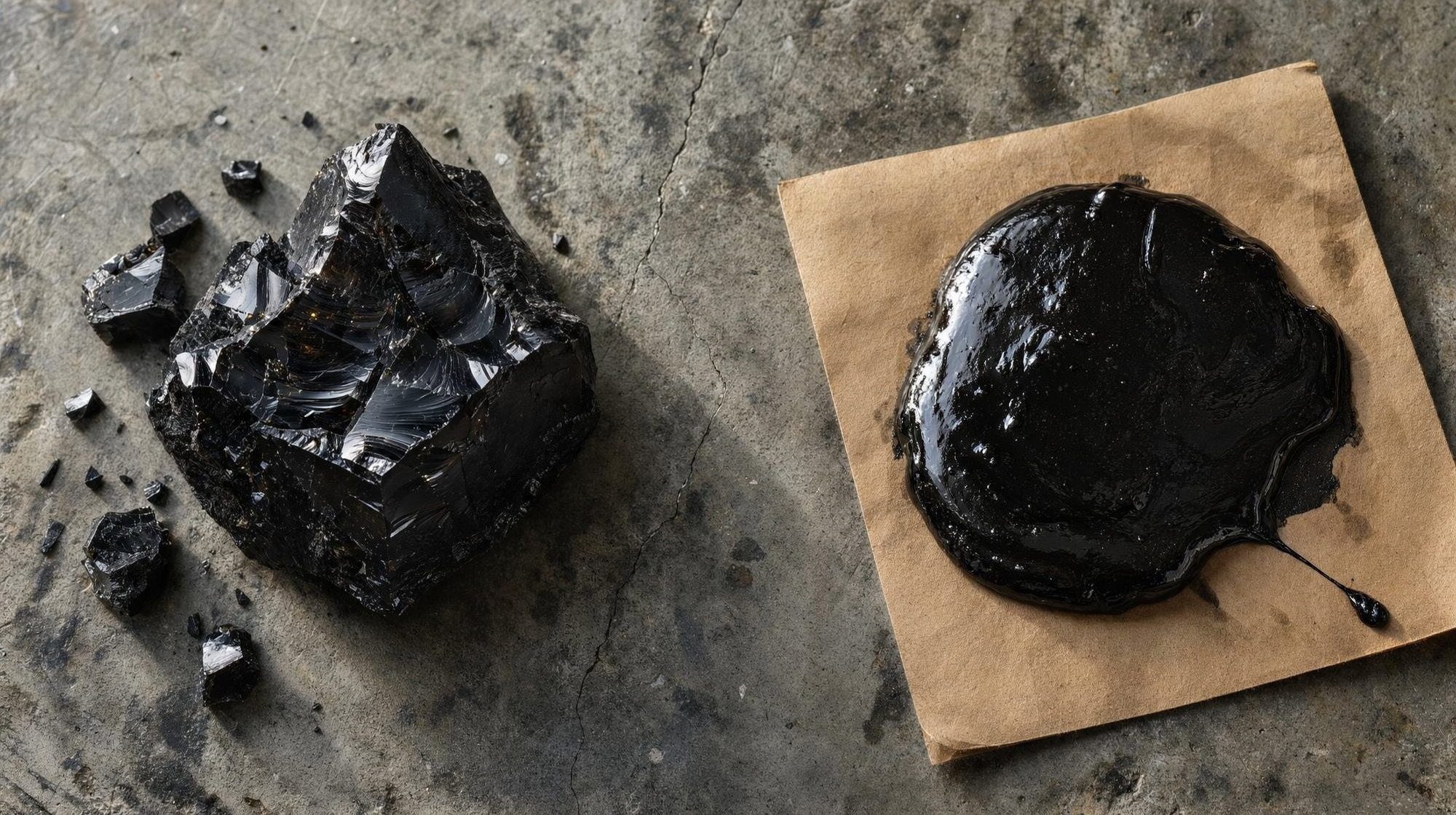
The five properties that create the advantages
Suppliers tend to describe the gilsonite technical advantages with adjectives — purer, harder, more consistent. Adjectives do not help a formulator. What follows instead is the property, the number behind it and the mechanism it drives.
| Property | Typical value | What it does in a formulation |
|---|---|---|
| Penetration | 0 | Behaves as a brittle solid at ambient temperature, so it grinds to a controlled particle size instead of smearing |
| Specific gravity | 1.04 – 1.06 | Cuts slurry density in oil well cement without taking compressive strength with it |
| Lustrous carbon | 25 – 35% | Lays down a reducing carbon film on the mould face in foundry sand, which releases the casting cleanly |
| Volatile combustible matter | 75 – 81% | Governs how much of the particle gasifies on heating, which sets both foundry behaviour and thermal stability |
| Moisture | 0.5 – 1% | Keeps the powder free-flowing and stops caking in a bag through a warm supply chain |
Penetration zero is the whole story
Petroleum bitumen is defined by how far a standard needle sinks into it. Gilsonite registers zero, which means the needle does not enter at all. In practice gilsonite is not a soft binder that happens to be stiff; it is a brittle solid that happens to be a hydrocarbon.
That single fact drives nearly everything else. Brittleness lets the material grind cleanly to a mesh specification rather than smear on the mill. Since it stays solid at ambient temperature and softens only on heating, a particle in a drilling fluid travels downhole intact and then deforms exactly where the hole runs hottest. The same solidity raises the stiffness of an asphalt binder instead of thinning it.
Low density is an advantage only in cementing
At 1.04 to 1.06 the material floats close to the density of water, which is unusual for a mineral additive. In oil well cementing that matters directly: the engineer can bring the slurry weight down without diluting the cement, so compressive strength survives the weight reduction.
In most other applications the figure is simply a handling fact rather than a benefit. It is worth knowing, though, that a low-density powder occupies more volume per tonne than buyers expect, which changes the loading calculation on a container.
Lustrous carbon is the foundry mechanism
Foundry buyers do not actually buy gilsonite for being a hydrocarbon. They buy the 25 to 35% lustrous carbon, because that fraction pyrolyses at the mould face and deposits a thin reducing film between the metal and the sand. The film is what prevents burn-on and gives a clean casting surface.
Anyone comparing carbonaceous additives for foundry sand should compare on lustrous carbon rather than on total carbon, since total carbon says nothing about how much of it forms that film.
Solubility in aromatic solvents
Gilsonite dissolves readily in aromatic and chlorinated solvents and resists water, alcohols and most dilute acids and alkalis. For printing ink and paint formulation this gives a clean dissolution in a hydrocarbon vehicle together with a deep black body, which is why it appears as both a resin and a pigment extender in the same formulation.
Consistency from a single geological source
Gilsonite comes out of narrow near-vertical veins rather than from a refinery stream, so the material does not shift when a refinery changes crude slate or process conditions. Vein-to-vein variation is real, but it is slow and traceable instead of being driven by someone else’s production schedule. For a formulator holding a fixed recipe, this predictability is often worth more than any single headline property.
Gilsonite against petroleum bitumen
This is the comparison that matters in asphalt modification, and the two materials are not really the same class of product despite sharing a colour.
| Aspect | Gilsonite | Petroleum bitumen |
|---|---|---|
| Origin | Mined from a natural vein deposit | Residue from crude oil distillation |
| Penetration | 0 | Grade-dependent, typically 40 to 100 |
| Physical state | Brittle solid, grinds to powder | Viscous semi-solid |
| Batch consistency | Follows the vein | Follows crude slate and refinery conditions |
| Role in a mix | Modifier added at a few percent | The binder itself |
Because the two play different roles, the comparison is not about which is better. Gilsonite goes into bitumen at a small percentage to raise high-temperature stiffness and rutting resistance. It does not replace the binder, and anyone treating it as a cheaper bitumen will get a mix that fails in the cold.
Gilsonite against coal tar pitch: the regulatory difference
Coal tar pitch was once the default black resin in roofing, coatings, foundry and ink. Regulation, rather than performance, is what moved formulators away from it.
Pitch, coal tar, high-temperature carries a harmonised classification under the EU CLP regulation as a category 1A carcinogen, a category 1B germ cell mutagen and a category 1B reproductive toxicant, with hazard statements H350, H340 and H360FD. It also sits on the REACH candidate list of substances of very high concern. Those classifications bring labelling obligations, worker exposure controls, customer declarations and, in some supply chains, an outright ban in the specification.
Gilsonite does not carry that harmonised classification. It is worth stating what that does and does not mean, because suppliers routinely overstate it.
| Claim | Status |
|---|---|
| Coal tar pitch carries a harmonised CMR classification | Correct, and checkable in CLP Annex VI |
| Gilsonite does not carry that classification | Correct |
| Gilsonite has therefore been proven non-carcinogenic | Not a supportable claim — absence of a classification is not proof of safety |
| Gilsonite needs no hazard labelling anywhere | Depends on the grade, the dust and the jurisdiction — work from the actual SDS |
The honest version of the advantage is narrower than the marketing version, and it is still a strong one: switching from pitch to gilsonite removes a CMR-classified raw material from the formulation, and that is usually the reason the switch gets approved. Work from the safety data sheet for the grade you are buying rather than from any general statement, including this one.
Gilsonite against sulfonated asphalt and lignite in drilling fluids
In a mud system gilsonite competes against sulfonated asphalt, lignite and leonardite rather than against bitumen, and the three work by different mechanisms.
The mechanism
Gilsonite works physically. A particle sized to the pore throat enters a microfracture, softens at bottom-hole temperature and deforms into the gap, which seals it. Because the mechanism is mechanical rather than chemical, it does not depend on mud chemistry and it survives the salinity and hardness that break down many additives.
Sulfonated asphalt, by contrast, works partly by adsorption onto the shale surface and stays dispersible in water. Lignite and leonardite are humic materials that work chiefly as deflocculants and filtrate reducers. Each has its place, and a well-built mud often carries more than one of them.
Where gilsonite wins
Temperature is the clearest case. A particle that must soften to work gets better at its job as the hole gets hotter, so gilsonite holds up in HT HP wells where humic additives are already degrading. Salinity is the second case, since the sealing mechanism does not care about brine. The third is shale stabilisation, where sealing the microfractures ahead of the bit stops water reaching the shale in the first place.
Where it does not
If the problem is rheology rather than filtration, gilsonite is the wrong tool — it is not a thinner and will not drop yield point. If the loss zone is a large fracture rather than a microfracture, particle size is the limit and a graded bridging material such as walnut shell or calcium carbonate does the job instead. And in a shallow, cool, low-salinity hole, lignite is usually cheaper and sufficient.
The full range for mud systems sits on the drilling fluid additives page.
Gilsonite against synthetic hydrocarbon resins
In ink and paint the competition is a synthetic hydrocarbon resin rather than another natural material, and here the trade-off runs in both directions.
A synthetic resin arrives with a narrow, engineered specification: a chosen softening point, a chosen molecular weight distribution, a chosen colour. Gilsonite arrives with whatever the vein gave, inside a typical range. For a formulator who needs a precise melt profile, that is a real disadvantage.
What gilsonite brings instead is a deep black body that a clear synthetic resin cannot supply, so a single raw material does the work of a resin and part of the pigment load. It also costs less per tonne than most engineered resins. The right question is therefore whether the formulation needs engineered precision or black colour plus binder in one addition.
The advantage, application by application
The property doing the work changes completely from one industry to the next, which is why a single generic claim about gilsonite is never much use.
| Application | Property that matters | The advantage |
|---|---|---|
| Water based muds | Softening point, particle size | Seals microfractures physically, so it survives brine and heat |
| Oil well cementing | Specific gravity 1.04 – 1.06 | Lowers slurry weight without losing compressive strength |
| Asphalt modification | Penetration 0, compatibility | Raises high-temperature stiffness and rutting resistance |
| Foundry sand | Lustrous carbon 25 – 35% | Reducing film at the mould face gives clean casting release |
| Printing ink | Colour in mass, solubility | Resin and black pigment body in one raw material |
| Paints and stains | Water and chemical resistance | Durable black finish without a CMR-classified resin |
Where gilsonite is the wrong choice
No material is right everywhere, and the limitations below come up often enough to be worth stating plainly.
Sulfur at 3 to 3.3%
This is the limitation buyers most often miss. Three percent sulfur is not trivial, and in ductile iron casting sulfur at the mould face can degrade graphite morphology and produce a pearlitic skin. Foundries running ductile iron should evaluate on their own castings rather than on a general recommendation, and should ask for the sulfur figure on the specific grade.
Colour
Gilsonite is black in mass and brown in powder, and nothing changes that. Any formulation needing a light or tintable finish rules it out at the first question.
Ash content
Raw material carries ash, and the figure varies by grade. Where ash matters — and in ink it matters a great deal — buy on a stated ash specification rather than on a typical value, and expect a selected low-ash grade to cost more.
It is not a binder on its own
Penetration zero means gilsonite has no ductility of its own. In asphalt it is an additive at a few percent. Pushed higher in the hope of a stiffer mix, it produces a brittle binder that cracks in cold weather, which is a failure mode that shows up a season later rather than in the lab.
It is not a thinner or a weighting agent
In a mud system gilsonite will not reduce yield point and it will not raise mud weight, because at a specific gravity near 1.05 it is barely denser than water. Those jobs belong to a deflocculant and to barite.
Claims about gilsonite worth checking
Several claims circulate widely in the trade, and some of them do not survive contact with a specification sheet. They are worth knowing before a buyer raises them with you.
| Claim | What to ask for |
|---|---|
| “99.8% pure” | The ash figure on the same sheet. A purity claim and an ash figure have to agree, and often they do not. |
| “High nitrogen content” | The nitrogen number from the elemental analysis, and the method. Published figures for this material vary very widely. |
| “Non-toxic and non-carcinogenic” | The safety data sheet. A classification statement belongs on an SDS, not in a brochure. |
| “Highest softening point available” | The softening point range and the test method for the specific grade, since the range across grades is wide. |
| “Consistent batch to batch” | Certificates for two or three recent batches, which settles it in a way a sentence cannot. |
The same test applies to anything on this page. Where a figure matters to your formulation, work from the certificate for the grade and the batch rather than from a published typical value.
Supply and commercial terms
RAHA Gilsonite supplies lump, powder and micronized grades, selected on softening point, ash and mesh against the application rather than on a general grade name.
| Payment | 50% TT in advance, balance agreed with the order |
|---|---|
| Incoterms | FOB, CFR or CIF |
| Loading ports | Jebel Ali or Mersin |
| Minimum order | One full 20′ container |
| Lead time | Quoted per destination |
| Documentation | Specification sheet, SDS and batch certificate |
Independent inspection at loading can be arranged on request — SGS, Bureau Veritas, Intertek or the surveyor named in your contract. Tell us the application and the property that governs it, and the right grade follows from that rather than from a catalogue.
Frequently asked questions
The properties
What are the main gilsonite technical advantages?
Penetration zero, which makes it a brittle solid that grinds to a controlled particle size rather than a soft binder. Specific gravity of 1.04 to 1.06, which lowers cement slurry weight without losing compressive strength. Lustrous carbon of 25 to 35%, which forms the reducing film that releases a casting cleanly. Solubility in aromatic solvents combined with a deep black mass colour. And consistency, because the material comes from a vein deposit rather than from a refinery stream.
Why use gilsonite instead of petroleum bitumen?
They do different jobs. Bitumen is the binder; gilsonite is a modifier added at a few percent to raise high-temperature stiffness and rutting resistance. Gilsonite registers penetration zero against typical bitumen grades of 40 to 100, so it is a brittle solid rather than a viscous semi-solid. Using it as a cheaper bitumen produces a brittle mix that cracks in cold weather.
What does penetration zero actually mean?
In the standard penetration test a needle under a fixed load does not enter the material at all. Practically it means gilsonite behaves as a brittle solid at ambient temperature: it grinds cleanly to a mesh specification, it travels downhole intact before softening where the hole is hottest, and it stiffens an asphalt binder instead of thinning it.
Why does lustrous carbon matter more than total carbon?
Only the lustrous carbon fraction pyrolyses at the mould face and deposits the thin reducing film that prevents burn-on and releases the casting. Total carbon says nothing about how much of it forms that film, so carbonaceous foundry additives should be compared on lustrous carbon content, which for gilsonite runs 25 to 35%.
Compared with the alternatives
How does gilsonite compare with coal tar pitch?
Coal tar pitch, high-temperature carries a harmonised EU classification as a category 1A carcinogen, category 1B germ cell mutagen and category 1B reproductive toxicant, and it sits on the REACH candidate list of substances of very high concern. Gilsonite does not carry that classification. That removes a CMR-classified raw material from the formulation, which is usually why the substitution gets approved.
Is gilsonite non-toxic and non-carcinogenic?
Gilsonite does not carry the harmonised CMR classification that coal tar pitch carries, and that difference is checkable. However, the absence of a classification is not the same as proof of safety, so claims of that kind are best avoided. Work from the safety data sheet for the specific grade, which is where classification statements belong.
How does gilsonite compare with sulfonated asphalt and lignite in a mud?
Gilsonite seals physically: a sized particle enters a microfracture, softens at bottom-hole temperature and deforms into the gap. Sulfonated asphalt works partly by adsorption onto the shale surface, while lignite and leonardite are humic materials acting mainly as deflocculants and filtrate reducers. Gilsonite holds up better at high temperature and in brine, because its mechanism is mechanical rather than chemical.
Why choose gilsonite over a synthetic hydrocarbon resin?
A synthetic resin gives engineered precision — a chosen softening point, molecular weight distribution and colour. Gilsonite gives a deep black body that a clear resin cannot supply, so one raw material covers both the resin and part of the pigment load, usually at a lower cost per tonne. Choose the synthetic where the formulation needs a precise melt profile.
Limitations
What are the disadvantages of gilsonite?
Sulfur at 3 to 3.3%, which matters in ductile iron casting. Black colour, which rules out any light or tintable finish. Ash content that varies by grade and has to be bought on specification. No ductility of its own, so it modifies a binder rather than replacing one. And no effect on mud rheology or mud weight, because it is barely denser than water.
Does the sulfur content cause problems in foundry use?
It can. Sulfur at the mould face can degrade graphite morphology in ductile iron and leave a pearlitic skin. Grey iron is far less sensitive. Any foundry running ductile iron should trial the material on its own castings and buy against a stated sulfur figure for the grade rather than a typical value.
Can gilsonite replace bitumen entirely in an asphalt mix?
No. Penetration zero means it has no ductility of its own, so it works as an additive at a few percent. Pushed higher it produces a brittle binder that cracks in cold weather — a failure that appears a season later rather than during mix design.
Will gilsonite reduce yield point or raise mud weight?
Neither. It is not a thinner, so rheology control belongs to a deflocculant. At a specific gravity near 1.05 it is barely denser than water, so mud weight belongs to barite. Gilsonite addresses filtration, microfracture sealing and shale stability.
Buying and documentation
How should purity claims about gilsonite be checked?
Against the ash figure on the same sheet. A purity percentage and an ash percentage have to be consistent with each other, and a high purity claim sitting next to a high ash figure means one of the two is wrong. Ask for both on the same certificate for the same grade.
Does gilsonite vary from batch to batch?
Less than a refinery product, because a vein deposit does not change when a refinery changes crude slate. Vein-to-vein variation is real but slow and traceable. The way to settle it for a given supply is to ask for certificates covering two or three recent batches rather than a single typical sheet.
Which grade suits which application?
Grade selection follows the controlling property, not a catalogue name. Drilling fluids are selected on softening point and particle size, cementing on specific gravity, asphalt modification on softening point and compatibility, foundry on lustrous carbon, and ink on colour in mass and solubility. Give the application and the governing property, and the grade follows.
Related technical pages
- Gilsonite specification — the full physical, thermal and elemental data
- Chemical characterisation — elemental composition of the resin
- Trace metal content — the figures behind the regulatory comparisons
- Safety data sheet — handling, exposure and classification
- Drilling fluid additives — the full range for mud systems
- Gilsonite solutions — problems it solves, by industry
