
Barite is the weighting material that holds a well under control. RAHA Gilsonite Co. supplies and exports API 13A drilling grade barite to drilling contractors, mud companies and service companies worldwide, in both specifications — 4.2 SG under Section 7 and 4.1 SG under Section 20 — in big bags and in bulk, by the container. This page sets out what each grade is, which one your programme actually needs, what the four API tests mean once the material is on the rig, and what to send with an enquiry so a firm quotation comes back on the first reply.
Why buy barite from RAHA Gilsonite Co.
We are an exporter rather than a domestic counter, and we ship barite by the container to wherever the rig is. Search for a barite supplier and most of what comes back gives you one line — “SG 4.20 min, API 13A” — and a contact form. That line is not enough to buy on, because two consignments can both carry it and behave differently in the same mud system. We publish the full specification of both grades, say plainly which one suits which programme, and ship a batch certificate of analysis with every consignment.
Both API specifications
Barite 4.2 to Section 7 and barite 4.1 to Section 20, from the same desk. Most suppliers quote one and quietly substitute the other; we price them separately because they are different products.
One desk for the whole mud programme
Barite rarely ships alone. Bentonite, PAC LV, PAC HV, CMC, KCl, caustic soda, calcium chloride and gilsonite come from the same desk — one consignment, one set of documents, one person to call.
Two routings, not one
We load from Jebel Ali and from Mersin. For most destinations one of the two is clearly cheaper on freight, and because we work both we can tell you which rather than quoting whichever one we are tied to.
Documents before the contract
The specification is on this page before you commit to anything. A batch certificate of analysis ships with every consignment, and the safety data sheet goes out with the offer.
Technical answers, not just prices
Ask what the sub-6 micron fraction will do to your plastic viscosity, or whether 4.1 is defensible on your well, and you get a worked answer rather than a brochure.
Inspection welcomed
We arrange independent inspection at loading by SGS, Bureau Veritas, Intertek or your own surveyor whenever you ask. A supplier confident in the material has no reason to resist a third party looking at it.
What we supply
Barite is naturally occurring barium sulphate, ground to a controlled particle size and sold by its density rather than by its chemistry. API Specification 13A recognises two drilling grades, and the difference between them is written into the standard itself rather than invented by suppliers.
| Grade | API 13A clause | Minimum density | Where it suits |
|---|---|---|---|
| Barite 4.2 | Section 7 | 4.20 g/cm3 | The default drilling grade. Required where the mud programme or the operator’s specification calls for API barite without qualification, and the sensible choice for high mud weights |
| Barite 4.1 | Section 20 | 4.10 g/cm3 | A recognised API grade in its own right, accepted on many land programmes at moderate mud weights, usually bought on delivered cost per tonne where the specification permits it |
The point most listings miss: barite 4.1 is not off-specification barite. It is a separate clause of the same standard, with the same limits on everything except density. Whether you may use it is a question for your mud programme and your operator, not for the supplier — but if the programme allows it, the delivered cost per tonne is usually lower.
Specification
A barite supplier should publish this before you ask for it. These are the guaranteed limits for both grades. Every consignment also ships with a batch certificate of analysis, and it is the certificate — not this table — that governs the material you receive.
| Property | Barite 4.2 | Barite 4.1 |
|---|---|---|
| API 13A clause | Section 7 | Section 20 |
| Density | 4.20 g/cm3 minimum | 4.10 g/cm3 minimum |
| Residue greater than 75 µm | 3.0 % by mass maximum | 3.0 % by mass maximum |
| Particles less than 6 µm | 30 % by mass maximum | 30 % by mass maximum |
| Water-soluble alkaline earth metals, as calcium | 250 mg/kg maximum | 250 mg/kg maximum |
| Barium sulphate content, typical | 90 % and above | 90 % and above |
| Fineness, through 200 mesh | 97 % typical | 97 % typical |
| pH of aqueous suspension | 8 to 9.5 | 8 to 9.5 |
| Appearance | Fine grey to buff powder | Fine grey to buff powder |
| CAS number | 7727-43-7 | 7727-43-7 |
| HS code | 2511.10 | 2511.10 |
Three of those rows are the same for both grades. Only density changes between Section 7 and Section 20, which is exactly why the two are so often confused and so often substituted.
Barite 4.1 or 4.2: which to buy
This is the question that decides the order, and almost no supplier answers it. Four things should drive the choice.
What the mud programme says
If the programme or the operator’s chemical specification says “API barite” without a number, that means Section 7 and 4.20 SG. Substituting 4.1 against that wording is a specification deviation, not a cost saving, and it is the buyer who carries it. Start here, before price.
The mud weight you are building
At low and moderate mud weights the density difference barely shows. As the target weight climbs, the lighter grade needs more tonnage to reach the same point, and that extra tonnage is extra solids in the system. Above roughly 16 pounds per gallon the arithmetic turns against 4.1 quickly, because every extra pound of weighting material raises plastic viscosity and eats into the volume left for liquid phase.
The tonnage arithmetic
Barite at 4.20 SG weighs about 35 pounds per gallon. The field formula for the amount needed to raise mud weight is:
barite (lb/bbl) = 1470 × (W2 − W1) ÷ (35 − W2)
Raising a 10.0 ppg mud to 12.0 ppg therefore takes about 128 lb/bbl. Run the same case with 4.1 SG material, which weighs about 34.2 pounds per gallon, and the figure rises to roughly 130 lb/bbl. The difference is small on one barrel and real across a programme: on a 2,000 barrel active system it is close to two tonnes of extra material, plus the mud volume that material displaces.
Delivered cost, not tonne price
Compare the two grades on cost per tonne delivered to your yard, then adjust for the extra tonnage the lighter grade needs. Where 4.1 comes in more than a few per cent cheaper delivered, it usually still wins at moderate weights. A narrow gap is not worth the specification argument, so take 4.2 and keep the paperwork clean.
| If | Take |
|---|---|
| The programme says API barite with no grade | 4.2, Section 7 |
| Mud weight above about 16 ppg | 4.2, Section 7 |
| Deepwater or a tight ECD window | 4.2, Section 7 |
| Land rig, moderate weights, programme permits Section 20 | 4.1 if the delivered cost is clearly lower |
| You are not sure what the programme permits | 4.2, and ask the operator before the next order |
What barite does in a drilling fluid
Barite has one job and it is the most consequential job on the rig: it puts weight into the mud column so that the pressure at the bottom of the hole exceeds the pressure in the formation. Everything else written about barite follows from that.
Hydrostatic pressure and well control
The pressure a mud column exerts is its density multiplied by its true vertical depth. Keep that above formation pore pressure and the well stays static; let it fall below and formation fluid enters the hole. Barite is how the density side of that equation is set, and it is chosen over cheaper minerals because it is dense enough to do the job without filling the system with solids.
Why density and not simply more solids
Any solid raises mud weight. What matters is how much weight you get per unit of volume occupied, because every cubic metre of solids is a cubic metre not available to the liquid phase, and solids loading drives plastic viscosity, equivalent circulating density and bit balling. At 4.2 SG, barite delivers the weight with roughly half the solids volume that a 2.7 SG mineral such as calcium carbonate would need for the same result. That is the whole reason barite is the industry default.
Barite sag, and why fineness matters
Sag is barite settling out of the mud, and it is the failure mode that costs rigs money. In a high-angle hole, settled barite slides down the low side of the annulus and arrives at the shakers as a slug of heavy mud followed by a slug of light mud. The pressure swing that produces can cost well control.
Sag is mostly a rheology problem, not a barite problem — low-shear-rate viscosity is what holds the particles up. But particle size distribution is the part the material itself controls, which is why API puts limits at both ends. Too little fine material and the solids have nothing to keep them suspended; too much and plastic viscosity climbs to the point where the mud is hard to pump. The 30 per cent limit on sub-6 micron material sits exactly on that trade-off.
Abrasion and equipment life
Barite is soft — 3 to 3.5 on the Mohs scale — which is another reason it is preferred over harder weighting minerals. The coarse fraction is the part that does damage, which is what the 3 per cent limit on material above 75 microns is protecting: pump fluid ends, bit nozzles and mud motors.
What the four API 13A tests actually tell you
The specification is short. Each line exists because something went wrong on a rig once, and reading them that way makes a certificate of analysis far more useful than a pass or fail.
Density
The headline number, and the one the whole purchase is priced on. It sets how much material you need per barrel and how much solids volume that costs you. 4.20 minimum for Section 7, 4.10 for Section 20.
Residue above 75 microns
Coarse grit. It settles fastest, abrades pumps and nozzles, and contributes nothing to suspension. Three per cent is the ceiling; a certificate well under it is a sign of a well-run grinding circuit.
Particles below 6 microns
The fines fraction. Some is necessary to keep the rest suspended; too much drives plastic viscosity up and makes the mud expensive to pump. Capped at 30 per cent, and worth watching on a programme that is already fighting viscosity.
Soluble alkaline earth metals as calcium
Contamination carried in with the mineral. Soluble calcium flocculates clays, interferes with polymers and shifts the alkalinity of the system. Capped at 250 mg per kg, and the row to check first if a new batch upsets a stable mud.
Barite, hematite or ilmenite
Barite is the default rather than the only option, and knowing why it wins makes it easier to defend the choice.
| Material | Typical SG | The trade-off |
|---|---|---|
| Barite | 4.1 to 4.2 | Soft, cheap, available everywhere, well understood by every mud engineer. The benchmark |
| Hematite | 4.9 to 5.1 | More weight per unit volume, so less solids loading at very high mud weights. Harder and markedly more abrasive on pumps and motors, and it carries iron into the system |
| Ilmenite | 4.5 to 4.7 | Between the two on density, with low abrasivity for its weight, but limited availability and a price that reflects it |
| Calcium carbonate | 2.6 to 2.8 | Acid soluble, so it is used where the weighting material must be removed from the pay zone. Far too light to be a general weighting agent |
In practice the choice is made at the top end of the weight range. Below about 16 ppg barite wins on cost and on equipment life; above it, the solids-volume argument starts to favour hematite, and the decision becomes one for the mud programme rather than the purchasing desk.
Packing and container loading
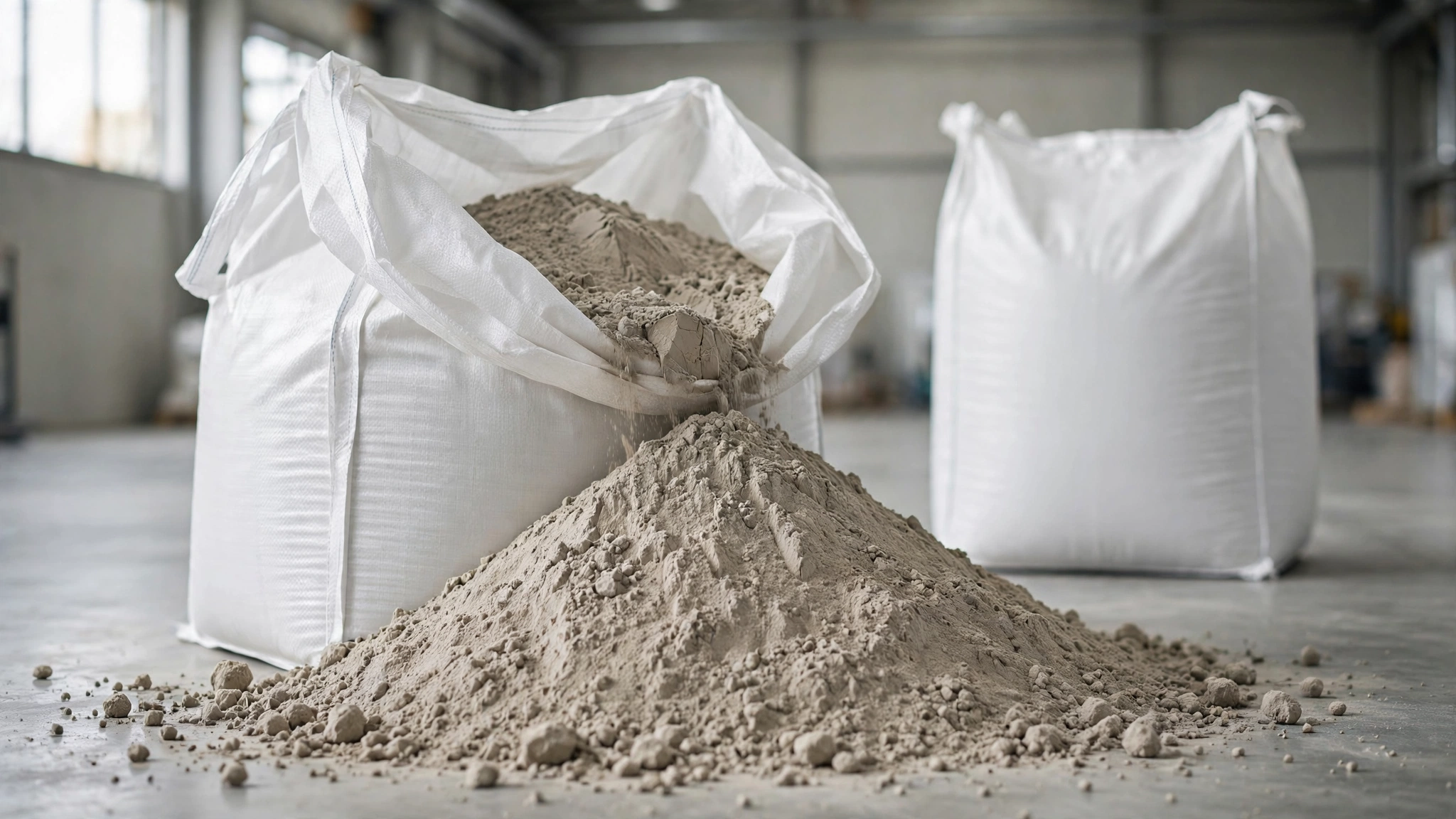
Barite is supplied in woven polypropylene bulk bags with a polyethylene liner, and in bulk where the destination can receive it.
| Packing | Suits |
|---|---|
| 1 MT big bags | Rig sites handling by forklift or crane, and anywhere the mixing hopper is fed a bag at a time. Easier to manoeuvre on a crowded location |
| 1.5 MT big bags | The standard for container shipment. Fewer lifts per container, less packaging cost per tonne, and a better fit to container payload |
| Bulk | Destinations with silo or pneumatic handling, and large programmes where bagging cost is worth removing |
Container loading
Barite is a weight-limited cargo, not a volume-limited one, and that single fact decides how it ships. A container reaches its payload limit long before it runs out of space, which is why barite moves in 20 foot containers and almost never in 40 foot ones — a 40 foot box cannot legally carry twice the weight, so the second half of it would travel empty.
| Packing | Container | Typical load |
|---|---|---|
| 1.5 MT big bags | 20 foot | 24 MT, 16 bags |
| 1 MT big bags | 20 foot | 24 MT, 24 bags |
| Bulk, lined container | 20 foot | Confirmed with the quotation against the carrier’s payload limit |
Payload limits differ by carrier, by route and by the road weight rules at the destination, so the final figure is confirmed on the proforma invoice rather than assumed. If your destination has an axle weight restriction, say so with the enquiry — it sometimes changes the sensible packing.
Storage
Barite is chemically inert and does not degrade with time. The only enemies are water and bag damage. Store the bags dry, off the ground and out of standing water; a bag that has taken on water does not lose density but does cake, and caked barite will not meter through a hopper. Keep the liner intact and use the oldest stock first.
Shipping and commercial terms
| Minimum order | One full 20 foot container |
|---|---|
| Incoterms | FOB, CFR or CIF |
| Loading ports | Jebel Ali or Mersin |
| Payment | 50% by telegraphic transfer in advance, balance agreed with the order |
| Lead time | Confirmed per order, depending on destination and quantity |
| HS code | 2511.10 |
| Transport classification | Not classified as dangerous goods |
That last row is worth a sentence. Barite carries no UN number and no hazard class, so it ships as ordinary cargo: no dangerous goods declaration, no segregation requirement in the container, no placarding on the truck. Dust control and ordinary personal protection still apply at the mixing hopper, but the paperwork is the paperwork of any mineral cargo.
Quality, documents and inspection
Certificate of analysis
Every consignment ships with a batch certificate of analysis giving density, both sieve fractions and soluble alkaline earth metals. It governs that shipment specifically, which is why it is the document to read.
Safety data sheet
Issued with the offer, before the order rather than after it.
Samples
Available on request where a pre-shipment trial is worth the time, particularly on a programme already managing viscosity or sag.
Independent inspection
Inspection and sampling at loading by SGS, Bureau Veritas, Intertek or your own contract surveyor, arranged at your instruction and cost.
How to get a firm quotation
Most enquiries that reach a barite supplier say only “please quote barite”, and the only possible reply is a list of questions. Send these five with the first message and a firm price comes back instead.
| Tell us | Why it changes the answer |
|---|---|
| Grade: 4.2 or 4.1 | Two different products at two different prices. If you are not sure which your programme permits, say so and we will work through it |
| Quantity and frequency | One container spot and a drilling campaign priced as a programme are different propositions, and the second is worth asking for explicitly |
| Destination port or rig location | Decides the loading port, the freight and whether FOB or CIF gives you the better delivered number |
| Packing | 1 MT bags, 1.5 MT bags or bulk, driven by the handling equipment at your end. It changes both price and the tonnage per container |
| Any limit tighter than API | If the operator’s specification caps a parameter below the API limit, send that line rather than the grade name and we will confirm it before contracting |
What to check when the material arrives
Four checks, none of which needs a laboratory, all of them easier on the day of discharge than three weeks later with the invoice in dispute.
Match the certificate to the batch
Read the batch number on the certificate of analysis against the number on the bag tags. A mismatch is usually a filing error and occasionally something more, and it takes thirty seconds to rule out.
Weigh a bag
Bulk bags are filled by weight, and a short bag is the commonest discrepancy in bagged mineral cargo. Weigh two or three at random before the container is stripped, not after.
Look for water damage
Staining on the outer bag, a hard crust at the base, or a liner that has sweated all mean water reached the material somewhere between loading and delivery. Photograph it before anything is moved.
Run a mud balance on the first batch
Mix a sample to a known weight and read it. This is the only field check that tests the thing you actually bought, and it takes one mud engineer ten minutes. If the mud comes in light against the calculation, stop and call before the consignment goes into the active system.
Frequently asked questions
Grades and specification
What is the difference between barite 4.1 and barite 4.2?
Density, and the clause of API 13A they are supplied against. Barite 4.2 is Section 7 of the standard at 4.20 g/cm³ minimum; barite 4.1 is Section 20 at 4.10 g/cm³ minimum. Every other limit — residue above 75 microns, particles below 6 microns, soluble alkaline earth metals — is identical. Barite 4.1 is a recognised API grade, not off-specification material.
What is API 13A barite?
Barite supplied against API Specification 13A, the American Petroleum Institute standard for drilling fluid materials. It sets four limits: minimum density, maximum residue above 75 microns, maximum particles below 6 microns, and maximum water-soluble alkaline earth metals measured as calcium. Material that meets all four may be sold as API barite.
What is the specific gravity of drilling grade barite?
4.20 g/cm³ minimum for the Section 7 grade and 4.10 g/cm³ minimum for the Section 20 grade. Pure barium sulphate is about 4.5, so commercial barite always sits below that because of the gangue minerals ground with it.
Fineness, purity and safety
What particle size is drilling barite?
About 97 per cent passes a 200 mesh screen, which is 75 microns. API caps the material retained above 75 microns at 3 per cent by mass and the material finer than 6 microns at 30 per cent by mass, so the specification controls both ends of the distribution rather than giving a single mesh figure.
Is barite radioactive?
Natural barium sulphate is not classified as a radioactive material for transport and carries no UN number on that basis. Some barite deposits do contain trace naturally occurring radioactive material, and a few operators set a limit on it. If your specification carries such a limit, send it with the enquiry and it will be addressed before contracting rather than after shipment.
Use in the mud system
What does barite do in drilling mud?
It raises the density of the mud so that the hydrostatic pressure of the column exceeds formation pore pressure, which is what keeps the well under control. It is chosen over lighter minerals because its density delivers that weight while occupying roughly half the solids volume, leaving room for the liquid phase and keeping plastic viscosity manageable.
How much barite is needed to raise mud weight?
For 4.20 SG barite the field formula is 1470 multiplied by the difference between target and current mud weight in pounds per gallon, divided by 35 minus the target weight. Raising a 10.0 ppg mud to 12.0 ppg works out at about 128 pounds per barrel. With 4.1 SG material the same case comes out near 130 pounds per barrel, because the lighter grade needs slightly more tonnage for the same result.
What is barite sag and how is it prevented?
Sag is barite settling out of suspension, most seriously in high-angle wells where the settled solids slide down the low side of the annulus and arrive as alternating heavy and light slugs. It is primarily controlled by rheology, particularly low-shear-rate viscosity, rather than by the barite itself. The material’s contribution is its particle size distribution, which is why API limits both the coarse and the fine fractions.
Viscosity and alternatives
Why does the specification limit particles below 6 microns?
Because fine material drives plastic viscosity. A mud carrying too much sub-6 micron solid becomes expensive to pump and runs a higher equivalent circulating density. Some fines are needed to help keep the coarser particles suspended, so the standard caps the fraction at 30 per cent rather than demanding it be minimised.
Can barite be used in oil-based mud?
Yes. Barite is the standard weighting material for invert emulsion systems as well as water-based ones, and the API limits apply the same way. Wetting of the barite surface by the oil phase is managed with the mud’s own wetting agents rather than by a change of grade.
Barite or hematite?
Barite below about 16 pounds per gallon, where its lower cost and much lower abrasivity decide it. Hematite becomes interesting above that, because at roughly 5.0 specific gravity it delivers the same weight with less solids volume. The trade-off is abrasion on pumps, motors and nozzles, and iron entering the system.
Ordering and packing
How do I tell a real barite supplier from a trader?
Three questions, all of them before price. First, request the full specification in writing rather than a single density figure. Second, check that a batch certificate of analysis ships with the consignment, and ask to read a recent one. Third, find out which loading ports they actually work from. A barite supplier who handles the material answers all three in one reply; a broker who has never seen a container answers with a price and a promise.
What is the minimum order quantity for barite?
One full 20 foot container. We do not ship part-container quantities, because the freight cost of a part load removes the reason to buy internationally in the first place.
How many tonnes of barite fit in a container?
Barite is weight-limited rather than volume-limited, so a 20 foot container is the practical unit and 40 foot containers are not used — the payload limit is reached long before the space runs out. A 20 foot container typically takes 24 MT in 1.5 MT big bags. The exact figure depends on the carrier’s payload limit and on road weight rules at the destination, so it is confirmed on the proforma invoice.
What packing is available?
Woven polypropylene bulk bags with a polyethylene liner, in 1 MT and 1.5 MT, or bulk where the destination can receive it. The 1.5 MT bag is the usual choice for container shipment; the 1 MT bag is easier to handle on a crowded rig location.
Terms, shipping and storage
What are the payment terms?
50 per cent by telegraphic transfer in advance, with the balance agreed with the order. Terms are set out in the proforma invoice before anything ships.
Which Incoterms and loading ports do you work on?
FOB, CFR or CIF, loading from Jebel Ali or Mersin. Which port gives the better freight depends on the destination and the routing, and we will say which one we recommend when we quote.
Can you supply barite together with the rest of the mud programme?
Yes, and it is usually cheaper that way. Barite ships alongside bentonite, potassium chloride, caustic soda, calcium chloride and the cellulose polymers, which consolidates the freight and the documents into one consignment. Send the full list with the enquiry.
How should barite be stored?
Dry, off the ground, out of standing water and with the bag liners intact. Barite is chemically inert and does not degrade with age, so time is not the problem. Water is: a wetted bag cakes, and caked barite will not meter through a hopper even though its density is unchanged.
What documents ship with the consignment?
A batch certificate of analysis, the commercial invoice and packing list, the bill of lading and the safety data sheet. We issue a certificate of origin and any further documents the destination requires.
Request a quotation for barite
RAHA Gilsonite Co. supplies and exports API 13A drilling grade barite by the container, in both the Section 7 and the Section 20 specification, in 1 MT and 1.5 MT big bags or in bulk, by the container, with a batch certificate of analysis on every shipment. Send the grade, the quantity and the destination, and a firm offer comes back on the first reply.
Related products: Bentonite for drilling mud · Calcium chloride · Caustic soda · KCl in drilling · PAC LV · PAC HV · CMC
