
Sodium chloride is the cheapest way to put weight, inhibition and salt saturation into a water-based drilling fluid, and the only way to drill a salt section without washing the hole out. RAHA Gilsonite Co. supplies and exports drilling grade sodium chloride — NaCl, roughly 98.7 per cent on the elemental analysis — in bags, bulk bags and bulk, by the container. This page sets out what the material actually does downhole, the arithmetic of a saturated salt mud, what the figures on the analysis mean once the salt is in the system, and what to send with an enquiry so a firm quotation comes back on the first reply.
Why buy sodium chloride from RAHA Gilsonite Co.
Search for a sodium chloride supplier and most of what comes back is a marketplace listing with a photograph and one line of text. Salt is the cheapest thing on a mud programme, which is exactly why nobody bothers to explain it — and exactly why it goes wrong. A salt section drilled with an under-saturated mud costs more in lost hole than the entire salt order was worth.
We publish the analysis
The elemental analysis is on this page before you ask for it, including the calcium and sulphate figures that most sellers leave off entirely. Every consignment ships with a batch certificate of analysis.
One desk for the whole programme
Salt rarely ships alone. Barite, bentonite, KCl, calcium chloride, caustic soda, PAC LV, PAC HV, CMC and gilsonite come from the same desk — one consignment, one set of documents, one person to call.
Two routings, not one
We load from Jebel Ali and from Mersin. Salt is a low-value, high-weight cargo, so freight decides the delivered price more than the material does, and working both ports means we can tell you which one wins on your route.
Technical answers, not just prices
Ask how much salt a 2,000 barrel system needs to reach saturation, or what the calcium in the analysis will do to your polymer, and you get a worked answer rather than a brochure.
Inspection welcomed
We arrange independent inspection and sampling at loading by SGS, Bureau Veritas, Intertek or your own surveyor whenever you ask for it.
Container quantities, repeatably
One full container minimum, and the same material on the second shipment as on the first. Campaign volumes are priced as a programme when you say so in the enquiry.
Specification
A sodium chloride supplier should publish this before you ask for it. The data sheet for this grade reports an elemental analysis rather than a compound assay. It is given here exactly as issued.
| Element or oxide | Weight % |
|---|---|
| Sodium, Na | 38.83 |
| Chlorine, Cl | 59.93 |
| Sulphur trioxide, SO3 | 0.73 |
| Calcium oxide, CaO | 0.51 |
| Loss on ignition | 0.0 |
| CAS number | 7647-14-5 |
| HS code | 2501.00 |
What that works out to as sodium chloride
An elemental analysis is not a purity figure, so the conversion is worth showing rather than asserting. Sodium is 39.34 per cent of the mass of sodium chloride and chlorine is 60.66 per cent. Running the two reported figures back through those fractions:
| From | Calculation | Implied NaCl |
|---|---|---|
| Sodium | 38.83 ÷ 0.3934 | 98.7 % |
| Chlorine | 59.93 ÷ 0.6066 | 98.8 % |
The two routes agree to within a tenth of a per cent, which is the arithmetic confirming itself. Call it 98.7 per cent sodium chloride, with the balance accounted for by the sulphate and calcium shown in the analysis. Loss on ignition at zero means the material is dry as supplied — there is no moisture being shipped as salt.
Particle size is not stated on this data sheet. For drilling use it matters, because coarse crystal dissolves more slowly and stays in suspension longer at the hopper, while fine material dissolves fast but can bridge in a feeder. Send the size you want with the enquiry and it is confirmed before the proforma.
The two figures a mud engineer reads first
Purity is the headline, but on a rig the trace figures decide whether a new batch of salt upsets a stable system. Two lines on this analysis are the ones to read.
Calcium, reported as CaO at 0.51 %
Soluble calcium flocculates clays, suppresses the yield of bentonite and interferes with cellulose polymers. In a salt-saturated system you are usually running polymers rather than clay anyway, but if a fresh consignment suddenly thickens the mud or costs you filtrate control, this is the first row to check against the previous batch.
Sulphate, reported as SO3 at 0.73 %
Sulphate arrives with the salt and adds to whatever the formation is already contributing. It matters on wells where sulphate-reducing bacteria are a concern, and in systems where calcium sulphate scaling is being managed. It is not a problem at this level; it is a number to know.
Both are low for a natural salt. The point is not that they are high but that they are published at all — most drilling salt is sold on a single purity figure with no trace analysis behind it, and the buyer finds out what else was in the bag after it is in the active system.
What sodium chloride does in a drilling fluid
Salt is not one additive with one job. It does four different things, and which one you are buying it for changes how much you need and how tightly the analysis matters.
1. It lets you drill salt without dissolving the hole
This is the application that cannot be substituted. When the bit enters a salt bed, halite dome or salt stringer, an under-saturated water-based mud dissolves the formation it is drilling through. The hole washes out, the caliper goes wild, cuttings loading rises, the wellbore loses gauge and the cement job that follows has nothing straight to bond to. Severe washouts in salt have cost whole sections.
The answer is to saturate the mud with the same salt before it ever reaches the formation. Water that is already holding all the sodium chloride it can hold cannot take any more out of the wall. The fluid passes through the salt bed chemically indifferent to it.
A saturated salt mud is not an inhibited mud with salt added. It is a mud whose water phase is at the saturation limit, and it has to be kept there. Dilution with fresh water at surface, or water entering from another formation, drops the system below saturation and the washout starts again.
2. It builds brine density without adding a single solid
Dissolved salt raises mud weight the same way a weighting agent does, but it occupies no solids volume and leaves nothing to damage a producing formation or to be removed by the solids control equipment. A fully saturated sodium chloride brine reaches about 10.0 pounds per gallon, which is 1.20 specific gravity.
That ceiling is the limit of what salt alone can do. Above it, the brine has to carry a different salt: calcium chloride takes a clear brine to roughly 11.6 pounds per gallon, and beyond that the system moves to calcium bromide or a blend. Where solids are acceptable, barite is the cheaper route to weight above 10 ppg.
3. It inhibits reactive shale, cheaply rather than best
Sodium chloride suppresses clay swelling by lowering the water activity of the fluid, which reduces the osmotic drive pulling water into the shale. The mechanism works, and on a cost per barrel basis nothing beats it.
It is not, however, the strongest inhibitor available. The sodium ion carries a large hydration shell and does not seat into the clay lattice the way potassium does, so it holds the clay layers apart rather than collapsing them. Potassium chloride is the better inhibitor and costs more; sodium chloride is the economic choice where the shale is moderately reactive and the budget is real.
4. It suppresses hydrate formation in cold systems
In deepwater and in cold-climate operations, gas hydrates can form in the riser, the choke and kill lines and at the wellhead where temperatures approach the mudline. Dissolved salt depresses the temperature at which hydrates are stable, and a salt-rich water phase is one of the standard thermodynamic defences against hydrate blockage. The same chemistry that stops the mud freezing in a surface pit is doing the work downhole.
The arithmetic of a saturated salt mud
These are the four numbers worth carrying in your head, and the ones that let you check a supplier’s quotation against the volume you actually need.
| Figure | Value | What it means on the job |
|---|---|---|
| Saturation concentration | About 26.4 % by weight at 20 °C | The point beyond which the water phase will not take any more salt, whatever you add |
| Salt to saturate fresh water | About 125 lb per barrel of water | The quantity to order. A 2,000 barrel water phase takes roughly 250,000 lb, which is about 113 tonnes — five containers, not one |
| Volume increase on saturation | About 13 % | A barrel of fresh water becomes roughly 1.13 barrels of saturated brine. Pit volumes have to allow for it |
| Density of the saturated brine | About 10.0 lb/gal, 1.20 SG | The weight the salt alone delivers, before any weighting material is added |
Why heating the water does not help
Most salts dissolve far better hot than cold, and mud crews raised on that assumption get caught out by sodium chloride. Its solubility barely moves with temperature: about 36 grams per 100 millilitres of water at 20 °C and only about 39 at boiling. There is no useful trick in warming the mixing water. If the system is short of salt, the answer is more salt, not more heat.
Crystallization in the cold
The flip side is that a saturated brine left in a cold pit or shipped through a cold climate drops salt out as crystals. Sodium chloride brine reaches its eutectic at about −21 °C, and above the eutectic any brine held near saturation will precipitate as it cools. Where the fluid will see low surface temperatures, mix slightly below saturation or accept that solids will appear and plan for them.
Designing a salt saturated mud: what else changes
Saturating the water phase does not only affect the salt. It changes what the rest of the additive list can do, and this is where salt-saturated systems most often go wrong.
| Additive | What saturation does to it | The usual answer |
|---|---|---|
| Bentonite | Will not hydrate. Salt collapses the plate spacing, so the clay never yields its viscosity and most of the tonne is wasted | Prehydrate in fresh water before adding, or replace with a salt-tolerant viscosifier |
| Cellulose polymers | PAC and CMC continue to work in saturated salt, which is why they dominate these systems | Specify the salt-tolerant grade and expect higher treating rates than in fresh water |
| Xanthan and attapulgite | Both carry viscosity in saturated brine where bentonite cannot | The standard viscosifiers for a salt-saturated system |
| Caustic soda | Still sets pH, and pH control still matters for polymer performance and corrosion | Dose to a measured alkalinity, not a fixed rate |
| Corrosion inhibitor | Chloride brine is corrosive and saturated brine is more so, particularly with oxygen entrained at surface | Treat as standard, with oxygen scavenger on long exposures |
The practical consequence: a salt-saturated mud is a polymer mud. Budget for the polymer, not only for the salt. The salt is cheap; the system that works around it is not.
Sodium chloride, potassium chloride or calcium chloride
Three chloride salts cover most water-based inhibition and brine work, and they are not interchangeable.
| Sodium chloride | Potassium chloride | Calcium chloride | |
|---|---|---|---|
| Maximum brine density | 10.0 lb/gal | 9.7 lb/gal | 11.6 lb/gal |
| Shale inhibition | Moderate, by water activity | Strong, by ionic exchange | Strong, by ionic exchange and activity |
| Relative cost per tonne | Lowest | Highest | Middle |
| Drilling salt formations | The only option — the mud must be saturated with the same salt | No | No |
| Divalent calcium in the system | No | No | Yes, which is sometimes the problem and sometimes the point |
| Usual reason to choose it | Salt sections, cheap weight, cheap inhibition | Reactive shale where inhibition is the controlling risk | Completion brine, invert emulsion internal phase, density above 10 ppg |
A useful rule: choose sodium chloride when the problem is the formation being salt, or when the budget is the constraint. Choose potassium chloride when the problem is shale and the well is worth protecting. Choose calcium chloride when you need density above what salt can reach, or a clear brine for completion.
Other industries we supply
The same material serves several markets, and buyers in each of them usually want a different particle size rather than a different purity.
De-icing and winter maintenance
Rock salt is the backbone of road de-icing, effective to about −9 °C and blended with calcium chloride for colder conditions. Coarse grades are the norm.
Water treatment
Regeneration of ion exchange resin in softening plants, and chlorine generation by electrolysis. Purity and insolubles matter more here than particle size.
Chemical feedstock
The starting point for chlorine, caustic soda and soda ash production, and a raw material in a long list of downstream chemistry.
Industrial process use
Dyeing and textile processing, hide curing, food processing brines where a food grade is specified, and refrigeration brine systems.
Packing, storage and container loading
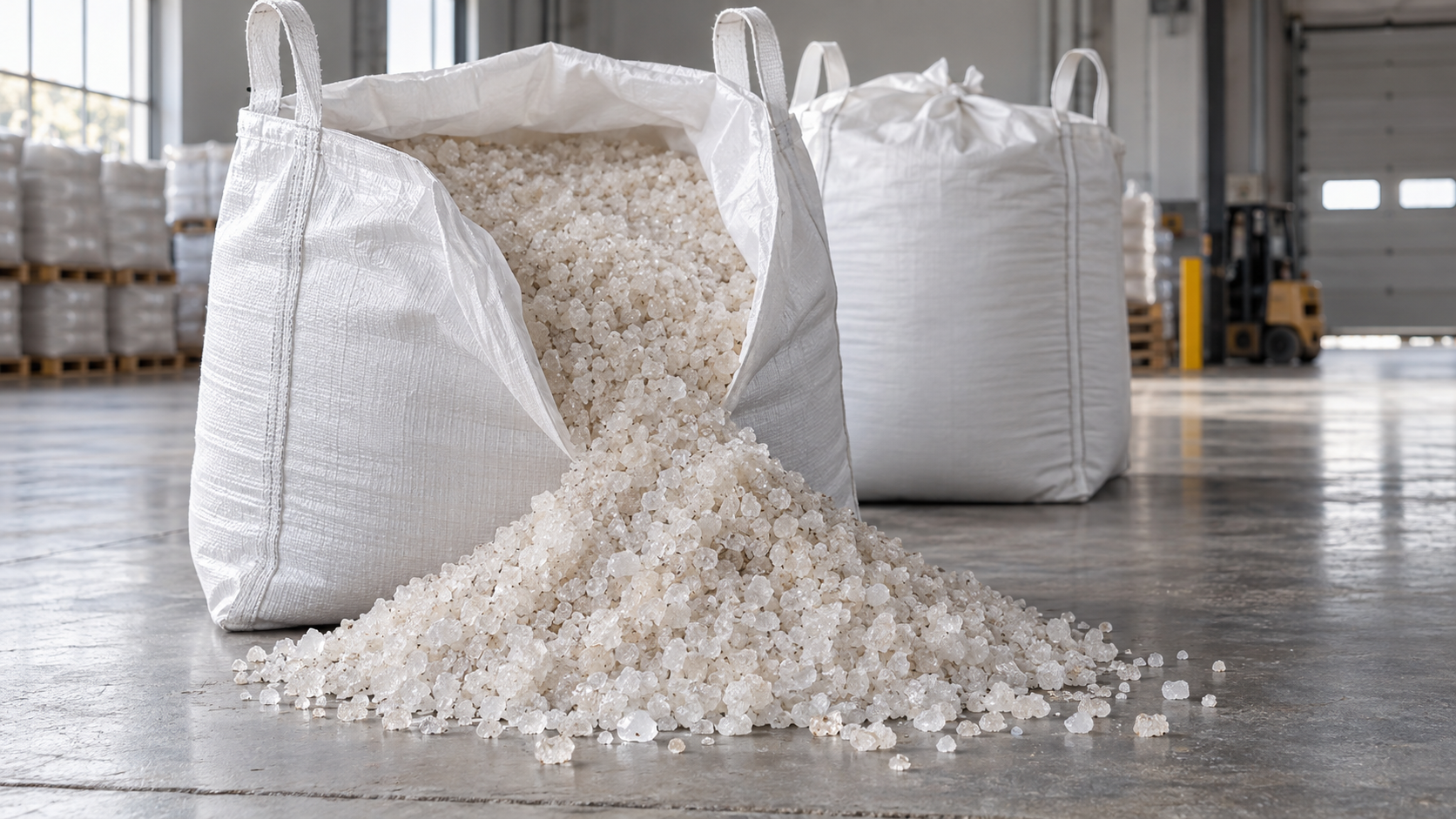
Sodium chloride is supplied in woven polypropylene bags with a polyethylene liner, in bulk bags, and in bulk where the destination can receive it.
| Packing | Suits |
|---|---|
| 25 kg bags | Rig supply where the salt is fed to the hopper a bag at a time, and any site without lifting equipment. Palletised and shrink wrapped on request |
| 1 MT and 1.5 MT bulk bags | The usual choice for container shipment. Fewer lifts, lower packing cost per tonne, and a better fit to container payload |
| Bulk | Large programmes and destinations with silo or grab handling, where bagging cost is worth removing altogether |
Container loading follows the packing and the carrier’s payload limit. Salt is a weight-limited cargo rather than a volume-limited one, so a 20 foot container is the practical unit and the tonnage is confirmed on the proforma invoice against the packing you choose.
Storage
Salt does not degrade. It does cake, and that is the whole storage problem. Sodium chloride draws moisture from humid air, and a bag that has taken on water sets into a block that will not meter through a hopper even though every gram of salt is still there. Keep bags sealed, pallets off the ground and the stack under cover, and use the oldest stock first. Loss on ignition at zero on the analysis means the material leaves dry; what happens afterwards is a storage question.
Shipping and commercial terms
| Minimum order | One full 20 foot container |
|---|---|
| Incoterms | FOB, CFR or CIF |
| Loading ports | Jebel Ali or Mersin |
| Payment | 50% by telegraphic transfer in advance, balance agreed with the order |
| Lead time | Confirmed per order, depending on destination and quantity |
| HS code | 2501.00 |
| Transport classification | Not classified as dangerous goods |
Salt carries no UN number and no hazard class, so it moves as ordinary cargo with no dangerous goods declaration and no segregation requirement in the container. The only handling caution worth stating is the obvious one: chloride and bare steel do not mix, so keep it out of standing water and away from equipment you care about.
Quality, documents and inspection
Certificate of analysis
Every consignment ships with a batch certificate. It governs that shipment specifically, which is why it is the document to read rather than the general analysis above.
Safety data sheet
Issued with the offer, before the order rather than after it.
Samples
Available on request where particle size or a trace limit needs checking before a campaign commits to a supply.
Independent inspection
Inspection and sampling at loading by SGS, Bureau Veritas, Intertek or your own contract surveyor, arranged at your instruction and cost.
How to get a firm quotation
Most enquiries that reach a sodium chloride supplier say only “please quote NaCl”, and the only possible reply is a list of questions. Send these five and a firm price comes back instead.
| Tell us | Why it changes the answer |
|---|---|
| What it is for | A salt section, a weighted brine, an inhibitive mud, de-icing or water treatment. The application decides the particle size and sometimes the grade |
| Quantity and frequency | Saturating a large active system runs to hundreds of tonnes. One container spot and a campaign priced as a programme are different propositions |
| Destination port | Salt is low value and high weight, so freight dominates the delivered price. The loading port is chosen from the destination, not the other way round |
| Particle size | Coarse for slow dissolution and open hopper work, finer for fast make-up. It is not a quality difference, it is a handling one |
| Any limit tighter than the analysis | If your specification caps calcium, sulphate or insolubles below what is shown above, send that line and it is confirmed before contracting |
What to check when the material arrives
Match the certificate to the batch
Read the batch number on the certificate of analysis against the number on the bag tags. It takes thirty seconds and it is the only check that ties the paperwork to the cargo.
Weigh a bag
Bulk bags are filled by weight and a short bag is the commonest discrepancy in bagged mineral cargo. Weigh two or three at random before the container is stripped.
Look for caking and water damage
Staining on the outer bag, a hard crust at the base, or lumps that resist hand pressure all mean moisture reached the salt between loading and delivery. The salt is still salt, but it will not meter. Photograph it before anything is moved.
Make up a saturated sample
Dissolve a measured sample to saturation and read the density. It should come in near 10.0 pounds per gallon. This is the one field check that tests the thing you actually bought, and it takes a mud engineer ten minutes.
Frequently asked questions
Specification and grade
What purity is drilling grade sodium chloride?
The grade supplied here calculates to about 98.7 per cent sodium chloride from its elemental analysis: sodium at 38.83 per cent and chlorine at 59.93 per cent, which convert to 98.7 and 98.8 per cent respectively through the stoichiometric fractions of NaCl. The balance is accounted for by sulphate at 0.73 per cent as SO3 and calcium at 0.51 per cent as CaO.
Why does the data sheet give elements instead of a purity figure?
Because it is an elemental analysis, typically by X-ray fluorescence, which reports what elements are present rather than what compounds they form. It is more informative than a single purity number, because it shows the calcium and sulphate as well. Converting it to a sodium chloride percentage is simple arithmetic and both routes through it agree to within a tenth of a per cent.
What does the calcium figure mean for my mud?
Soluble calcium flocculates clays and interferes with cellulose polymers, so it is the row to check if a new consignment changes the behaviour of a previously stable system. At 0.51 per cent as calcium oxide it is low for a natural salt and will not normally cause trouble, but knowing the figure means you can rule it in or out rather than guess.
What particle size is supplied?
Particle size is not fixed on the data sheet because it is chosen for the application. Coarse crystal dissolves more slowly and suits open hopper work on a rig; finer material makes up faster but can bridge in a feeder. Send the size you need with the enquiry and it is confirmed before the proforma invoice.
Use in the drilling fluid
What does sodium chloride do in a drilling fluid?
Four things. It saturates the mud so that a salt formation can be drilled without dissolving the wellbore, it raises brine density to about 10 pounds per gallon without adding solids, it inhibits reactive shale by lowering the water activity of the fluid, and it depresses the temperature at which gas hydrates form in cold risers and surface lines.
Why must a mud be saturated to drill a salt section?
Because water that is not already holding all the salt it can hold will dissolve the salt it is drilling through. The hole washes out, loses gauge, loads the system with dissolved salt anyway, and leaves an irregular wellbore that the cement job cannot bond to properly. Saturating the water phase before the bit reaches the salt removes the driving force for that dissolution entirely.
How much salt is needed to saturate a drilling fluid?
About 125 pounds per barrel of fresh water, which saturates it at roughly 26.4 per cent by weight at 20 degrees Celsius. A 2,000 barrel water phase therefore takes on the order of 113 tonnes, which is five containers rather than one. The water volume also increases by about 13 per cent as the salt dissolves, so pit capacity has to allow for it.
What is the maximum density of a sodium chloride brine?
About 10.0 pounds per gallon, which is 1.20 specific gravity, at full saturation. That is the ceiling for sodium chloride alone. Calcium chloride brine reaches roughly 11.6 pounds per gallon, and above that the system moves to calcium bromide or a blend. Where solids are acceptable, barite is the cheaper route to weight above 10 ppg.
Mixing, compatibility and cold weather
Does heating the water let me dissolve more salt?
Barely. Unlike most salts, sodium chloride solubility hardly changes with temperature: about 36 grams per 100 millilitres of water at 20 degrees Celsius and only about 39 at boiling. There is no practical gain in warming the mixing water. If the system is short of salt the answer is more salt.
Will bentonite work in a salt saturated mud?
Not if added directly. Salt collapses the spacing between the clay plates so the bentonite never hydrates and most of the tonne is wasted. It can be prehydrated in fresh water and then added as a slurry, but salt-saturated systems are normally built on polymers instead, with PAC, CMC, xanthan or attapulgite carrying the viscosity.
Choosing between the salts
Sodium chloride or potassium chloride for shale inhibition?
Potassium chloride inhibits better. The potassium ion seats into the clay lattice and collapses the interlayer spacing, while sodium holds the layers apart because of its larger hydration shell. Sodium chloride still inhibits by lowering water activity and costs far less per tonne, so it is the economic choice on moderately reactive shale. Where instability is the controlling risk on the well, KCl earns its price.
Does salt brine crystallize in cold weather?
Yes. A brine held near saturation drops salt out as crystals when it cools, and sodium chloride brine reaches its eutectic at about minus 21 degrees Celsius. Where the fluid will see low surface temperatures, either mix slightly below saturation or plan for the solids that will appear in the pits.
Is salt brine corrosive to the drill string?
Yes, and more so as concentration rises, particularly where oxygen is entrained at surface. A corrosion inhibitor should be part of any chloride brine system, with an oxygen scavenger on long exposures and in higher-temperature wells. Keeping pH up with caustic soda helps, since steel corrodes slowly in alkaline conditions and quickly in acidic ones.
Ordering, packing and shipping
What is the minimum order quantity?
One full 20 foot container. We do not ship part-container quantities, because the freight cost of a part load removes the reason to buy internationally in the first place.
What packing is available?
25 kg bags for hopper work and sites without lifting equipment, 1 MT and 1.5 MT bulk bags for container shipment, and bulk where the destination can receive it. All bagged material is woven polypropylene with a polyethylene liner against moisture.
How many tonnes fit in a container?
Salt is weight-limited rather than volume-limited, so a 20 foot container is the practical unit and the payload limit is reached long before the space runs out. The exact tonnage depends on the packing and on the carrier’s limit, and is confirmed on the proforma invoice.
What are the payment terms and loading ports?
50 per cent by telegraphic transfer in advance with the balance agreed with the order, FOB, CFR or CIF, loading from Jebel Ali or Mersin. Which port gives the better freight depends on the destination, and we will say which one we recommend when we quote.
Is sodium chloride classified as dangerous goods?
No. Salt carries no UN number and no transport hazard class, so it ships as ordinary cargo with no dangerous goods declaration and no segregation requirement in the container.
Can you supply salt with the rest of the mud programme?
Yes, and it is usually cheaper that way. Sodium chloride ships alongside barite, bentonite, potassium chloride, caustic soda, calcium chloride and the cellulose polymers, which consolidates the freight and the documents into one consignment.
Request a quotation for sodium chloride
RAHA Gilsonite Co. is a sodium chloride supplier to drilling contractors and industrial buyers worldwide, supplying and exporting drilling grade salt by the container, with the elemental analysis published before you contract and a batch certificate of analysis on every shipment. Send the application, the quantity, the particle size and the destination, and a firm offer comes back on the first reply.
Related products: Barite supplier · KCl in drilling · Calcium chloride · Caustic soda · Bentonite for drilling mud · PAC LV · PAC HV · CMC
