
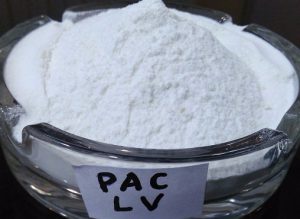
PAC LV (polyanionic cellulose, low viscosity) is a cellulose ether used in water-based drilling fluids to control filtration without raising viscosity. That last part is the whole point of the grade: it lowers fluid loss and builds a thin filter cake while leaving the rheology of the system largely where the mud engineer set it.
First, a naming problem worth clearing up. The abbreviation PAC is used for two unrelated chemicals. In drilling it means polyanionic cellulose, a cellulose derivative. In water treatment, however, it means polyaluminium chloride, an inorganic coagulant. They share nothing but three letters. Everything on this page refers to polyanionic cellulose; if a datasheet mentions basicity or aluminium content, it is describing the other product.
What PAC LV Is and How It Is Made
PAC is produced by reacting purified cellulose with sodium hydroxide and monochloroacetic acid. The reaction attaches carboxymethyl groups to the cellulose backbone, which makes the polymer water-soluble and gives it an anionic charge.
Degree of substitution
How many of those groups attach per glucose unit is the degree of substitution (DS), and it is the single figure that separates PAC from ordinary CMC. Technical-grade CMC runs roughly 0.4 to 0.8 DS. PAC, however, is manufactured to 0.9 and above, and that higher, more uniform substitution is what lets it stay in solution in brine where CMC drops out.
What the LV suffix means
The LV suffix refers to molecular weight, not to purity or quality. A shorter polymer chain gives a low-viscosity solution, while a longer chain gives the high-viscosity grade. Both are the same chemistry.
Specification
| Parameter | Typical value |
|---|---|
| Chemical name | Polyanionic cellulose, sodium salt |
| Appearance | Free-flowing white to cream powder |
| Degree of substitution | 0.9 – 1.2 |
| Purity (active content) | ≥ 95% |
| Moisture | ≤ 10% |
| pH (1% solution) | 6.5 – 8.5 |
| Viscosity, 1% solution, 25 °C | 25 – 60 cP |
| Particle size | 95% through 30 mesh |
| Bulk density | 0.6 – 0.8 g/cm³ |
| Salt tolerance | Fresh water to saturated brine |
Viscosity figures are not comparable between suppliers unless the method matches. A 1% solution measured on a Brookfield at 25 °C and a 2% solution measured on a Fann 35 give very different numbers for the same powder. Therefore, when comparing quotes, confirm concentration, instrument and temperature before concluding that one product is thinner than another.
How It Controls Filtration
PAC LV works by two mechanisms at once, and the second is the one most datasheets leave out.
Pore blocking
The dissolved polymer adsorbs onto clay platelets and bridges between them in the filter cake, filling the spaces through which filtrate would otherwise pass. As a result, the cake becomes less permeable without becoming thicker.
Viscosity of the filtrate itself
The polymer that passes into the cake raises the viscosity of the liquid moving through it. Consequently, a more viscous filtrate flows more slowly through the same pore structure, so filtrate volume drops even where cake permeability is unchanged.
Why cake quality matters more than filtrate volume
The result is what a mud engineer actually wants: a thin, firm, low-permeability cake. This matters because cake thickness, not filtrate volume, is what causes differential sticking. A product that halves the filtrate while doubling cake thickness has made the well more dangerous, not less. For the wider picture, see fluid loss control.
PAC LV vs PAC HV — Which Grade
This is the question most enquiries actually need answered.
| PAC LV | PAC HV | |
|---|---|---|
| Molecular weight | Lower | Higher |
| Viscosity, 1% @ 25 °C | 25 – 60 cP | 300 – 600 cP |
| Primary function | Filtration control only | Filtration control plus viscosity |
| Effect on rheology | Minimal | Significant rise in PV and YP |
| Typical use | Weighted muds, high-solids systems, horizontal sections | Low-solids non-dispersed muds, top-hole, hole cleaning |
| Shear thinning | Slight | Pronounced |
The selection rule in one line. If the mud already has enough viscosity and you only need the filtrate down, use LV. If instead you need filtration control and carrying capacity from the same sack, use HV. Running HV into a system that is already viscous is the most common way to end up with a mud you then have to thin — which costs a second additive and a second trip to the mixing hopper.
PAC vs CMC — Why Degree of Substitution Decides
PAC and CMC are chemically the same family. The practical difference is how far the carboxymethylation was taken and how evenly it was distributed along the chain.
| PAC | Technical CMC | |
|---|---|---|
| Degree of substitution | 0.9 – 1.2 | 0.4 – 0.8 |
| Salt tolerance | To saturation | Degrades above roughly 10% salt |
| Calcium tolerance | Good | Poor — flocculates |
| Dosage for equal filtrate | Lower | Higher |
| Cost per sack | Higher | Lower |
In fresh-water mud with low hardness, CMC does the job at lower cost and PAC is over-specification. However, in KCl, seawater or saturated-salt systems, CMC will not hold and PAC is the only one of the two that works. The cost comparison should therefore be made per barrel treated, not per sack.
Treating Rates by Mud System
| System | PAC LV concentration | Note |
|---|---|---|
| Fresh water | 0.25 – 0.75 lb/bbl | Lowest requirement; polymer hydrates fully |
| Seawater | 0.5 – 1.5 lb/bbl | Pre-hydrate in fresh water where possible |
| KCl / polymer | 1.0 – 2.0 lb/bbl | Works alongside PHPA; see KCl in drilling |
| Saturated salt | 1.5 – 3.0 lb/bbl | Highest requirement; hydration is slowest here |
| Weighted mud, high solids | 1.0 – 2.0 lb/bbl | LV preferred so viscosity is not pushed further up |
Mixing
Add slowly through the hopper with the shear pump running. Otherwise you get fish-eyes — lumps with a hydrated skin and dry powder inside — which never dissolve and are screened out at the shakers. The material is then paid for and discarded.
Temperature and Contamination Limits
| Condition | Effect on PAC LV |
|---|---|
| Up to ~149 °C (300 °F) | Stable; normal performance |
| Above ~149 °C | Progressive thermal degradation; filtrate rises |
| pH below 6 | Hydrolysis of the polymer chain accelerates |
| pH above 11 | Performance falls off |
| Calcium and magnesium | Tolerated far better than CMC, but high hardness still reduces efficiency |
| Bacterial attack | Resistant — unlike starch, no biocide required |
| Oxidisers and strong bleach | Degrade the polymer; avoid contact |
For sections hotter than PAC can survive, the filtration package has to change rather than simply be increased. Gilsonite seals physically rather than chemically, so its working limit is set by the softening point specified rather than by thermal decomposition. For that reason the two are often run together in HPHT water-based systems.
Where PAC LV Fits in the Mud System
PAC LV is a filtration control additive and nothing else. It does not replace the other functional components:
- Bentonite provides viscosity and gel strength — PAC LV deliberately does not
- Barite provides density
- KCl or amines provide shale inhibition
- PAC LV controls filtrate and cake quality
- Gilsonite seals microfractures that chemistry alone cannot close
For the full picture of how these fit together, see water-based muds.
Packing and Supply
| Item | Detail |
|---|---|
| Grades | PAC LV, PAC R, PAC HV |
| Packing | 25 kg multi-wall paper bags with PE liner; 500 / 750 kg jumbo bags |
| Storage | Dry, under cover, off the ground. Shelf life two years in sealed packing |
| Testing | Filtrate and rheology per API 13B-1 procedures |
| Documentation | Certificate of analysis per batch, SDS, third-party inspection on request |
Frequently Asked Questions
What is PAC LV used for in drilling fluid?
Filtration control in water-based muds. It reduces API and HPHT filtrate and builds a thin, low-permeability filter cake while adding almost no viscosity to the system. That last point is what distinguishes it from the high-viscosity grade.
What is the difference between PAC LV and PAC HV?
Molecular weight. PAC LV has shorter polymer chains and gives 25 to 60 cP in a 1% solution, while PAC HV gives roughly 300 to 600 cP and raises plastic viscosity and yield point significantly. Use LV when the mud already has the rheology it needs and only the filtrate must come down; use HV when you need filtration control and carrying capacity from the same product.
Is PAC the same as polyaluminium chloride?
No. Both are abbreviated PAC but they are unrelated. In drilling, PAC means polyanionic cellulose, an organic cellulose derivative. Polyaluminium chloride, by contrast, is an inorganic coagulant used in water treatment. A datasheet that mentions basicity or aluminium content is describing the water treatment product, not a drilling fluid additive.
What is the difference between PAC and CMC?
Degree of substitution. PAC is manufactured to 0.9 to 1.2 DS against roughly 0.4 to 0.8 for technical CMC, and the substitution is more uniform along the chain. Consequently PAC stays in solution to salt saturation and tolerates calcium, while CMC begins to fail above about 10% salt. In fresh-water mud with low hardness, CMC is adequate and cheaper.
How much PAC LV should be added per barrel?
Typically 0.25 to 0.75 lb/bbl in fresh water, 0.5 to 1.5 in seawater, 1.0 to 2.0 in KCl/polymer systems, and 1.5 to 3.0 in saturated salt. However, these are starting points for pilot testing against the actual mud and target filtrate specification, not a substitute for it.
What temperature can PAC LV withstand?
It is stable to approximately 149 °C (300 °F). Above that, thermal degradation of the polymer begins and filtrate rises progressively. For hotter sections the filtration package has to change rather than simply be increased in concentration.
Does PAC LV need a biocide?
No. Unlike starch-based filtration control agents, PAC resists bacterial attack, so no preservative is required. This is one of the practical reasons it is preferred for long-duration wells and for mud that will sit between sections.
Why does PAC form lumps when mixed?
Because it was added too quickly. The outer surface of a clump hydrates instantly and forms a gel skin that seals dry powder inside — the fish-eye problem. Therefore, add slowly through the hopper with the shear pump running. Lumps that form will not dissolve later and are removed at the shakers, so the material is wasted.
Physical Properties
| Parameter | Specifications |
|---|---|
| Appearance | Off white to Creamish free flowing powder |
| Nature of Polymer | Poly Anionic Cellulose |
| Purity | 99% Min |
| Moisture Content | <10 % |
| PH of 1% Solution | 6.0-7.5 |
| Degree of Substitution | 0.9 Min |
| Sodium Chloride content | 0.02%max |
| Solubility | Soluble in fresh water , Insoluble in oil |
| Toxicity | Non Toxic |
| Filtrate Volume | Max. 10.0 ml |
| Temperature Stability | >150 Deg C |
Request a Quotation for PAC LV
Tell us the mud system, the salinity and the target filtrate and we will confirm the grade and treating rate. Samples and certificates of analysis available on request. Supplied from Dubai and Ankara offices.
Related pages: PAC HV · CMC · KCl in Drilling · Bentonite in Drilling · Water-Based Muds · Fluid Loss Control · Gilsonite in Drilling Fluids
