

Gilsonite powder — also sold as asphalt powder or natural bitumen powder — is micronized uintaite ground from lump to a controlled particle size. Two things decide whether a given batch suits your process, and neither is the mesh number alone: the volatile matter content, which we supply in four ranges from 5% to 25%, and the ash figure. This page explains which range suits which industry and what to specify when you order.
What gilsonite powder is
Gilsonite is a naturally occurring solid hydrocarbon — a pure resinous rock formed of a complex combination of hydrocarbons, rich in nitrogen and low in sulfur. It is non-hazardous and non-toxic. Gilsonite powder is that material ground from lump form to a controlled particle size.
It enhances performance across oil and gas, ink, paint, construction, asphalt and foundry applications. Which powder grade each of those needs is a different question, and the answer is below.
A note on naming. Gilsonite, asphalt powder, natural bitumen powder and uintaite all describe the same material. Uintaite is the scientific mineral name; gilsonite is the commercial name used generically across the industry. Suppliers describe the same product under all four, so compare the measured specification rather than the name on the bag. Our what is gilsonite page covers the terminology in detail.
The four volatile matter grades
This is the specification that most buyers overlook and that most determines performance. Volatile matter content governs how the powder behaves under heat — whether it softens, flows, binds or burns off.
| Volatile content | Behaviour | Best suited to |
|---|---|---|
| 5–10% | Hardest, most thermally stable. Least flow under heat | HTHP drilling fluids, oil well cementing, high-temperature applications where the material must hold structure |
| 10–15% | Balanced. General-purpose across most industries | Standard drilling fluid additive, asphalt modification, general industrial use |
| 15–20% | Softer, more reactive under heat and solvent | Printing inks, paints and coatings, where solubility and dispersion in the vehicle matter |
| 20–25% | Softest, highest reactivity | Foundry sand additives, where controlled gas evolution during pouring produces the reducing atmosphere that gives a smooth cast finish |
The foundry case is the clearest illustration of why this matters. There, volatile matter is not an impurity to be minimised — it is the working mechanism. Gas evolving from the additive during pouring creates a reducing atmosphere at the metal-sand interface. Specify a low-volatile grade for foundry work and the additive simply does not perform.
Mesh selection by application
Particle size is the second variable, and it is set by where the powder has to go.
| Mesh | Approximate particle size | Typical application |
|---|---|---|
| 30–40 | Coarse granular | Lost circulation material, bridging agents, bulk blending |
| 100 | 150 microns | General drilling fluid additive, asphalt modification |
| 200 | 75 microns | Fluid loss control, foundry sand additive, most industrial use |
| 300 | 50 microns | Paints, coatings, finer dispersion requirements |
| 400–600 | Under 40 microns | Printing inks, where particle size affects gloss and print quality |
Our micronized product delivers 95% of particles below 75 microns with consistent sizing. Finer grinding costs more energy, so specifying finer than the process needs adds cost without adding performance.

From mine to powder
The process starts underground and in open-pit workings. After removing overburden, the core of the vein is reached — material that is purer than the vein margins — and transported to the grinding plant.
| Stage | What happens |
|---|---|
| Extraction | Vein core taken from underground and open-pit workings; purer than the vein margins |
| Primary crushing | Reduced to 30–40 mesh and held in storage |
| Feeding | Fed to the mill at a rate matched to grinding capacity |
| Micronizing | Ground from 100 to 600 mesh, with an air separator classifying the output |
| Classification | Closed system — oversize returns to the mill, on-spec material goes forward |
| Quality control | Particle size, volatile matter, ash and moisture verified before packing |
| Packing | Two lines — small bag or jumbo — selected according to the order |
Why the closed system matters
Two reasons, and both show up in the finished product.
Consistency. An air separator classifies continuously, returning oversize to the mill rather than letting it through. That is what produces a narrow particle size distribution rather than a wide one with the same average.
Purity. Conventional mechanical milling to fine sizes is hard on the equipment, and equipment wear shows up as metallic contamination in the product. A closed system with air classification reduces both the energy consumed and the contamination introduced. For applications where metal content governs, that difference is measurable.
Applications
-
Drilling fluids
Fluid loss control, shale stabilisation and wellbore strengthening. 200 mesh, low volatile grade for HTHP wells.
-
Oil well cementing
Lightweight additive for slurry density reduction and lost circulation control.
-
Printing inks
Wets and disperses carbon black, binds pigment to newsprint. Fine mesh, higher volatile grade.
-
Paints and coatings
Black pigment and binder for protective and anti-corrosion systems, and wood stains.
-
Foundry sand
Controlled gas evolution produces a reducing atmosphere and a smoother cast finish.
-
Asphalt modification
Raises softening point and rut resistance in hot mix asphalt.
-
Rubber and latex
Reinforcing filler and processing aid in rubber compounding.
-
Chemical products
Feedstock and modifier across industrial formulations.
Coated and uncoated
Both are available. Coated powder resists caking and handles better in humid conditions or where the material sits in storage before use. Uncoated is standard for processes where any surface treatment would interfere with the formulation. If you are unsure which your process needs, tell us the end use and we will advise.
Specifications by volatile grade
Gilsonite Powder — 5–10% volatile
| Color in Mass | Black |
|---|---|
| Color in streak or powder | Brown-Black |
| Softening point | 160-220 C |
| Moisture Content | <3 |
| Specific gravity@77℉ | 1.02-1.2 |
| Hardness (mohr s scale) | 2 |
| Penetration | 0 |
| Flash point,°C, C.O.C | >290 |
| Trace elements | <1 |
| Solubility in T.C.E Wt% | 70-85 |
| Solubility in CS2,Wt% | 70-90 |
| Ash | 5-10 |
| Fixed carbon | 25-35 |
Gilsonite Powder — 10–15% volatile
| Color in Mass | Black |
|---|---|
| Color in streak or powder | Black |
| Softening point | 200-240˚C |
| Moisture Content | <3 |
| Specific gravity@77℉ | 1.04 -1.06 |
| Hardness (mohr s scale) | 2 |
| Penetration | 0 |
| Flash point,˚C,C.O.C | 280> |
| Trace elements | <1 |
| Volatile matter | 55-70 |
| Ash | 10-15 |
| Fixed Carbone | 20-35 |
Gilsonite Powder — 15–20% volatile
| Color in mass | Black |
|---|---|
| Color in streak or powder | Black |
| Softening point | 220-260˚C |
| Moisture content | <3 |
| Specific gravity @77˚F | 1.04 -1.2 |
| Hardness (Mohr҆ s scale) | 2 |
| Penetration | 0 |
| Flash point,˚C,C.O.C | 300< |
| Trace elements | <1 |
| Solubility in T.C.E., Wt% | 60-75 |
| Solubility in CS2,Wt% | 70-85 |
| Volatile matter | 60-75 |
| Ash | 15-20 |
| Fixed Carbone | 20-35 |
Gilsonite Powder — 20–25% volatile
| Color in mass | Black |
|---|---|
| Color in streak or powder | Black |
| Softening point | 220-260˚C |
| Moisture content | <3 |
| Specific gravity @77˚F | 1.04 -1.2 |
| Hardness (Mohr҆ s scale) | 2 |
| Penetration | 0 |
| Flash point,˚C,C.O.C | 300< |
| Trace elements | <1 |
| Solubility in T.C.E., Wt% | 60-70 |
| Solubility in CS2,Wt% | 70-80 |
| Volatile matter | 60-75 |
| Ash | 20-25 |
| c | 20-35 |
These are the standard grade ranges. Measured batch values are stated on the certificate of analysis with the lot number and production date — not typical values. Custom specifications outside these ranges are available on request.
Packing and shipping
| Packing | Net weight | Suits |
|---|---|---|
| Kraft or PP bag | 25 kg | Manual handling, rig site, small batch use |
| Kraft or PP bag | 50 lb | Markets working in imperial units |
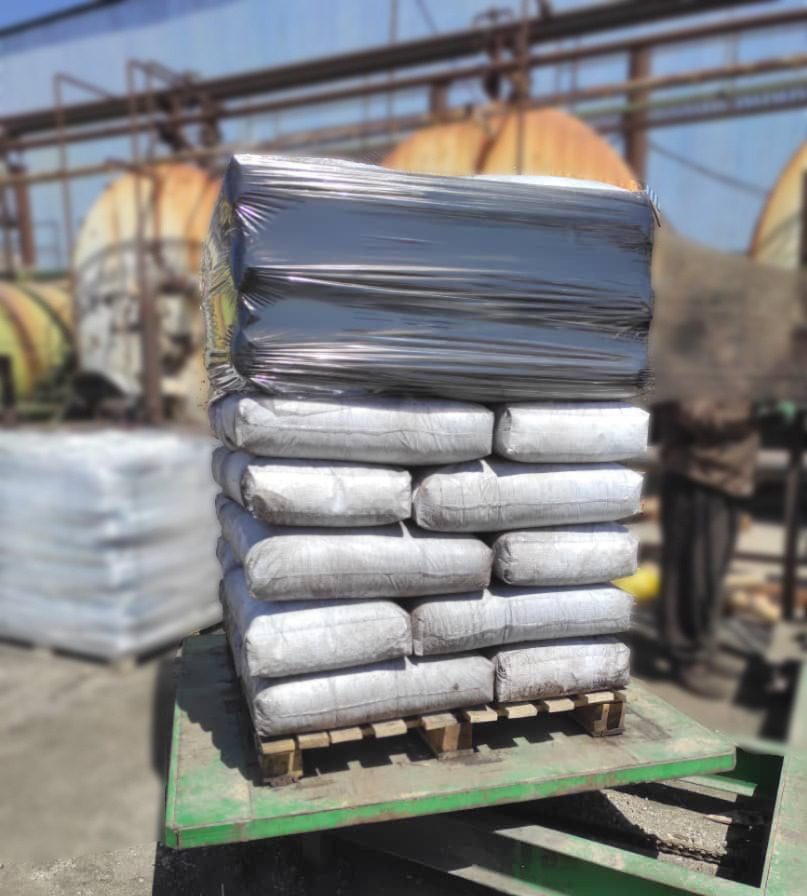
| Jumbo bag | 750–1,500 kg | Plants with forklift or crane; lower packing cost per tonne |
Shipping is straightforward. Gilsonite powder is ordinary cargo and is not classified as dangerous goods, so it carries no DG declaration, no special stowage requirement and no hazmat surcharge. That is a real cost and scheduling advantage over some alternative additives.
HS code and customs classification are on our HS code page. Handling and storage information is in the MSDS.
What to specify when ordering
| Parameter | Why it governs |
|---|---|
| Volatile matter range | The single most important figure. Determines thermal behaviour and reactivity |
| Mesh or particle size | Set by the process, not by preference. Finer than needed costs more without performing better |
| Ash content | Governs in drilling fluids and inks, where inert material is a defect |
| Softening point | Governs in asphalt modification and cementing |
| Moisture | Affects flowability and effective dosage per bag |
| Coated or uncoated | Depends on storage conditions and whether surface treatment interferes with your formulation |
| Packing | Set by handling equipment at the receiving end |
Frequently asked questions
What is gilsonite powder?
Micronized natural bitumen — gilsonite ground from lump form to a controlled particle size. It is also sold as asphalt powder or natural bitumen powder. It is a naturally occurring solid hydrocarbon, non-hazardous and non-toxic, used across drilling fluids, inks, paints, foundry, asphalt modification and chemical formulations.
Which volatile matter grade do I need?
5 to 10% for HTHP drilling fluids and cementing, where thermal stability governs. 10 to 15% as the general-purpose grade for standard drilling and asphalt modification. 15 to 20% for inks and paints, where solubility in the vehicle matters. 20 to 25% for foundry, where controlled gas evolution during pouring is the working mechanism rather than an impurity.
Why does volatile content matter so much?
Because it governs how the powder behaves under heat — whether it softens, flows, binds or burns off. The foundry case shows it clearest: there the gas evolving from the additive creates the reducing atmosphere that produces a smooth cast finish. Specify a low-volatile grade for foundry work and the additive simply does not perform.
What mesh sizes are available?
100 to 600 mesh through the micronizing line, plus 30 to 40 mesh granular. Roughly: 200 mesh (75 microns) for most drilling and foundry use, 300 mesh for paints, 400 to 600 for printing inks where particle size affects gloss. Custom cuts are available.
What particle size distribution do you achieve?
95% of particles below 75 microns in the micronized product, with consistent sizing. The air separator in the closed grinding system classifies continuously, returning oversize to the mill, which produces a narrow distribution rather than a wide one with the same average.
Why does the grinding method matter?
Two reasons. Consistency, because air classification returns oversize to the mill rather than letting it through. And purity, because conventional mechanical milling to fine sizes wears the equipment, and that wear shows up as metallic contamination in the product. A closed system with air classification reduces both energy consumption and contamination.
What is the difference between coated and uncoated powder?
Coated powder resists caking and handles better in humid conditions or where material sits in storage before use. Uncoated is standard where any surface treatment would interfere with the formulation. Both are available; tell us the end use if you are unsure which your process needs.
Is gilsonite powder the same as asphalt powder?
Yes. Gilsonite, asphalt powder, natural bitumen powder and uintaite all describe the same material. Uintaite is the scientific mineral name and gilsonite the commercial name used generically across the industry. Compare the measured specification rather than the name on the bag.
What packing is available?
25 kg and 50 lb kraft or PP bags for manual handling, and jumbo bags from 750 to 1,500 kg for plants with forklift or crane. Jumbo packing carries a lower cost per tonne but requires handling equipment at the receiving end.
Is gilsonite powder classified as dangerous goods?
No. It is ordinary cargo with no DG declaration, no special stowage requirement and no hazmat surcharge. That is a real cost and scheduling advantage over some alternative additives, particularly on container shipments and air freight.
Can you supply custom specifications?
Yes. The four volatile ranges and standard mesh cuts cover most requirements, but specifications outside those ranges are available on request. Send us the parameter that governs your process and the volume, and we will confirm what we can produce.
What is on the certificate of analysis?
Measured batch values for volatile matter, ash, moisture, softening point and particle size distribution, with the lot number and production date — not typical values from a product sheet. Third-party inspection at loading by SGS, Bureau Veritas or the surveyor named in your contract is accepted.
Related pages
Forms and specification: lump gilsonite, specification, properties, analysis, metal content and gilsonite rock.
Applications: drilling fluids, cementing, ink, paint, foundry, asphalt, construction and chemical products.
Commercial: price, MSDS, HS code and what is gilsonite.
Order gilsonite powder
Send us the end use, the volatile range and mesh your process needs, the volume and the packing. If you are not certain which grade fits, tell us the application and we will advise — specifying finer or harder than the process requires costs money without improving performance. Trial quantities are available before a full container.
Dubai: No. 2305, Burlington Tower, Business Bay — +971 4 566 4998
Ankara: Karşıyaka District, 749 Street No. 30, Gölbaşı 06830 — +90 312 544 5481
