
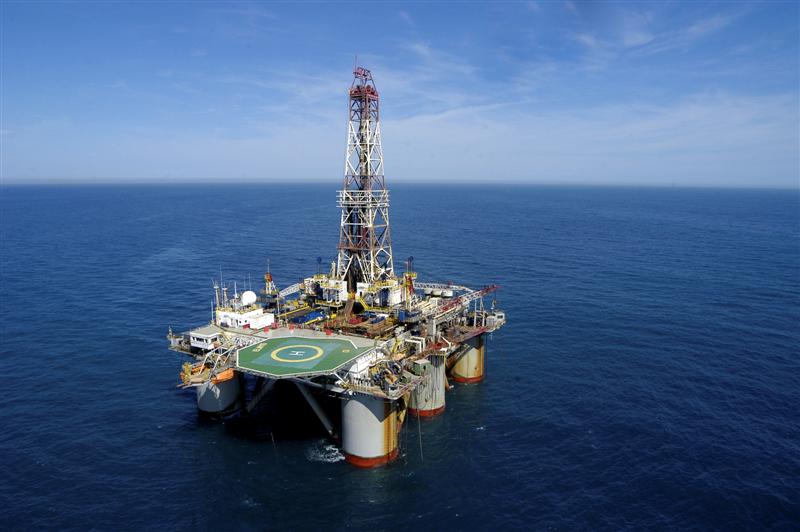
Gilsonite is used extensively onshore and on the offshore shelf, but its use in deepwater has been limited for one reason that has nothing to do with performance: a widespread industry belief that gilsonite and other asphaltic additives — the so-called black powders — cannot be discharged into a marine environment without breaching EPA standards. An AADE paper published in 2017 tested that assumption directly, and the finding is the reason this page exists.
The EPA discharge question in deepwater
Gilsonite controls fluid loss, prevents lost circulation and protects the formation from damage. Those properties are not disputed — the material is used extensively in onshore and offshore shelf applications around the world.
Deepwater has been the exception. The prevailing perception in the industry is that gilsonite and other asphaltic additives are detrimental if discharged into a marine environment, and that their use will lead to non-compliance with Environmental Protection Agency standards for deepwater discharge.

What the AADE study found
A study presented at the AADE National Technical Conference and Exhibition, paper reference AADE-17-NTCE-086, evaluated the performance and environmental compliance of uintaite — gilsonite — in deepwater drilling operations.
The study concluded that uintaite is a safe and effective means of extending emulsion stability and increasing the temperature threshold in invert emulsion system formulations, while fully complying with EPA standards for deepwater discharge.
Why this matters commercially. If the discharge concern is the only thing keeping gilsonite out of a deepwater programme, then the study removes the obstacle rather than arguing around it. That is a different conversation from a performance claim: it is a regulatory question with a documented answer. We host the paper so you can read it and form your own view rather than take ours.

Read the study: Uintaite Application in Deepwater Operations (AADE-17-NTCE-086)
What gilsonite does in a deepwater fluid
Gilsonite is a naturally occurring hydrocarbon resin with natural bonding and plugging properties and a high softening point. Added to a drilling fluid, it delivers several functions simultaneously rather than one.
-
Extends thermal life
Adds 10% or more to the thermal life of synthetic-based and water-based mud formulations, which directly affects how long a system can stay in the hole.
-
Prevents lost circulation
Bridges and plugs permeable zones and fractures, sealing them before returns are lost.
-
Minimises differential sticking
By sealing permeable formations and limiting filtrate invasion, it reduces the pressure differential that causes stuck pipe.
-
Stabilises shale
Protects reactive and low-reactive shale surfaces, including at elevated bottomhole temperature.
-
Works in OBM and WBM
Untreated in oil and synthetic systems, sulfonated in water based muds. One material, all three fluid types.
-
Performs in HP/HT
Holds function at high pressure and high temperature where many additives lose theirs.
-
Costs less than polymers
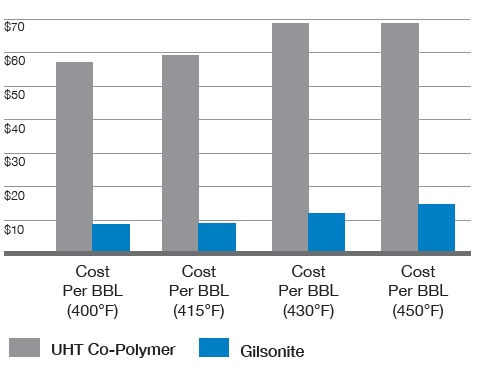
Up to 80% cheaper than premium synthetic alternatives, and the advantage widens as temperature rises.
-
No HSE penalty
Higher performance without the handling and disposal constraints that apply to synthetic additives.
Why one additive covers several functions
Each of the eight functions above is normally addressed by a separate product in a conventional formulation. Gilsonite covers them with one addition, which reduces the additive count in the system and simplifies the mud programme — and that is where most of the cost advantage comes from, rather than from unit price alone.
Gilsonite extends thermal life
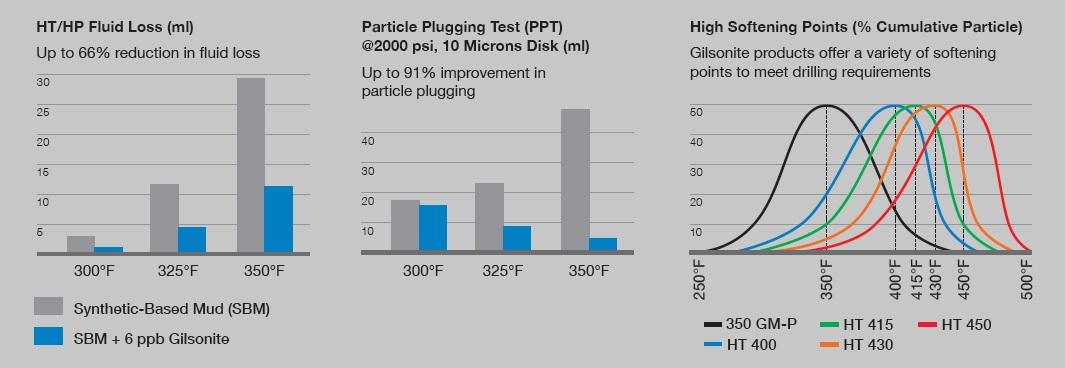
Uintaite occurs with a range of softening points, and carefully selected varieties can be combined to meet a customer’s specification. Blended grades have been formulated to perform at temperatures as high as 500 °F.
Adding gilsonite extends the thermal life of synthetic-based and water-based mud formulations by 10% or more. In a deepwater programme where fluid replacement is expensive and time-critical, that margin is not cosmetic.
Cost against premium polymers
At a fraction of the cost of premium polymers, gilsonite delivers a widening cost advantage as temperature increases — which is precisely the direction deepwater programmes move in.
| Gilsonite | Premium synthetic polymers | |
|---|---|---|
| Relative cost | Baseline | Up to 5× higher |
| Cost advantage at higher temperature | Widens | Narrows or reverses |
| Functions covered | FLC, shale stabilisation, LCM, thermal extension | Usually one function each |
| Additive count in the system | Fewer products needed | Multiple products to cover the same functions |
| Origin | Naturally occurring, mined | Synthesised |
| Deepwater discharge | EPA compliant per AADE-17-NTCE-086 | Product dependent |
Bonding and plugging: how formation damage is prevented
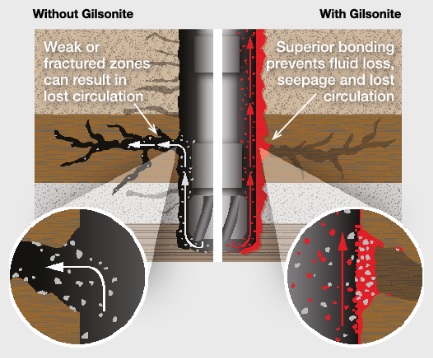
Gilsonite forms a physical and chemical bond with permeable formations, creating an effective seal that prevents the passage of drilling fluid into the formation.
What makes it unusual is that it functions as both a malleable and a solid plugging agent. A purely rigid material bridges but does not conform; a purely soft one deforms but does not hold. Gilsonite does both, which is why it controls fluid loss and seepage, prevents lost circulation and protects reactive and low-reactive shale surfaces even at elevated bottomhole temperature.
Case history: eliminating differential sticking below 16,000 ft
An international oil company drilling below 16,000 ft in the Gulf of Mexico encountered a major pressure regression, and the pipe became differentially stuck.
| Parameter | Detail |
|---|---|
| Location | Gulf of Mexico, deepwater |
| Depth | Below 16,000 ft |
| Problem | Major pressure regression, pipe differentially stuck |
| First response | Unable to free the pipe; decision taken to sidetrack the well |
| Reformulation | Zero fluid loss WBM — sized particles and calcium carbonate with high concentrations of gilsonite |
| Onsite test result | Under 0.5 cc HPHT fluid loss; nil loss on the permeability plugging apparatus |
| Outcome | Drilling proceeded through the pressure regression with no sticking tendencies in the problematic wellbore |
The detail worth noting is the fluid loss figure. Under 0.5 cc HPHT is effectively zero for a water based system, and nil on the permeability plugging apparatus means the seal held under differential pressure rather than merely filtering.
HSE profile in a marine environment
Gilsonite is a naturally occurring hydrocarbon resin, mined rather than synthesised. That origin is the basis of its health and environmental position.
| Property | Gilsonite | Coal and fly ash | Synthetic additives |
|---|---|---|---|
| Toxicity | Non-toxic | Toxicity concerns | Product dependent |
| Carcinogenicity | Non-carcinogenic | Concerns documented | Product dependent |
| Mutagenicity | Non-mutagenic | Concerns documented | Product dependent |
| Handling on the rig | Standard PPE, no extreme measures | Dust control required | May require additional controls |
| Deepwater discharge | EPA compliant per the AADE study | Generally restricted | Product dependent |
No extreme safety measures are needed to handle gilsonite, which matters on a deepwater rig where every additional handling protocol costs time and deck space.
Frequently asked questions
Can gilsonite be used in deepwater drilling?
Yes. Its use in deepwater has historically been limited by an industry perception that asphaltic additives cannot be discharged into a marine environment without breaching EPA standards. A study presented at the AADE National Technical Conference, paper AADE-17-NTCE-086, evaluated uintaite in deepwater operations and found it to be a safe and effective means of extending emulsion stability and raising the temperature threshold in invert emulsion formulations while fully complying with EPA deepwater discharge standards.
Is gilsonite EPA compliant for Gulf of Mexico discharge?
The AADE-17-NTCE-086 study concluded that uintaite complies with EPA standards for deepwater discharge. The paper is hosted on this site and can be read in full. As with any regulatory question, confirm the current position against the applicable permit and the operator’s own environmental plan before a programme is committed.
How much does gilsonite extend drilling fluid thermal life?
Adding gilsonite extends the thermal life of synthetic-based and water-based mud formulations by 10% or more. Uintaite occurs with a range of softening points, and selected varieties can be blended to a customer’s specification, with formulations performing at temperatures as high as 500 °F.
What does gilsonite do in an invert emulsion system?
It extends emulsion stability and raises the temperature threshold of the formulation, alongside its filtration and sealing functions. In an invert emulsion the water phase is dispersed in oil, and maintaining that dispersion at elevated temperature is one of the practical limits on how long a system can stay downhole.
How does gilsonite prevent differential sticking?
By forming a physical and chemical bond with permeable formations and sealing them against filtrate invasion. It functions as both a malleable and a solid plugging agent, so it bridges the pore throats and then conforms to hold the seal. A documented Gulf of Mexico case below 16,000 ft recorded under 0.5 cc HPHT fluid loss and nil loss on the permeability plugging apparatus in a reformulated WBM, after which drilling proceeded through a major pressure regression with no sticking tendencies.
How much cheaper is gilsonite than premium polymers?
Up to 80% lower cost than premium synthetic alternatives, and the advantage widens as temperature rises. Part of the saving is direct price and part is additive count: gilsonite covers fluid loss control, shale stabilisation, lost circulation and thermal extension, so fewer separate products are needed to achieve the same result.
Is gilsonite safe to handle offshore?
Yes. It is non-toxic, non-carcinogenic and non-mutagenic, unlike coal or fly ash, and requires only standard PPE. No extreme safety measures are needed, which matters on a deepwater rig where every additional handling protocol costs time and deck space.
Does gilsonite work in both oil based and water based deepwater systems?
Yes, but in different forms. In oil based and synthetic systems it is used untreated, dissolving into the oil phase to build the filter cake. In water based muds it must be sulfonated first, because an untreated hydrocarbon will not disperse in water.
What softening point should be specified for deepwater work?
It depends on the bottomhole temperature and the fluid system. Uintaite occurs across a range of softening points and selected varieties are blended to specification. Send us the well conditions and the mud formulation and we will confirm which grade fits.
What forms and particle sizes are supplied?
Granular and micronized powder, with mesh sizes of 30–40, 100, 200, 300 and custom cuts. Ash content, softening point and particle size distribution are adjusted to the application. Low-ash grades under 5% ash are available where ash content governs. See gilsonite powder.
Related pages
Drilling applications: gilsonite in drilling fluids, oil based muds, water based muds, gilsonite in cementing, sulfonated asphalt and oil and gas overview.
Product information: gilsonite overview, specification, properties, powder and granular, price, MSDS and HS code.
Specify gilsonite for a deepwater programme
Send us the fluid system, the bottomhole temperature, the water depth and the discharge requirement. We will confirm the grade and softening point, state them on the batch certificate of analysis, and accept third-party inspection by SGS, Bureau Veritas or the surveyor named in your contract.
Dubai: No. 2305, Burlington Tower, Business Bay — +971 4 566 4998
Ankara: Karşıyaka District, 749 Street No. 30, Gölbaşı 06830 — +90 312 544 5481
