
Caustic soda is one chemical sold in three physical forms, and the form you buy changes almost everything except the chemistry: how it is handled, how it is stored, what it costs to freight, and how much of it you are actually paying for. Flakes, pearls and liquid at 48 per cent all deliver sodium hydroxide. This page sets out the specification of each, what each one suits, and how to decide between them.
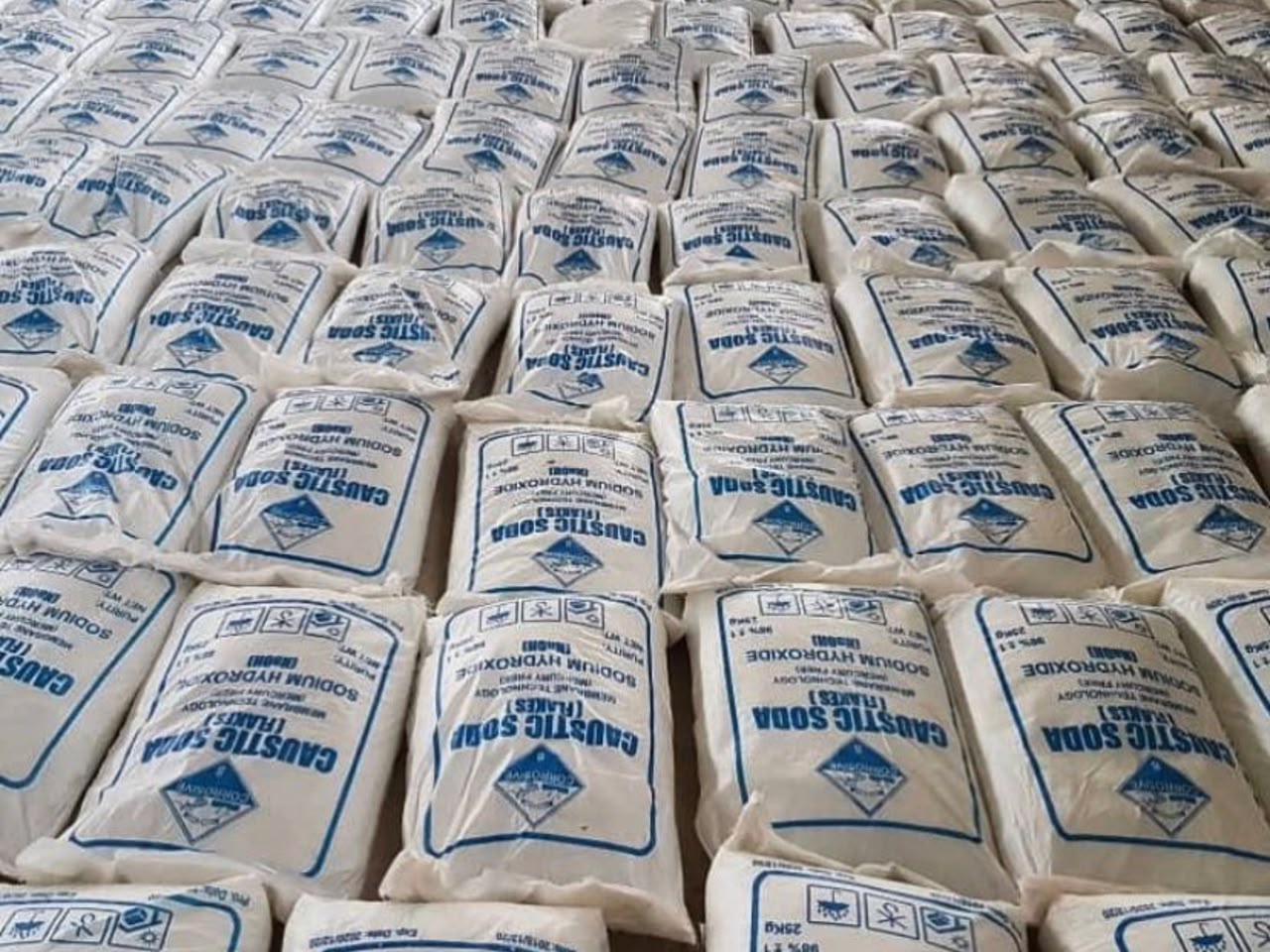
The three forms at a glance
Before the detail, the short version. The three rows below are what decide most purchases.
| Flakes | Pearls | Liquid 48% | |
|---|---|---|---|
| Appearance | Thin white flakes, 0.3–1 cm | Small white beads | Colourless clear solution |
| NaOH content | 98% ± 1 | 99.0% minimum | 48% minimum |
| Dust in handling | High | Low | None |
| Dissolving needed | Yes, strongly exothermic | Yes, strongly exothermic | No — ready to use or dilute |
| Freight efficiency | High — almost no water shipped | High | Low — more than half the weight is water |
| Storage requirement | Dry, sealed bags | Dry, sealed bags | Tank, protected from cold |
| Typically suits | Bulk consumers, lowest cost per tonne of NaOH | Clean handling, automated dosing, humid climates | Large plants near the source with tank storage |
Caustic soda flakes
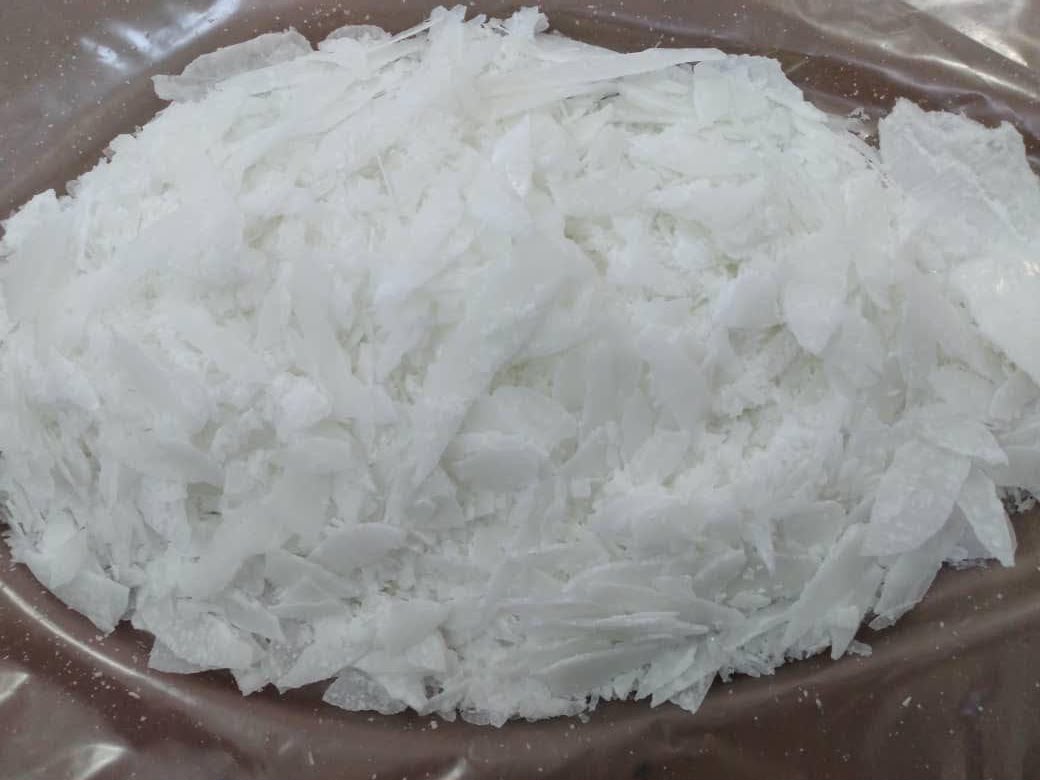
Flakes are the most widely traded solid form and the cheapest route to a tonne of sodium hydroxide. They are thin and irregular, which gives a large surface area and fast dissolution, but the same thinness is why they fracture, generate dust when poured, and cake into a solid mass if a bag is left open.
Specification
| Content | Value | Unit |
|---|---|---|
| Sodium hydroxide (NaOH) | 98 ± 1 | % w |
| Sodium carbonate (Na2CO3) | 0.43 | % w |
| Sodium chloride (NaCl) | 0.0085 | % w |
| Sodium sulphate (Na2SO4) | 0.0047 | % w |
| Silica (SiO2) | 0.0019 | % w |
| Iron (Fe) | 10 | ppm |
| Aluminium oxide (Al2O3) | Max 3 | ppm |
| Heavy metals as lead (Pb) | Max 2 | ppm |
| Insoluble in water | 0 | % w |
| Flake size | 0.3–1 | cm |
Where flakes are used
- Soap and detergent manufacturing
- Oil refining and petrochemicals
- Water treatment
- Textiles and cotton processing
- Pulp and paper
- Food processing
- Biodiesel production
- Aluminium extraction and metallurgy
- Pharmaceuticals
Caustic soda pearls
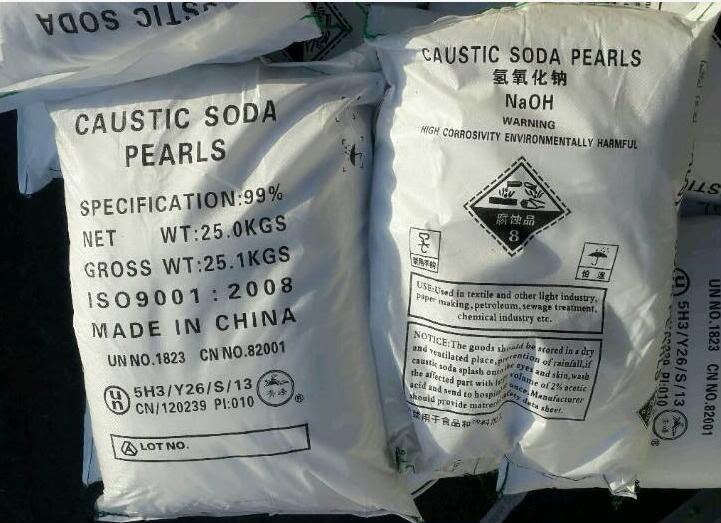
Pearls — also called prills or beads — are near-spherical granules formed by solidifying molten caustic soda in a prilling tower. The shape is the point: round particles flow freely, pour evenly, meter accurately through automated equipment and generate far less dust than flakes. They also resist caking better in humid air.
Note that the pearl grade is not simply flakes in a different shape. It carries a higher headline purity than the flake grade but a wider carbonate limit, and for some applications that second figure matters more than the first.
Specification
| Item | Value | Unit |
|---|---|---|
| Purity (NaOH) | 99.0 minimum | % |
| Sodium carbonate (Na2CO3) | 0.8 maximum | % |
| Sodium chloride (NaCl) | 0.05 maximum | % |
| Ferric oxide (Fe2O3) | 50 maximum | ppm |
| Melting point | 320–325 | °C |
| Boiling point | 1385–1390 | °C |
Where pearls are preferred
Anywhere the solid is handled by people at an open hopper, because the dust is what causes most caustic soda injuries. Anywhere dosing is automated, because beads flow and flakes bridge. And anywhere the material is stored in a humid climate, where flakes are more likely to be lost to caking.
Liquid caustic soda, 48%
Liquid caustic soda is sodium hydroxide already dissolved in water, supplied as a clear colourless solution at 48 per cent. For a plant that consumes it continuously, it removes the dissolving step entirely — no hoppers, no dust, no exotherm to manage, no bags to dispose of. It is pumped from a tank and metered.
Specification
| Property | Value | Unit |
|---|---|---|
| Sodium hydroxide (NaOH) | Min 48 | % w/w |
| Carbonate as Na2CO3 | Max 0.3 | % w/w |
| Chloride as NaCl | Max 0.015 | % w/w |
| Sulphate as Na2SO4 | Max 0.004 | % w/w |
| Silicate as SiO2 | Max 0.005 | % w/w |
| Iron as Fe | Max 7 | mg/kg |
| Insoluble in water | 0 | % w/w |
| Heavy metals as lead (Pb) | Max 10 | mg/kg |
| Mercury as Hg | Max 0.1 | mg/kg |
| Appearance | Colourless, clear, free of sediment and suspended particles | — |
The thing to know before buying liquid: it freezes
A concentrated caustic soda solution crystallises well above the freezing point of water. A 50 per cent solution begins to drop solid out at roughly 12 degrees Celsius, which is an ordinary winter night in much of the world. This is precisely why 48 per cent is the standard commercial strength rather than 50 — the lower concentration stays liquid to a noticeably lower temperature and survives transport and storage that 50 per cent would not.
Even so, liquid caustic needs storage that accounts for ambient temperature: an insulated tank, and in colder climates a heated or traced one. A tank that crystallises is not a small inconvenience. Plan the storage before ordering the first load, not after.
Technical data sheets and safety data sheet
The specification of each form is set out in full on this page. The data sheets below carry the same figures as signed documents, and the safety data sheet should be read by everyone who will handle the material.
A certificate of analysis is not published here because it belongs to a single consignment rather than to the product. The lot-specific certificate is the governing document and is issued with every shipment; a sample is available on request.
Which form should you buy?
Three questions settle it in almost every case.
1. How far is it travelling?
Liquid at 48 per cent means that for every tonne on the truck or in the tank, roughly 520 kilograms is water. Over a long haul you pay freight on that water twice — once to move it, and again in the tank capacity it occupies. Solid caustic is close to pure product, so the further the material travels, the more decisively the economics favour flakes or pearls.
For a plant a short distance from the supply point, consuming continuously, that calculation reverses. The handling saving outweighs the freight.
2. Who is handling it, and how?
If people open bags and tip them into a hopper, dust is the hazard that matters, and pearls cut it sharply. If dosing is automated, pearls flow and meter where flakes bridge and jam. Where the plant already has tanks, pumps and a dosing loop, liquid removes the handling question altogether.
3. What does the downstream process tolerate?
Headline purity is the figure everyone compares, but it is rarely the one that decides. Carbonate content matters where carbonate interferes with the process; chloride matters where chloride attacks stainless steel; iron matters where colour or catalyst poisoning is a concern. Compare the specification line by line against your own process limits rather than ranking the three forms by NaOH percentage alone. For the drilling fluid case, where carbonate load and magnesium removal govern the choice, see caustic soda in drilling fluids.
| Your situation | Usually the right form |
|---|---|
| Long-distance import, bulk tonnage, cost-driven | Flakes |
| Manual handling, operator safety is the priority | Pearls |
| Automated or metered dosing of solid | Pearls |
| Humid climate, long storage before use | Pearls |
| Continuous large-volume use with tank storage | Liquid 48% |
| No tanks, no heating, cold winters | Flakes or pearls |
Making your own solution from solid
Buyers who want liquid but cannot justify shipping water often dissolve solid on site. It works, and for most long-haul situations it is the cheaper answer, but it is not a trivial operation.
Always add the caustic soda to the water, never water to the caustic soda. Dissolving sodium hydroxide releases a large amount of heat. Making a concentrated solution from solid can take the batch close to boiling if it is added too quickly, and water poured onto dry solid will spit concentrated alkali out of the vessel.
Add slowly, with agitation running, and allow the temperature to settle between additions. Make the solution up in steel or lined steel — never aluminium, zinc or galvanised vessels, which caustic soda attacks while releasing hydrogen. And remember that a solution made at 50 per cent will behave like the commercial 50 per cent product: it will crystallise in a cold tank. If the solution is to be stored, make it at 48 per cent or lower.
Packing and container loading
Solid caustic soda is supplied in 25 kg polypropylene bags and in jumbo bags of 1,000 kg and 1,200 kg. How much goes into a 20 foot container depends on the packing and on whether the cargo is palletised.
| Packing | With pallets | Without pallets |
|---|---|---|
| 25 kg PP bags | 25 MT | 28 MT |
| 1,000 kg jumbo bags | 20 MT | 20 MT |
| 1,200 kg jumbo bags | 24 MT | 24 MT |
Loading without pallets puts three more tonnes in a container of 25 kg bags, which is a real saving on freight per tonne — but it means manual stuffing and stripping at both ends. Where the destination has a forklift and no labour to spare, palletised is usually worth the three tonnes.
Liquid caustic soda is shipped in bulk. Tell us the receiving arrangement at your end — tank, IBC or road tanker — and we will confirm what can be loaded.
Storage and safety
Solid: keep it sealed
Caustic soda is hygroscopic. An open or torn bag absorbs moisture and carbon dioxide from the air and cakes into a hard mass that will not dissolve properly. Store dry, under cover, pallets off the ground.
Liquid: keep it above its crystallisation point
Store in an insulated tank, heated or traced where winter temperatures require it. Carbon steel is suitable at ambient temperature; check the metallurgy before heating.
Never aluminium or zinc
Caustic soda attacks aluminium, zinc, tin and galvanised metal, releasing hydrogen. Use steel, polyethylene or lined vessels for storage, mixing and transfer.
Protect eyes and skin
Caustic soda is a corrosive that causes deep burns and can cause blindness. Splash goggles, face shield, gauntlets and apron, plus a dust respirator for the solid. An eyewash station and safety shower within reach.
A safety data sheet is supplied with every shipment and should be read by everyone who will handle the material. The summary above does not replace it.
Frequently asked questions
Choosing between the forms
What is the difference between caustic soda flakes and pearls?
Shape, and with it handling. Flakes are thin and irregular, 0.3 to 1 cm, dissolve quickly and cost less per tonne, but generate dust and cake in damp air. Pearls are near-spherical beads that flow freely, meter accurately and raise far less dust. The grades also differ chemically: the pearl grade runs 99.0 per cent minimum NaOH against 98 per cent plus or minus 1 for flakes, but allows a wider carbonate limit at 0.8 per cent against 0.43.
Should I buy solid or liquid caustic soda?
It comes down to distance and handling. Liquid at 48 per cent is more than half water by weight, so on a long haul you are paying freight to move water. Solid is close to pure product. For a plant near the supply point that consumes continuously and has tank storage, liquid removes the dissolving step and is usually worth it. For imported material travelling a long way, flakes or pearls almost always win on cost.
Which form is safest to handle?
Liquid, because there is no dust and no exotherm at the point of use. Among the solids, pearls, because they raise far less dust than flakes when poured. Caustic soda dust is what causes most respiratory and eye injuries with this product, so where people open bags by hand the choice of form is a genuine safety decision rather than a convenience one.
Specification
What purity is caustic soda supplied at?
Flakes at 98 per cent plus or minus 1, pearls at 99.0 per cent minimum, and liquid at 48 per cent minimum NaOH. The 48 per cent figure is not a lower quality; it is a solution, and 48 per cent is the standard commercial strength.
Why does the carbonate figure matter?
Because sodium carbonate is the impurity that most often interferes downstream. It forms when caustic soda absorbs carbon dioxide from the air, and it carries through into whatever the caustic is used for. The liquid grade is held tightest at 0.3 per cent maximum, flakes test around 0.43 per cent, and the pearl grade allows up to 0.8 per cent. Where the process is carbonate-sensitive, this figure can matter more than headline purity.
Is a higher NaOH percentage always better?
No. Compare the specification line by line against your process limits. Carbonate matters where it interferes with the reaction, chloride where it attacks stainless steel, iron where colour or catalyst poisoning is a concern. The pearl grade has the highest headline purity and the widest carbonate limit at the same time, which is exactly why ranking the forms by NaOH percentage alone can lead to the wrong purchase.
Handling and storage
Why must caustic soda be added to water and never the reverse?
Because dissolving sodium hydroxide releases a great deal of heat. Water poured onto dry caustic concentrates that heat at the surface, where it can boil and spit concentrated alkali out of the vessel. Adding the caustic to the water spreads the heat through the whole volume. This is the single most important handling rule for the product.
At what temperature does liquid caustic soda freeze?
A 50 per cent solution begins to crystallise at roughly 12 degrees Celsius, which is an ordinary winter night in much of the world. That is why 48 per cent is the standard commercial strength: it stays liquid to a noticeably lower temperature. Even at 48 per cent, storage should be insulated, and heated or traced in cold climates.
Can caustic soda be stored in aluminium tanks?
No. Caustic soda attacks aluminium, zinc, tin and galvanised metal, and that reaction releases hydrogen, which is flammable and dangerous in an enclosed space. Use steel, lined steel or polyethylene for storage, mixing and transfer of both the solid and the solution.
How long does caustic soda keep?
Indefinitely if it is kept sealed and dry. Caustic soda does not degrade chemically with time. What ruins it is moisture: it is hygroscopic, so an open or damaged bag absorbs water and carbon dioxide from the air and cakes into a hard mass that no longer dissolves properly. Humidity, not age, is what loses a consignment.
Supply and shipping
How is caustic soda packed?
Solid caustic soda ships in 25 kg polypropylene bags and in jumbo bags of 1,000 kg and 1,200 kg. Liquid is shipped in bulk, with the arrangement depending on the receiving facilities at the destination.
How many tonnes fit in a 20 foot container?
A container of 25 kg bags takes 25 tonnes palletised, or 28 tonnes loose. Jumbo bags of 1,000 kg give 20 tonnes and 1,200 kg bags give 24 tonnes. Loading loose puts three more tonnes in a container of 25 kg bags, which lowers freight per tonne but means manual stuffing and stripping at both ends.
What are the UN number and HS code for caustic soda?
Solid sodium hydroxide is UN 1823, hazard Class 8, packing group II, under HS code 2815.11. Sodium hydroxide solution is UN 1824, also Class 8, under HS code 2815.12. National tariff schedules add further digits, so confirm the full code with your customs broker before shipping.
Is a certificate of analysis provided?
Yes. Every consignment ships with a batch certificate of analysis. Samples and specification sheets are available on request before contracting, and independent inspection at loading can be arranged at the buyer’s instruction.
Request a quotation for caustic soda
Tell us the form you need — flakes, pearls or liquid — the quantity, the packing and the destination port. If you are not certain which form suits, tell us instead how the material will be handled at your end and how far it has to travel, and we will say which one we would supply and why. Samples and a certificate of analysis are available on request, and every shipment carries a batch certificate. Independent inspection at loading by SGS, Bureau Veritas, Intertek or the contract surveyor can be arranged at the buyer’s instruction.
