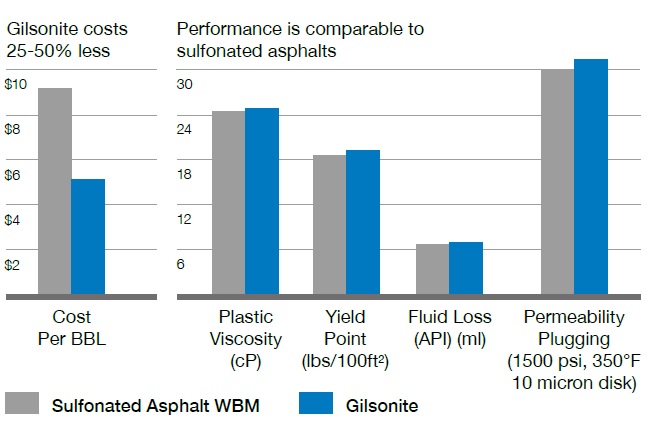
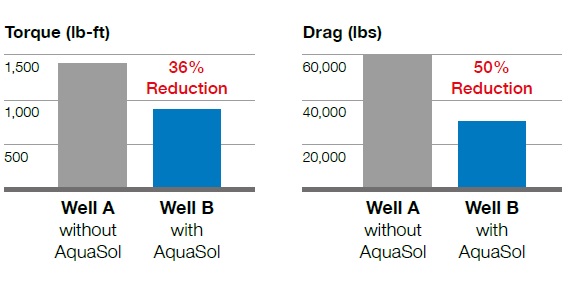
Gilsonite performs comparably to sulfonated asphalt in water based mud systems at 25 to 50% lower cost. That claim is easy to make and harder to evidence, so this page sets out the field data behind it: two offshore Louisiana wells where the numbers were measured rather than estimated — a 36% reduction in torque, 50% in drag, and hole enlargement cut from 50% to 15% in the same section.
RAHA Gilsonite Co. supplies gilsonite powder as a cost-effective, high-performance drilling fluid additive, effective across a wide range of water based systems for both low and high temperature wells. The technical explanation of why gilsonite must be treated for water based use is on our water based muds page; this page covers what it does once it is in the mud.
Gilsonite against sulfonated asphalt: the cost case
Sulfonated asphalt is the established shale stabiliser and filtration additive in water based systems. Gilsonite performs comparably at a materially lower price — and the saving is larger than the headline number suggests, because of what it does not require.
| Gilsonite | Sulfonated asphalt | |
|---|---|---|
| Relative cost | 25–50% lower | Baseline |
| Surfactants or coupling agents | Not required | Often required |
| Base material | Naturally occurring, mined | Refinery bitumen, processed |
| Mixing | Through the hopper, mild agitation | Product dependent |
| Contaminant tolerance | Tolerant | Product dependent |
| Temperature range | Low and high temperature wells | Depends on base binder |
| Additive count in the system | Fewer products needed | May need supporting additives |
The second saving is the one usually missed. Because gilsonite requires no additional surfactants or coupling agents, it removes products from the mud programme rather than just substituting one line item for a cheaper one. On a long well that compounds: fewer products to procure, fewer to store on deck, fewer to monitor. Our comparison of the two materials in detail is on the sulfonated asphalt page.
Disperses quickly and easily in water based muds
Gilsonite is a free-flowing powder that mixes easily through the hopper and disperses with only mild agitation. It is tolerant of contaminants and eliminates the need for additional surfactants or coupling agents.
That matters operationally more than it sounds. A product that needs high shear or a coupling agent to go into the system consumes rig time and introduces a failure mode — incomplete dispersion means the additive is present on the ticket but not functioning in the hole.
Performance benefits in water based systems
-
Mixes easily through the hopper
Free-flowing powder that resists clumping and disperses with mild agitation.
-
Controls fluid loss and seepage
Builds a thin competent filter cake rather than a thick permeable one.
-
Stabilises shale
Renowned as a shale stabiliser — seals micro-fractures and pore throats in water-sensitive formations.
-
Prevents lost circulation
Bridges and plugs permeable zones before returns are lost.
-
Strengthens the wellbore
Forms a continuous sealant along the wellbore wall, reducing pore pressure transmission.
-
Minimises differential sticking
By sealing permeable zones and limiting filtrate invasion, it cuts the risk of stuck pipe.
-
Maintains lubricity in tight formations
Reduces torque and drag where the hole is tight or deviated.
-
Compatible with most WBM systems
Works across the common water based formulations without reformulation.
Properties of the powder
| Property | Detail |
|---|---|
| Form | Free-flowing powder, resists clumping |
| Origin | Naturally occurring mined material |
| Dispersion | Mild agitation, through the hopper |
| System compatibility | Most water based systems |
| Temperature range | Effective in low and high temperature wells |
| Additional agents | No surfactants or coupling agents required |
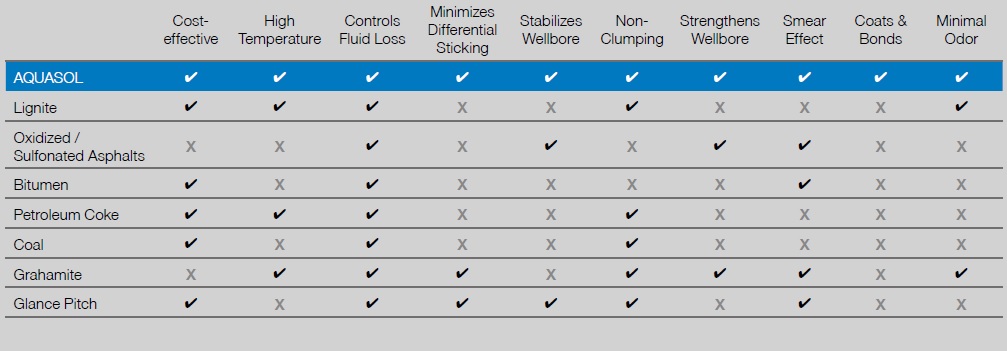
Performance advantages over alternatives
Field case: 36% less torque, 50% less drag
In the South Pass area of offshore Louisiana, the operator wanted to reduce torque and drag. Wells in this area are normally deviated approximately 30° from vertical and are drilled with a conventional lignosulfonate mud.
Two wells were compared directly.
| Well A | Well B | |
|---|---|---|
| Mud system | Conventional lignosulfonate | Conventional lignosulfonate |
| Deviation | Approximately 30° from vertical | Approximately 30° from vertical |
| Treatment | Conventional and bead-type lubricants | 3–4 ppb gilsonite from approximately 10,600 ft |
| Torque | Baseline | 36% lower |
| Drag | Baseline | 50% lower |
| Caliper log | Baseline | Substantial improvement |
The detail worth noting is that Well A was not untreated. It ran conventional and bead-type lubricants specifically for torque and drag reduction. The gilsonite result is measured against a well that was already being managed for the same problem.
Field case: hole enlargement cut from 50% to 15%
Hole enlargement is a persistent problem for wells drilled in the Eugene Island area of offshore Louisiana. On average, enlargement ran at approximately 50% in the 12.25-inch holes.
| Parameter | Before | After |
|---|---|---|
| Hole size | 12.25 inch | 12.25 inch |
| Mud system | Conventional water based | Conventional water based plus gilsonite |
| Treatment | None | 4 ppb sulfonated gilsonite |
| Average hole enlargement | Approximately 50% | 15% |
Hole enlargement is not a cosmetic problem. An oversize hole means more cement to fill the annulus, poorer cement bond, unreliable log interpretation and a greater volume of cuttings to handle at surface. Cutting enlargement from 50% to 15% in the same section changes the economics of the whole interval.
Where each function matters
| Drilling problem | How gilsonite addresses it | Field evidence |
|---|---|---|
| High torque and drag | Maintains lubricity in tight and deviated hole | 36% torque, 50% drag reduction — South Pass |
| Hole enlargement and washout | Stabilises shale, seals the wellbore wall | 50% to 15% — Eugene Island |
| Fluid loss and seepage | Builds a thin low-permeability filter cake | Standard function across WBM systems |
| Differential sticking | Seals permeable zones, limits filtrate invasion | Documented across offshore and onshore use |
| Lost circulation | Bridges and plugs fractures and vugs | Standard function across WBM systems |
| Additive cost | Replaces sulfonated asphalt, removes surfactants | 25–50% lower cost |
Frequently asked questions
How does gilsonite compare with sulfonated asphalt in water based mud?
Gilsonite performs comparably to sulfonated asphalt at 25 to 50% lower cost. The saving is larger in practice because gilsonite requires no additional surfactants or coupling agents, so it removes products from the mud programme rather than simply substituting a cheaper equivalent. Both materials serve as shale stabilisers and filtration additives in water based systems.
How much does gilsonite reduce torque and drag?
In a documented South Pass comparison offshore Louisiana, adding 3 to 4 ppb of gilsonite from approximately 10,600 ft reduced torque by 36% and drag by 50%. The comparison well was not untreated — it ran conventional and bead-type lubricants specifically for torque and drag reduction, so the gilsonite result is measured against active management of the same problem.
Can gilsonite control hole enlargement?
Yes. In the Eugene Island area offshore Louisiana, average hole enlargement in 12.25-inch holes ran at approximately 50%. Adding 4 ppb of sulfonated gilsonite to the conventional water based formulation reduced enlargement to 15% in the same section. Oversize hole means more cement, poorer bond and unreliable logs, so the change affects the economics of the whole interval.
What dosage of gilsonite is used in water based mud?
The documented field cases used 3 to 4 ppb for torque and drag reduction and 4 ppb for hole enlargement control. Actual concentration depends on mud weight, bottomhole temperature, shale reactivity and the target, and is normally established by laboratory testing with the specific system.
Does gilsonite need surfactants or coupling agents in WBM?
No. It is a free-flowing powder that mixes easily through the hopper and disperses with mild agitation, and it is tolerant of contaminants. Eliminating the need for additional surfactants or coupling agents is part of the cost advantage, because it reduces the number of products in the mud programme.
Is gilsonite effective in high temperature wells?
Yes. It is effective across a wide range of water based systems for both low and high temperature wells. The base softening point governs how far the material holds its function at bottomhole temperature, which is why the softening point should be stated on the certificate of analysis rather than assumed.
Is gilsonite compatible with lignosulfonate mud?
Yes. The South Pass field case used a conventional lignosulfonate mud, with gilsonite added to the existing system rather than requiring reformulation. Gilsonite is compatible with most water based systems.
Why does hole enlargement matter?
Because an oversize hole means more cement to fill the annulus, a poorer cement bond, unreliable log interpretation and a greater volume of cuttings to handle at surface. Each of those carries cost and risk, which is why cutting enlargement from 50% to 15% in the same section changes the economics of the interval rather than just the appearance of the caliper log.
What form is supplied for water based systems?
Sulfonated gilsonite in powder and granular form, with mesh sizes of 30–40, 100, 200, 300 and custom cuts. Untreated gilsonite will not disperse in water, so the sulfonated form is required — see water based muds for the explanation. Ash content, softening point and particle size are adjusted to the system.
Does gilsonite work in oil based mud as well?
Yes, and in untreated form. In oil based and synthetic systems gilsonite dissolves into the oil phase and functions as a fluid loss control agent through filter cake development. Only water based systems require the sulfonated form.
Related pages
Drilling applications: water based muds, oil based muds, gilsonite in drilling fluids, sulfonated asphalt, deepwater drilling, gilsonite in cementing and oil and gas overview.
Product information: gilsonite overview, specification, properties, powder and granular, price, MSDS and HS code.
Specify gilsonite for your water based system
Send us the mud formulation, the bottomhole temperature and the problem you are trying to solve — torque and drag, hole enlargement, fluid loss or shale instability. We will confirm the grade and the base softening point, state both on the batch certificate of analysis, and accept third-party inspection at loading.
Dubai: No. 2305, Burlington Tower, Business Bay — +971 4 566 4998
Ankara: Karşıyaka District, 749 Street No. 30, Gölbaşı 06830 — +90 312 544 5481
