
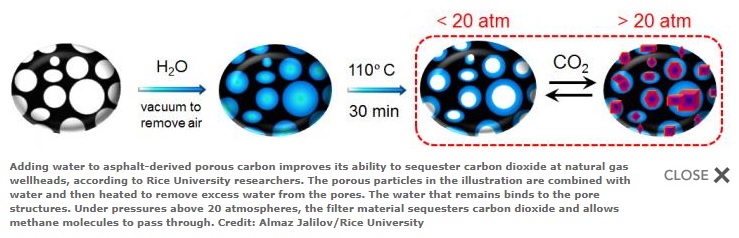
Gilsonite asphalt derived porous carbon is activated carbon made from natural bitumen rather than coconut shell, wood or coal. Research at Rice University produced material with a surface area of 4,200 m²/g from a low-cost asphaltic feedstock using a two-step KOH activation — a figure at the upper end of what activated carbon achieves by any route. This page covers why gilsonite works as a precursor, what specification matters when you buy it for that purpose, and how it compares with conventional feedstocks.
Why gilsonite works as an activated carbon precursor
Activated carbon performance is governed by what the precursor brings to the furnace. Three properties matter, and gilsonite scores well on all three.
| Property | Gilsonite | Why it matters for activated carbon |
|---|---|---|
| Carbon content | Approximately 85% | Determines yield. A high-carbon precursor gives more product per tonne of feedstock |
| Ash content | Low; grades under 5% available | Ash occupies pore volume without adsorbing anything and can catalyse unwanted reactions |
| Aromaticity | High — asphaltene-rich structure | Aromatic carbon forms the graphitic domains that give pore walls their structure |
| Molecular weight | Approximately 3,000 | Higher than refinery residues; behaves as a quasi-polymer through carbonisation |
| Consistency | Mined from a single deposit type | Batch-to-batch variation is narrower than agricultural feedstocks, which vary by harvest |
| Sulfur | Low | Sulfur in the precursor shows up in the product and limits some applications |
The property that separates precursors is ash, not carbon. Most feedstocks have enough carbon. What differs is what else comes with it. Coconut shell runs 1 to 4% ash, coal 5 to 15%, and agricultural residues can exceed 20%. Ash does not adsorb, it occupies pore volume, and it has to be washed out afterwards with acid — a step that costs money and generates effluent. A low-ash precursor shortens the process. Ask for the measured ash figure on the batch certificate, not a typical value.
What the Rice University research demonstrated
A laboratory at Rice University, led by chemist James Tour, developed a route from asphaltic feedstock to high surface area porous carbon and published the work in Advanced Energy Materials.
The significance for precursor selection is in the method and the number it produced.
| Step | Detail |
|---|---|
| Feedstock | Gilsonite — described by the researchers as a low-cost, readily available asphalt |
| First heating | At ambient pressure, to eliminate unneeded organic molecules |
| Activation | Reheated in the presence of potassium hydroxide for approximately 20 minutes |
| Product | Oxygen-enhanced porous carbon |
| Surface area | 4,200 m²/g |
| Pore size | Micropores measured at approximately 23 angstroms |
Two points are worth drawing out. The activation time was around twenty minutes, which is short for KOH activation. And the researchers moved deliberately from an expensive asphalt to gilsonite specifically because it was cheaper and more available, while producing a higher surface area than the earlier material.
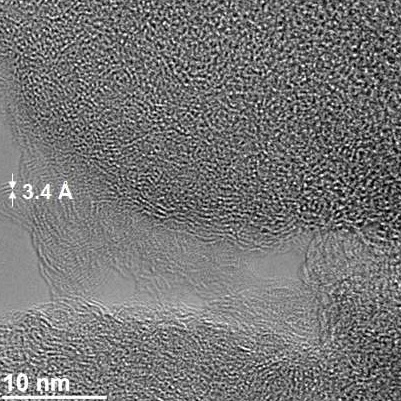
Transmission electron microscope image of gilsonite-derived porous carbon showing a micropore in the structure. Source: Rice University.
Putting 4,200 m²/g in context
| Material | Typical surface area |
|---|---|
| Commercial granular activated carbon | 600–1,200 m²/g |
| High-grade coconut shell carbon | 1,100–1,600 m²/g |
| KOH-activated carbons, laboratory | 2,000–3,500 m²/g |
| Gilsonite-derived, Rice University | 4,200 m²/g |
Laboratory figures under optimised conditions are not production figures, and no commercial plant would expect to reproduce that number at scale. What the result establishes is the ceiling the feedstock permits — and it is high.
Applications for asphalt-derived porous carbon
Gas separation
CO₂ removal from natural gas streams, biogas upgrading and flue gas treatment, where high micropore volume drives capacity.
Water treatment
Removal of organics, chlorine, taste and odour compounds in municipal and industrial systems.
Supercapacitor electrodes
Energy storage depends directly on accessible surface area, which is where a 4,000 m²/g class material matters.
Solvent recovery
Capturing and recovering volatile organic compounds from industrial exhaust streams.
Air purification
VOC and odour control in industrial ventilation and cabin air systems.
Catalyst support
High surface area carbon as a substrate for dispersed metal catalysts.
Gas storage
Adsorbed natural gas and hydrogen storage research, where volumetric capacity is limited by pore structure.
Precious metal recovery
Gold adsorption in CIP and CIL circuits, where ash and hardness both matter.
The carbon capture application in detail
The Rice work was aimed specifically at removing CO₂ from natural gas at the wellhead. Raw natural gas typically contains 2 to 10% carbon dioxide, which must be removed before sale.
The conventional route uses liquid amines, which capture roughly 13 to 15% of their own weight in CO₂ and require superheated steam to regenerate — a significant energy cost. The asphalt-derived material captured substantially more by weight at wellhead pressures, and released it when pressure dropped, with no thermal input required.
| Amine scrubbing | Asphalt-derived porous carbon | |
|---|---|---|
| Capture mechanism | Chemical absorption | Physical adsorption, pressure-swing |
| Capacity by weight | Approximately 13–15% | Over 100% at wellhead pressure |
| Regeneration | Superheated steam | Pressure release — no heating |
| Equipment footprint | Large | Small |
| Corrosivity | Corrosive fluid handling | Solid, non-corrosive |
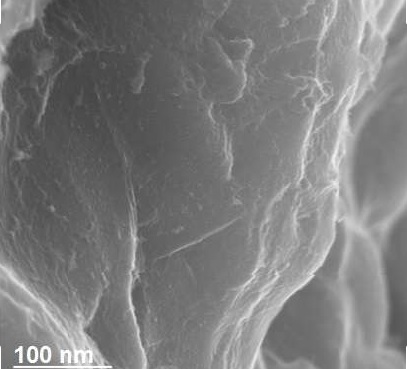
Scanning electron microscope image showing micropores in carbon capture material derived from asphalt. Source: Rice University.
A later refinement from the same laboratory found that treating the porous carbon with water improved selectivity substantially. Water forms a hydrate within the pore microstructure, tightening the effective pore opening. Since CO₂ and methane molecules are close in size — roughly 3.3 against 3.8 angstroms — that narrowing is what allows one to be held while the other passes. The treated material selected CO₂ over methane at a ratio reported above 200 to 1.
Research findings summarised from work published by Rice University in Advanced Energy Materials. We supply the precursor material, not the finished porous carbon. For the underlying material properties see gilsonite properties and chemical characterization.
Gilsonite against conventional activated carbon precursors
| Precursor | Typical ash | Consistency | Notes |
|---|---|---|---|
| Gilsonite | Low; sub-5% grades available | High | Mined from a consistent deposit type; high aromaticity and carbon content |
| Coconut shell | 1–4% | Variable | Excellent micropore structure; supply and price track agricultural cycles |
| Bituminous coal | 5–15% | Moderate | Widely used; higher ash means an acid wash step |
| Wood | 0.5–5% | Variable | Favours mesopores rather than micropores; lower density product |
| Agricultural residues | Often above 20% | Low | Cheap feedstock, but ash removal offsets much of the saving |
| Petroleum coke | Low | Moderate | High carbon; sulfur content is the usual constraint |
The honest position. Coconut shell remains the benchmark for high-micropore applications and will stay there. Gilsonite is not a universal replacement. Where it competes is in supply consistency — it does not have a harvest, so the specification does not shift with the season — and in the combination of low ash with high aromaticity, which is what allows the very high surface areas the Rice work demonstrated.
Specification for activated carbon feedstock
If you are buying gilsonite as a carbon precursor rather than for a bituminous application, the governing properties are different from those on a standard product sheet.
| Property | Test method | Why it governs |
|---|---|---|
| Ash content | ASTM D2939 or equivalent | The single most important figure. Determines whether an acid wash step is needed |
| Fixed carbon | Proximate analysis | Predicts carbonisation yield |
| Volatile matter | Proximate analysis | Determines mass loss in the first heating stage |
| Moisture | ASTM D95 or equivalent | Affects furnace energy balance and handling |
| Sulfur | ASTM D4294 or equivalent | Carries through to the product; limits some end uses |
| Softening point | ASTM D36 | Determines whether the material fuses before it carbonises — relevant to furnace design |
| Particle size distribution | Sieve analysis | Affects heat transfer and activation uniformity |
| Metal content | ICP or AAS | Trace metals can catalyse unwanted reactions during activation |
We state measured batch values for these properties on the certificate of analysis rather than typical values, and we can supply a full metal content analysis where trace elements govern. If your process is sensitive to a particular figure, tell us at the enquiry stage — it affects which production batch is allocated.
Forms available
| Form | Size | Suits |
|---|---|---|
| Lump | Run of mine, sized on request | Buyers with their own crushing and milling |
| Granular | 30–40 mesh and custom cuts | Direct feed to rotary or fluidised bed furnaces |
| Micronized powder | 100, 200, 300 mesh | Processes requiring uniform heat transfer and fast activation |
Frequently asked questions
What is gilsonite asphalt derived porous carbon?
Activated carbon produced from gilsonite — a naturally occurring solid hydrocarbon — rather than from coconut shell, wood or coal. The material is carbonised and then chemically activated, most commonly with potassium hydroxide, to develop the pore structure. Research at Rice University produced material with a surface area of 4,200 m²/g by this route.
Why is gilsonite suitable as an activated carbon precursor?
Four reasons. Carbon content around 85% gives good yield. Ash content is low, with sub-5% grades available, which matters because ash occupies pore volume without adsorbing and has to be washed out. High aromaticity from the asphaltene-rich structure forms the graphitic domains that give pore walls their structure. And because it is mined from a consistent deposit type, batch-to-batch variation is narrower than with agricultural feedstocks.
What surface area can be achieved?
Rice University reported 4,200 m²/g from a two-step KOH activation with approximately twenty minutes of activation time. For context, commercial granular activated carbon typically runs 600 to 1,200 m²/g and high-grade coconut shell carbon 1,100 to 1,600. Laboratory figures under optimised conditions are not production figures, but they establish the ceiling the feedstock permits.
How does gilsonite compare with coconut shell as a precursor?
Coconut shell remains the benchmark for high-micropore applications and gilsonite is not a universal replacement. Where gilsonite competes is supply consistency — it has no harvest cycle, so the specification does not shift with the season — and in combining low ash with high aromaticity, which is what allows the very high surface areas demonstrated in the Rice work.
Why does ash content matter so much?
Because ash does not adsorb anything. It occupies pore volume, it can catalyse unwanted reactions during activation, and it has to be removed afterwards with an acid wash — a step that costs money and generates effluent. Coconut shell runs 1 to 4% ash, coal 5 to 15%, and agricultural residues often above 20%. A low-ash precursor shortens the process.
What activation method is used?
The Rice route used two-step chemical activation: heating at ambient pressure to remove unneeded organic molecules, then reheating with potassium hydroxide for approximately twenty minutes. KOH activation generally produces higher surface areas than steam or CO₂ physical activation, at the cost of reagent handling and a washing step to remove residual potassium.
What is the material used for?
Gas separation including CO₂ removal from natural gas and biogas upgrading, water treatment, supercapacitor electrodes, solvent recovery, air purification, catalyst supports, gas storage research and precious metal recovery. Applications that depend on accessible surface area benefit most from a high-surface-area precursor.
How does asphalt-derived carbon compare with amine scrubbing for CO₂ capture?
Amines capture roughly 13 to 15% of their own weight and need superheated steam to regenerate, which is a significant energy cost. The asphalt-derived material works by pressure-swing physical adsorption: it captures at wellhead pressure and releases when pressure drops, with no heating required. Capacity by weight is substantially higher and the equipment footprint smaller.
What does adding water do to the pore structure?
Water forms a hydrate within the pore microstructure, which tightens the effective pore opening. Because CO₂ and methane are close in molecular size — roughly 3.3 against 3.8 angstroms — that narrowing is what allows one to be retained while the other passes. Rice reported selectivity above 200 to 1 for CO₂ over methane with the water-treated material.
What should be specified when ordering gilsonite as a carbon precursor?
Ash content above all, plus fixed carbon, volatile matter, moisture, sulfur, softening point, particle size distribution and metal content where trace elements govern. These are different from the properties on a standard bituminous product sheet, so ask for measured batch values rather than typical figures.
What forms and particle sizes are available?
Lump for buyers with their own crushing and milling, granular at 30–40 mesh and custom cuts for direct furnace feed, and micronized powder at 100, 200 and 300 mesh where uniform heat transfer and fast activation are required.
Do you supply the finished porous carbon or only the precursor?
We supply the gilsonite precursor, not the activated carbon. Carbonisation and activation are carried out by the buyer or a toll processor. What we can do is match the feedstock specification to your process — ash, softening point and particle size all affect how the material behaves in the furnace.
Related pages
Material properties: what is gilsonite, properties, specification, analysis, chemical characterization, molecular structure and metal content.
Forms and supply: lump, micronized powder, price, MSDS and HS code.
Other industrial applications: chemical products, asphalt modification, printing inks, paints and coatings, foundry and oil and gas.
Specify gilsonite for carbon production
Send us the target ash figure, the activation route you run, the particle size your furnace needs and the volume. We will confirm which grade fits, state the measured ash, fixed carbon and softening point on the batch certificate of analysis, and supply a trial quantity before a full container where that helps.
Dubai: No. 2305, Burlington Tower, Business Bay — +971 4 566 4998
Ankara: Karşıyaka District, 749 Street No. 30, Gölbaşı 06830 — +90 312 544 5481
