
Gilsonite Construction Grade
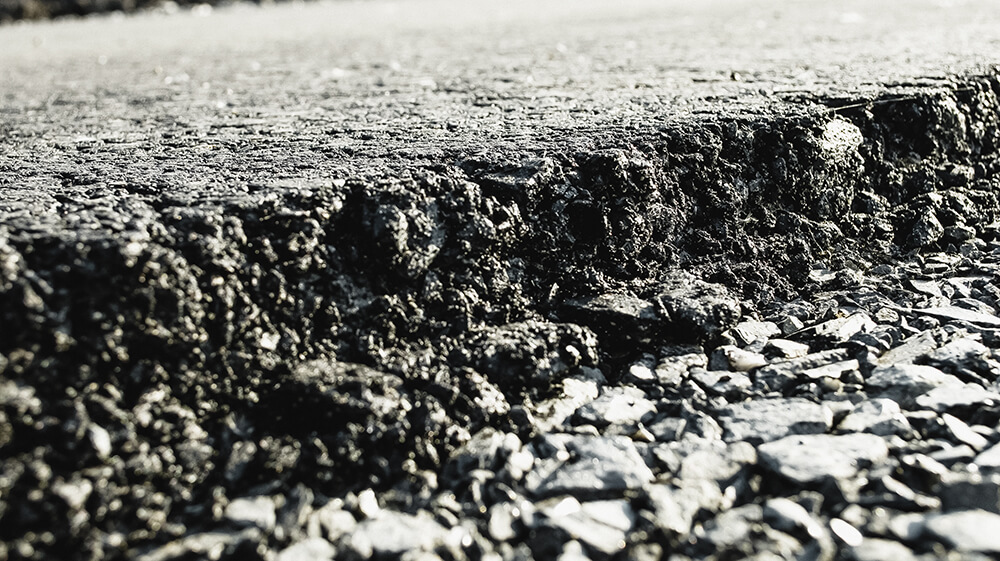
Gilsonite Construction Grade is a naturally occurring solid hydrocarbon — classified as an asphaltite — used as a high-performance modifier in road construction, HMA (Hot Mix Asphalt), and pavement preservation. When blended into bitumen, it fundamentally stiffens the binder, raises its softening point, and dramatically improves resistance to rutting, fatigue, and moisture damage — without the cost of synthetic polymer modifiers (PMB).
RAHA Gilsonite Co. supplies this natural asphalt modifier in powder and lump form, available FOB Mersin (Turkey) and Jebel Ali (Dubai) for export to road construction projects worldwide.
What Is Gilsonite Construction Grade?
Gilsonite Construction Grade — also referred to as HMA Grade or Asphalt Grade Gilsonite — is distinguished from industrial grades and oil & gas grades primarily by its ash content, softening point, and particle size. For asphalt modification, lower ash content grades are preferred because they dissolve more readily in liquid bitumen and contribute a higher proportion of active asphaltenes to the modified binder.
As a natural asphalt modifier, this asphaltite raises the performance grade (PG) of base bitumen, increases stiffness, and enhances resistance to oxidation — delivering measurable pavement performance improvements at a fraction of the cost of synthetic polymer modifiers. According to Construction and Building Materials (Elsevier), natural asphaltite modifiers consistently improve HMA performance under heavy traffic and high-temperature conditions.
Key Physical Specifications:
| Property | Typical Range | Test Method |
|---|---|---|
| Softening Point | 160°C – 220°C | ASTM D36 |
| Ash Content | 2% – 8% | ASTM D271 |
| Penetration (25°C) | 0 – 2 (0.1mm) | ASTM D5 |
| Solubility in CS₂ | >95% | ASTM D4 |
| Specific Gravity | 1.05 – 1.10 | ASTM D71 |
| Asphaltene Content | 60% – 80% | ASTM D2007 |
How Gilsonite Construction Grade Modifies Road Bitumen
The modifier is added to base bitumen — typically 60/70 or 80/100 penetration grade — through one of two established processes used in road construction:
Wet Process (Binder Modification): Gilsonite Construction Grade is dissolved directly into hot liquid bitumen before mixing with aggregates. This ensures complete and uniform dispersion throughout the binder, delivering consistent performance across the entire asphalt mix. Preferred for large-scale highway and expressway projects.
Dry Process (Mix Modification): The modifier is blended with the aggregate before the bitumen is added. It dissolves into the binder during the hot mixing process at the asphalt plant. Simpler to implement but slightly less uniform than the wet process.
The optimal dosage is typically 3% to 8% by weight of bitumen, depending on base bitumen grade, climate conditions, and traffic load. Research published in the Journal of Materials Research and Technology (2023) confirmed that 15% Gilsonite by weight of VG-30 bitumen produced optimum hard-grade bitumen meeting EME2 specifications — with resilient modulus increasing 2.4× and rut depth decreasing by 4mm compared to conventional mixes. For standard road construction applications, dosage commonly ranges from 2% to 6% by weight of bitumen, adjusted empirically based on final asphalt concrete performance targets.
Performance Benefits in Asphalt Pavement
Laboratory and field studies consistently demonstrate the following improvements when this natural bitumen modifier is used in road construction:
Rutting Resistance
Gilsonite Construction Grade increases binder stiffness and raises the PG temperature grade of base bitumen. Studies show that 4.6% addition significantly increases Marshall Stability, directly reducing permanent deformation in wheel paths under sustained heavy traffic load in hot climates.
Fatigue Life Extension
Asphalt concrete modified with this asphaltite exhibits improved resilient modulus and indirect tensile strength, extending pavement fatigue life under repeated dynamic loading — critical for highways, port roads, and industrial pavements with continuous heavy vehicle traffic.
Moisture and Stripping Resistance
Laboratory indirect tensile testing confirms that the modifier reduces moisture sensitivity of HMA mixes, improving resistance to stripping and water-induced damage — essential in tropical climates, monsoon regions, and freeze-thaw environments.
High-Temperature Binder Performance
With an asphaltene content of 60–80% and a natural softening point of 160–220°C, Gilsonite Construction Grade fundamentally improves binder performance at elevated pavement temperatures — matching or exceeding PMB performance in high-temperature road construction at significantly lower material cost.
Proven Performance Benefits — Summary:
- Improved rutting resistance under heavy traffic and high temperatures
- Increased Marshall Stability and resilient modulus
- Enhanced fatigue life and crack resistance
- Reduced moisture sensitivity and improved stripping resistance
- Higher softening point and binder viscosity
- Cost-effective alternative to PMB in hot-climate road construction
- Compatible with reclaimed asphalt pavement (RAP)
- Permitted for use in all climate zones
Laboratory Data: Gilsonite Construction Grade Effect on BND 60/90 Bitumen
The following data illustrates the physico-chemical changes observed when the modifier is added to road bitumen BND 60/90 at 3% and 5% dosage rates — demonstrating the progressive stiffening effect on the base binder:
| No | Parameter | Norm BND 60/90 | BND 60/90 (initial) | BND 60/90 + 3% Gilsonite | BND 60/90 + 5% Gilsonite |
|---|---|---|---|---|---|
| 1 | Needle penetration depth at 25°C, 0.1mm | 61–90 | 77 | 56 | 46 |
| 2 | Softening point, °C, min | 47 | 49 | 52 | 55 |
| 3 | Elongation at 25°C, cm, min | 55 | 82 | 55 | 33 |
| 4 | Brittleness temperature, °C, max | min 15 | min 18 | min 16 | min 14 |
| 5 | Change in softening temperature after heating, °C, max | 5 | 5 | 3 | 3 |
As the data confirms, increasing dosage progressively reduces penetration and raises softening point — confirming the stiffening effect on the base binder. The reduction in elongation at 5% dosage underlines the importance of controlled dosage to preserve low-temperature flexibility while achieving target high-temperature performance.
Gilsonite Construction Grade: Road and Pavement Applications
This natural asphalt modifier is specified and used in the following road construction and pavement applications:
- Highway and expressway construction — prevents rutting and surface deformation under sustained heavy vehicle flow; widely used in high-temperature climate road networks across the Middle East and Africa
- Airport runways and taxiways — provides the binder stiffness and stability required for safe static and dynamic aircraft loading
- Port and industrial pavements — resists chemical exposure, fuel spills, and heavy machinery loads in logistics and industrial zones
- Urban road rehabilitation — extends service life and reduces maintenance frequency in congested high-traffic urban corridors
- Crack sealing and joint filling — blended with SBS and crumb rubber for superior flexibility, bond strength, and long-term adhesion in pavement joints
- Mastic asphalt and Stone Mastic Asphalt (SMA) — enhances binder richness and mix stability in dense, gap-graded pavement layers
- Perpetual pavement systems — incorporated into the high-modulus intermediate layer for 50+ year pavement design life structures (EME2 method)
For detailed technical information on Gilsonite in asphalt applications, see our Gilsonite Asphalt page. For HMA binder-specific modification, see Gilsonite Binder Grade.
Gilsonite Construction Grade vs. Polymer-Modified Bitumen (PMB)
Road engineers and procurement managers frequently evaluate this modifier against conventional polymer-modified bitumen (PMB) for high-performance asphalt projects. Research and field experience confirm that for road construction in the Middle East, Africa, South Asia, and other hot-climate regions, Gilsonite-modified asphalt delivers performance approaching PMB — at significantly lower material cost.
Key advantages over PMB in road construction:
- Lower cost per tonne — natural hydrocarbon with no chemical synthesis required
- Lower carbon footprint — unprocessed natural material vs. synthetic polymer production
- Full RAP compatibility — supports sustainable road construction with reclaimed asphalt pavement
- Simpler plant integration — dissolves in hot bitumen without special polymer blending equipment
- Proven international track record — used in road construction across 40+ countries
Packaging and Export Supply
RAHA Gilsonite Co. supplies Gilsonite Construction Grade for export in the following packaging configurations:
- 25 kg PP Bags — Palletized & Shrink Wrapped
- 25 kg Kraft Bags — Palletized & Shrink Wrapped
- 25 kg Carton Boxes — Palletized & Shrink Wrapped
Loading capacity: 22–23 MT per 20ft container.
Shipment terms: FOB Mersin (Turkey) | FOB Jebel Ali (Dubai)
For technical data sheets, certificates of analysis, or export quotations, contact our team directly.
Why Choose RAHA Gilsonite Co. for Gilsonite Construction Grade Supply?
The performance of Gilsonite-modified asphalt is directly dependent on the quality and consistency of the modifier used. Variability in ash content, softening point, or particle size across supply batches leads to inconsistent binder modification — affecting Marshall Stability, rutting resistance, and long-term pavement performance.
RAHA Gilsonite Co. applies rigorous quality control across every shipment:
- Batch-level laboratory testing — softening point, ash content, penetration, and solubility verified per ASTM standards for every export consignment
- Certificate of Analysis (COA) — issued with each shipment, enabling full traceability and compliance documentation for project engineers and procurement teams
- Consistent particle size — controlled milling ensures uniform dissolution in bitumen during wet process modification, eliminating undissolved residue
- Technical support — dosage guidance, mix design consultation, and application support for road construction projects across the Middle East, Africa, and Asia
- Strategic export locations — FOB Mersin (Turkey) and FOB Jebel Ali (Dubai) ensure competitive freight rates and reliable lead times to global markets
- Flexible packaging — 25 kg bags in PP, Kraft, or Carton formats, palletized and shrink-wrapped for safe container loading and site handling
RAHA Gilsonite Co. combines technical expertise in asphaltite chemistry with established export infrastructure — providing reliable, documented, and scientifically consistent supply to road construction projects worldwide. Learn more about our Gilsonite properties and specifications.
Frequently Asked Questions — Gilsonite Construction Grade
What is Gilsonite Construction Grade used for?
Gilsonite Construction Grade is used as a natural modifier for hot mix asphalt (HMA) and road bitumen in road construction. It improves rutting resistance, fatigue life, Marshall Stability, and moisture resistance — making it suitable for highways, airport runways, port pavements, industrial roads, and urban rehabilitation projects.
What percentage of Gilsonite Construction Grade is added to asphalt?
The typical dosage range is 3% to 8% by weight of bitumen, with standard road construction applications commonly using 2% to 6%. The optimum percentage depends on the base bitumen grade, climate zone, and traffic load requirements. Dosage control is essential to balance high-temperature stiffness gains with low-temperature flexibility retention.
What is the difference between Gilsonite Construction Grade and Binder Grade?
Both grades target asphalt modification, but Gilsonite Binder Grade specifically focuses on PG temperature grade improvement in HMA binders for high-temperature rutting resistance. Gilsonite Construction Grade covers a broader application range — including pavement preservation, crack sealing, road rehabilitation, mastic asphalt, and SMA production.
Is Gilsonite Construction Grade a cost-effective alternative to PMB?
Yes. Research and field experience confirm that Gilsonite-modified asphalt delivers performance approaching polymer-modified bitumen (PMB) in hot-climate, high-traffic road construction at significantly lower material cost. It also carries a lower environmental footprint as a natural, unprocessed hydrocarbon compatible with RAP.
How is Gilsonite Construction Grade added to asphalt in road construction?
Through wet process — dissolved into liquid bitumen before mixing with aggregates — or dry process — blended with aggregate before bitumen addition at the asphalt plant. The wet process delivers more uniform dispersion and is preferred for large-scale highway projects requiring consistent performance across all layers.
What are the key physical specifications of Gilsonite Construction Grade?
Softening point: 160–220°C (ASTM D36). Ash content: 2–8% (ASTM D271). Penetration at 25°C: 0–2 per ASTM D5. Solubility in CS₂: >95% (ASTM D4). Specific gravity: 1.05–1.10 (ASTM D71). Asphaltene content: 60–80% (ASTM D2007).
Is Gilsonite Construction Grade suitable for all climate zones?
Yes. This natural asphalt modifier is permitted for use in all climate zones. In hot climates it prevents rutting by raising binder stiffness. Dosage must be carefully controlled in cold climates to preserve low-temperature flexibility and prevent thermal cracking.
