
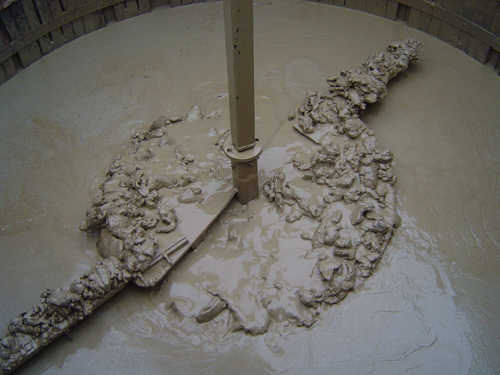
Water based muds present a problem that oil based systems do not: gilsonite is a hydrocarbon, and hydrocarbons are not soluble in water. Adding untreated gilsonite to a WBM gives you a suspended solid, not a functioning additive. The answer is sulfonation — a chemical treatment that makes the material water dispersible while keeping the shale-stabilising and filtration properties that make gilsonite worth using in the first place.
Gilsonite in water based drilling muds — WBM
In water based drilling muds it is essential to have a fluid loss control agent that disperses in water. Sulfonated gilsonite has that characteristic; untreated gilsonite does not. Getting the formula and composition of the sulfonated product right is therefore the key factor in supplying FLC to water based systems.
Using gilsonite in its sulfonated form provides easy mixing during mud preparation and decreases differential sticking significantly. It also improves lubricity and flow. Sulfonated gilsonite disperses in both water and oil phases, so it can be applied across all drilling mud systems — but water based muds are where it earns its place.
The three mud systems
On a drilling rig, mud is circulated to cool the hole, lubricate the assembly and carry cuttings to surface. Three base fluids are used, and gilsonite behaves differently in each.
| System | Base material | Gilsonite form required | Primary function |
|---|---|---|---|
| OBM — oil based mud | Oil product, typically diesel | Untreated granular or powder | Fluid loss control through filter cake development |
| WBM — water based mud | Water | Sulfonated — untreated will not disperse | Shale stabilisation, fluid loss control, lubricity |
| SBM — synthetic based mud | Polymers | Untreated, as for OBM | FLC. Replaces UHT co-polymers at a fraction of the cost |
Why gilsonite must be treated for water based muds
Gilsonite is a naturally occurring solid hydrocarbon. Hydrocarbons are not soluble in water, which means untreated gilsonite added to a WBM sits as a suspended solid rather than functioning as an additive. It will not build a filter cake, it will not seal micro-fractures in shale, and it will settle out.
Making it work requires a sulfonation treatment: the natural bitumen is reacted with a sulfonating agent at a controlled temperature between 100 and 140 °C. The reaction attaches sulfonate groups to the hydrocarbon structure, and those groups are hydrophilic. The result is a material that disperses readily in water while the hydrocarbon backbone continues to do what gilsonite does: seal, stabilise and lubricate.
What the treatment does and does not change. Sulfonation changes how the material behaves in water. It does not change the underlying hydrocarbon chemistry, the softening point of the base material, or the particle characteristics that govern sealing. That is why the base gilsonite matters as much as the treatment — a sulfonated product made from a low softening point feedstock will not perform at bottomhole temperature no matter how well it disperses.
Where sulfonated gilsonite comes from
The sulfonation route was developed first by American gilsonite suppliers, and later by Chinese producers from around 2005. For most of the period since, commercially available sulfonated gilsonite has come from those two origins.
RAHA Gilsonite Co. has since developed its own sulfonated gilsonite using an in-house formula and process. Because it is produced from Iranian gilsonite with a base softening point above 180 °C, it performs in tight formations and across a wide temperature range. The formulation also allows fewer additives to be carried in the mud mix, which compounds the cost advantage.
Sulfonated gilsonite is not sulfonated asphalt
This is the most common and most expensive confusion in WBM additive selection. The two names sound similar and they are frequently treated as interchangeable in procurement. They are two different materials.
| Sulfonated gilsonite | Sulfonated asphalt | |
|---|---|---|
| Base material | Naturally occurring solid hydrocarbon, mined | Refinery bitumen, a petroleum residue |
| Softening point of base | Above 180 °C for the grades used | Typically far lower, depending on the feedstock |
| Structure | High asphaltene content, naturally hard and brittle | Viscoelastic, softer at ambient |
| Behaviour at BHT | Retains function at elevated bottomhole temperature | Depends on the base binder used |
| Cost | Generally lower | Generally higher |
| Naming | Frequently sold as the same thing | Frequently sold as the same thing |
Suppliers on both sides claim equivalent performance. In practice the results are not identical, and the difference shows up under HPHT conditions where the softening point of the base material governs whether the additive is still functioning at depth.
Our position is straightforward: ask what the base material is and what its softening point is, not just whether the product is sulfonated. If a supplier cannot answer that, the certificate is not telling you what you are buying. See our sulfonated asphalt page for the comparison in more detail.
Advantages of sulfonated gilsonite in water based muds
-
More economical than sulfonated asphalt
Lower cost per unit of performance, which is the reason most operators evaluate it in the first place.
-
Emulsifies across phases
Works in fresh water, sea water and oil-contaminated systems, which matters on offshore rigs where sea water is the make-up fluid.
-
Stable rheology under HTHP
Maintains shear characteristics under high temperature and high pressure rather than thinning out.
-
Builds proper mud cake
Produces a thin, competent filter cake rather than a thick permeable one, which is what controls filtrate invasion.
-
Shale stabilisation
Seals micro-fractures and pore throats in water-sensitive shale, reducing pore pressure transmission.
-
Reduced differential sticking
By sealing permeable zones and limiting filtrate invasion, it cuts the risk of stuck pipe and stuck logging tools.
-
Improved lubricity
Lowers torque and drag, which matters in deviated and extended-reach wells.
-
Fewer additives needed
One product covers several functions, so the total additive count and the total mud cost both fall.
Why water based mud demand is rising
HSE regulation is steadily pushing oil based muds out of use, particularly offshore and in environmentally sensitive areas. Cuttings from OBM require treatment or transport to shore; cuttings from WBM often do not.
That regulatory pressure is transferring volume to water based systems, and with it the demand for water-dispersible additives. Sulfonated gilsonite sits directly in that shift. Given its cost position against sulfonated asphalt, consumption in WBM systems is likely to keep increasing.
The natural characteristics of gilsonite also help on the environmental side. It is a mined mineral rather than a synthesised chemical, and it is compatible with most water based systems as a substitute for sulfonated asphalt.
How the filter cake works
When the hydrostatic pressure of the mud column exceeds the pore pressure of the surrounding formation, mud is forced into that formation through the wellbore wall. Left unchecked, that costs fluid, damages the reservoir and destabilises the hole.
The purpose of an FLC additive is to deposit a filter cake on the wellbore wall instead. A competent cake does three things at once.
| Function of the filter cake | What it prevents |
|---|---|
| Limits invasion of formation fluids into the wellbore | Influx, kicks and contamination of the mud system |
| Supports the wellbore wall | Collapse, washout and hole enlargement during drilling |
| Resists escape of drilling fluid into the formation | Fluid loss, reservoir damage and lost circulation |
What makes a cake competent is thinness and low permeability, not thickness. A thick cake increases the contact area between pipe and wall, which is precisely the condition that causes differential sticking. Sulfonated gilsonite contributes by sealing the pore throats rather than bulking the cake out.
Frequently asked questions
Can gilsonite be used directly in water based mud?
No. Gilsonite is a solid hydrocarbon and hydrocarbons are not soluble in water, so untreated material added to a WBM sits as a suspended solid rather than functioning as an additive. It will not build a filter cake and it will settle out. Sulfonation treatment is what makes it water dispersible.
What is sulfonated gilsonite?
Gilsonite that has undergone a sulfonation treatment at a controlled temperature between 100 and 140 °C. The reaction attaches hydrophilic sulfonate groups to the hydrocarbon structure, making the material disperse readily in water while the hydrocarbon backbone continues to seal, stabilise shale and improve lubricity.
Is sulfonated gilsonite the same as sulfonated asphalt?
No, and treating them as interchangeable is the most common error in WBM additive selection. Sulfonated gilsonite is made from naturally occurring mined hydrocarbon with a base softening point above 180 °C. Sulfonated asphalt is made from refinery bitumen, which is softer and more variable. Suppliers on both sides claim equivalent performance, but the difference shows up under HPHT conditions where the base softening point governs whether the additive still works at depth.
What does sulfonated gilsonite do in a water based mud?
Three things at once: it controls fluid loss by building a thin competent filter cake, it stabilises water-sensitive shale by sealing micro-fractures and pore throats, and it improves lubricity by reducing torque and drag. It also reduces differential sticking by limiting filtrate invasion into permeable zones.
Why does the base gilsonite softening point matter?
Because sulfonation changes how the material behaves in water but not its underlying thermal behaviour. A sulfonated product made from a low softening point feedstock will disperse perfectly well and then stop functioning at bottomhole temperature. Our material uses Iranian gilsonite with a base softening point above 180 °C, which is why it holds up in tight formations and across a wide temperature range.
Does sulfonated gilsonite work in sea water systems?
Yes. It emulsifies across fresh water, sea water and oil-contaminated systems, which matters on offshore rigs where sea water is the make-up fluid. Compatibility across phases is one of the practical advantages of the sulfonated form over untreated gilsonite.
Why is demand for water based muds increasing?
HSE regulation is steadily pushing oil based muds out of use, particularly offshore and in environmentally sensitive areas, because OBM cuttings require treatment or transport to shore while WBM cuttings often do not. That regulatory shift transfers volume to water based systems and with it the demand for water-dispersible additives such as sulfonated gilsonite.
What makes a good filter cake?
Thinness and low permeability, not thickness. A thick cake increases the contact area between pipe and wellbore wall, which is exactly the condition that causes differential sticking. Sulfonated gilsonite contributes by sealing pore throats rather than bulking the cake out, which is why it reduces sticking rather than aggravating it.
What forms and particle sizes do you supply?
Powder and granular, with mesh sizes of 30–40, 100, 200, 300 and custom cuts. Ash content, softening point and particle size distribution are adjusted to the mud system. Low-ash grades under 5% ash are available where ash content governs. See gilsonite powder for the full range.
What concentration is used in a WBM system?
Concentration depends on the mud weight, bottomhole temperature, shale reactivity and the fluid loss target, and is normally established by laboratory testing with the specific system. Send us the mud formulation and the well conditions and we will advise on the grade and starting concentration.
Related pages
Drilling applications: gilsonite in drilling fluids, oil based muds, gilsonite in cementing, sulfonated asphalt, oil and gas overview and bentonite.
Product information: gilsonite overview, specification, properties, powder and granular, price, MSDS and HS code.
Specify sulfonated gilsonite for your WBM system
Send us the mud formulation, the bottomhole temperature, the shale conditions and the fluid loss target. We will confirm the grade, state the base softening point on the certificate of analysis, and accept third-party inspection by SGS, Bureau Veritas or the surveyor named in your contract.
Dubai: No. 2305, Burlington Tower, Business Bay — +971 4 566 4998
Ankara: Karşıyaka District, 749 Street No. 30, Gölbaşı 06830 — +90 312 544 5481
